Northwest Pakistan sees influx of over 95,000 tourists during Eid holidays

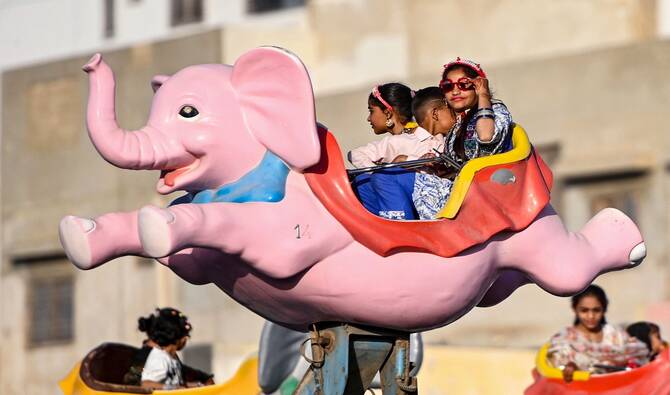
People enjoy rides at a carnival during celebrations a day after Eid al-Fitr, that marks the end of the Islamic holy fasting month of Ramadan, in Karachi on April 1, 2025 (AFP)
Short Url
Updated 03 April 2025
Follow

Northwest Pakistan sees influx of over 95,000 tourists during Eid holidays

  • Khyber Pakhtunkhwa’s Naran Valley saw the highest tourist turnout, says the provincial tourism authority
  • Northwestern Pakistan is home to scenic mountain landscapes, lush valleys and picturesque lakes

PESHAWAR: Over 95,000 tourists visited various scenic destinations across Pakistan’s northwestern Khyber Pakhtunkhwa (KP) province during the Eid Al-Fitr holidays, the provincial tourism authority said on Thursday.
KP, with its scenic mountains, valleys and lakes, is home to popular tourist destinations like Swat, Malam Jabba, Abbottabad, Kaghan, Naran and Shogran, which attract visitors from across Pakistan.
Pakistan observed the three-day Eid Al-Fitr holidays — celebrated by Muslims worldwide to mark the end of the fasting month of Ramadan — from Mar. 31 to Apr. 2.
“Tourists flocked to various tourist destinations in Khyber Pakhtunkhwa on Eid-Al-Fitr,” Muhammad Saad, the spokesperson for the KP Tourism Authority, said in a statement on Thursday. 
“More than 95,000 tourists were recorded in three days.”
He said the highest number of tourists visited the province’s scenic Naran valley, 42,111, during the Eid holidays and the Galiyat region saw 28,000 visitors during the same time period. 
At least 16,400 tourists visited Kumrat valley, he added.
“Tourism police personnel are performing their duty at various tourist destinations,” the official said.
Tourism in KP saw a massive surge during last year’s Eid holidays, with an increase of over 360 percent compared to 2023.
According to data from the provincial tourism authority, at least 580,000 tourists visited northwestern Pakistan during the five-day holidays in April 2024.
While Pakistan’s inflation has significantly decreased compared to last year, militant attacks, especially in Khyber Pakhtunkhwa, have surged recently.
March saw militant attacks in Pakistan exceed 100 for the first time in over nine years, making it the deadliest month since 2015, according to the Pakistan Institute for Conflict and Security Studies (PICSS). 
The think tank reported that KP and southwestern Balochistan province were the hardest-hit provinces, although eastern Punjab and southern Sindh also witnessed a rise in militant activity.
Islamabad has repeatedly accused Afghanistan of providing shelter to militant groups targeting civilians and security forces in cross-border attacks in Khyber Pakhtunkhwa, a claim that has been denied by Kabul’s authorities.


Nearly 25% of Pakistan’s primary schools enrolling girls operate as single-teacher ones— report

Updated 13 sec ago
Follow

Nearly 25% of Pakistan’s primary schools enrolling girls operate as single-teacher ones— report

  • Pakistan needs over 115,000 more teachers in primary schools enrolling girls to meet global benchmark of one teacher per 30 students, says report
  • Sixty percent of Pakistani primary schools enrolling girls are overcrowded, while 32% lack clean drinking water or toilets, says Tabadlab report

ISLAMABAD: Nearly 25% of Pakistan’s primary schools that enrolls girls operate as single-teacher ones, a report by a leading think tank said this week, calling on the government to devolve teacher recruitment powers, upskill underutilized teachers and introduce reforms to hire and promote faculty members. 

Pakistan faces an acute education crisis which is reflected in the fact that it has the world’s second-highest number of out-of-school children, an estimated 22.8 million aged 5-16 who are not in educational institutions, according to UNICEF. 

While poverty remains the biggest factor keeping children out of classrooms, Pakistan’s education crisis is exacerbated by inadequate infrastructure and underqualified teachers, cultural barriers and the impacts of frequently occurring natural disasters. 

According to “The Missing Ustaani,” a report published by Islamabad-based think tank Tabadlab and supported by Malala Fund and the Pakistan Institute of Education (PIE), Pakistan needs over 115,000 more teachers in primary schools with girls’ enrolment to meet the basic international benchmark of ensuring one teacher per 30 children. Currently, the average Student-to-Teacher Ratio (STR) across Pakistan’s primary schools with girls’ enrolment is 39:1, it said. 

“Approximately 60% of these schools are overcrowded, necessitating the recruitment of over 115,000 additional teachers nationwide,” the report said on Monday. “Compounding this, nearly 25% of primary schools with girls’ enrolment operate as single-teacher schools, placing immense pressure on the quality of education.”

It said the situation is more dire in Pakistan’s poverty-stricken southwestern Balochistan province, where nearly 52% of the schools are single-teacher only ones while the percentage decreases slightly in the southern Sindh province to 51 percent. 

The report said while the STR improves to 25:1 at the middle school level, acute shortages of subject specialists emerge as the top-priority concern for quality education in these schools.

“Furthermore, around 32% of primary schools with girls’ enrolment and 18% of middle schools face ‘critical infrastructural shortages’— lacking clean drinking water or toilets in addition to high STRs— which significantly affects girls’ attendance and learning, particularly during adolescence,” the report said. 

The report cited a set of priority recommendations to address Pakistan’s systemic teacher deployment challenges and improve educational equity for girls. 

It urged the government to devolve recruitment authority to school or cluster levels to enable timely, context-specific hiring. It also called upon authorities to reform teacher transfer and promotion policies to introduce school-specific postings with minimum service terms. 

This, it said, would reduce arbitrary transfers and improving continuity in classrooms. The report advised authorities to upskill surplus or underutilized primary teachers to support instruction at the middle school level, helping address subject-specialist shortages.

“Together, these reforms offer a pathway toward a more equitable, efficient, and responsive teaching workforce— one capable of improving learning outcomes and ensuring that every girl in Pakistan has access to a qualified teacher,” the report said. 

To tackle Pakistan’s education crisis, Prime Minister Shehbaz Sharif declared an ‘education emeregency’ in September 2024, stressing the importance of education for all.