



ROME/MEXICO CITY/SYDNEY/TOKYO: The sweeping new tariffs announced Wednesday by US President Donald Trump were met initially with measured reactions from key trading partners, highlighting the lack of appetite for a full-fledged trade war.
Italian Prime Minister Giorgia Meloni, seen as close to Trump, described the new 20 percent tariffs against the European Union as “wrong,” saying they benefit neither side, but suggested finding a way to avoid a trade war.
“We will do everything we can to work toward an agreement with the United States, with the goal of avoiding a trade war that would inevitably weaken the West in favor of other global players,” she said in a statement on Facebook.
“In any case, as always, we will act in the interest of Italy and its economy, also engaging with other European partners,” she added.
In Sydney, Prime Minister Anthony Albanese said Trump’s decision to impose a 10 percent tariff on Australia was “not the act of a friend,” but ruled out reciprocal tariffs against the United States.
Trump singled out Australian beef, which saw a surge in exports to the United States last year, reaching A$4 billion amid a slump in US beef production.
“They won’t take any of our beef. They don’t want it because they don’t want it to affect their farmers and you know, I don’t blame them but we’re doing the same thing right now,” Trump said in an event in the White House Rose Garden announcing tariffs on a wide range of US trading partners.
Australia banned US fresh beef products in 2003 due to the detection of bovine spongiform encephalopathy, otherwise known as mad cow disease, in US cattle. BSE poses a risk to human health and has never been detected in cattle in Australia.
Albanese said Trump had not banned Australia beef, but had imposed a 10 percent duty on all Australian goods entering the United States, equivalent to the US baseline tariff on all imports, despite US goods entering Australia tariff free.
“The (Trump) administration’s tariffs have no basis in logic and they go against the basis of our two nations’ partnership. This is not the act of a friend,” Albanese told reporters.
Australia would not impose reciprocal tariffs as this would increase prices for Australian households, he added.
“We will not join a race to the bottom that leads to higher prices and slower growth,” Albanese said.
In Tokyo, Japan’s trade minister said he told his US counterpart that sweeping new tariffs including a 24-percent levy on Japanese imports were “extremely regrettable.”
Japanese firms are the biggest investors into the United States but Tokyo has failed in its attempts to secure exemption from Trump’s tariffs.
“I have conveyed that the unilateral tariff measures taken by the United States are extremely regrettable, and I have again strongly urged (Washington) not to apply them to Japan,” Yoji Muto, trade and industry minister, told reporters.
He said he made the comments in a conversation with US Commerce Secretary Howard Lutnick before Trump’s announcement of new across-the-board tariffs.
“I also explained in detail how the US tariffs would adversely affect the US economy by undermining the capacity of Japanese companies to invest in the United States,” said Muto.
“We had a frank discussion on how to pursue cooperation in the interest of both Japan and the United States that does not rely on tariffs,” Muto said.
Government spokesman Yoshimasa Hayashi also said that the measures may contravene World Trade Organization (WTO) rules and the two countries’ trade treaty.
“We have serious concerns as to consistency with the WTO agreement and Japan-US trade agreement,” chief cabinet secretary Hayashi told reporters.
‘Nobody wants a trade war’
The fact that the tariffs fell most heavily on parts of the world sleeping through the night appeared to at least temporarily delay some of the potential outrage.
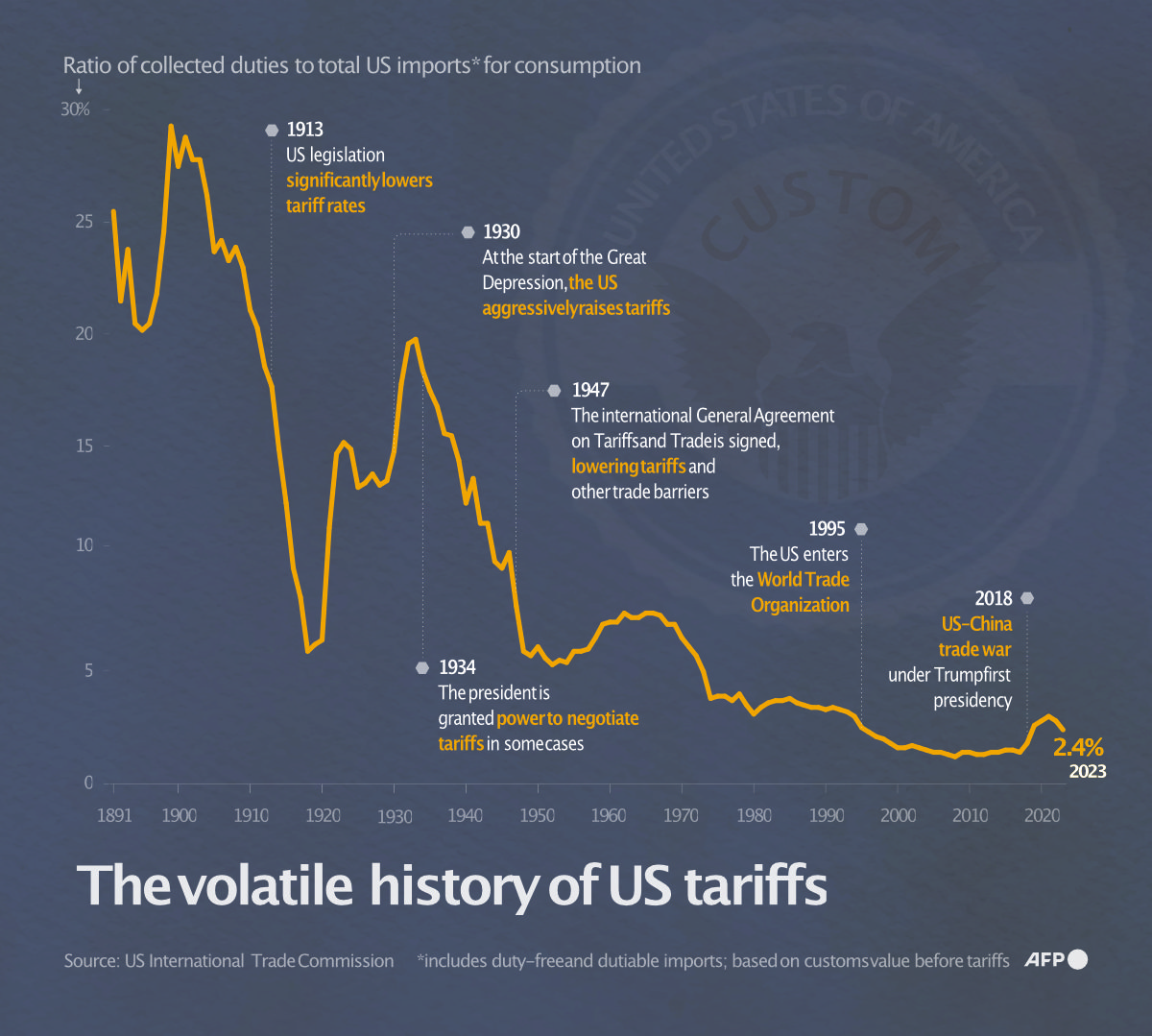
Trump presented the import taxes, which he calls “reciprocal tariffs” and range from 10 percent to 49 percent, in the simplest terms: the US would do to its trading partners what he said they had been doing to the US for decades.
“Taxpayers have been ripped off for more than 50 years,” he said. “But it is not going to happen anymore.”
The president promised that “Jobs and factories will come roaring back into our country.” He framed it not just as an economic issue, but a question of national security that threatens “our very way of life.”
Shortly after Trump’s announcement, the British government said the United States remains the UK’s “closest ally.”
Business Secretary Jonathan Reynolds said the UK hoped to strike a trade deal to “mitigate the impact” of the 10 percent tariffs on British goods announced by Trump.
“Nobody wants a trade war and our intention remains to secure a deal,” said Reynolds. “But nothing is off the table and the government will do everything necessary to defend the UK’s national interest.”
British officials have said they will not immediately retaliate, an approach backed by the Confederation of British Industry, a major business group.
Little to gain
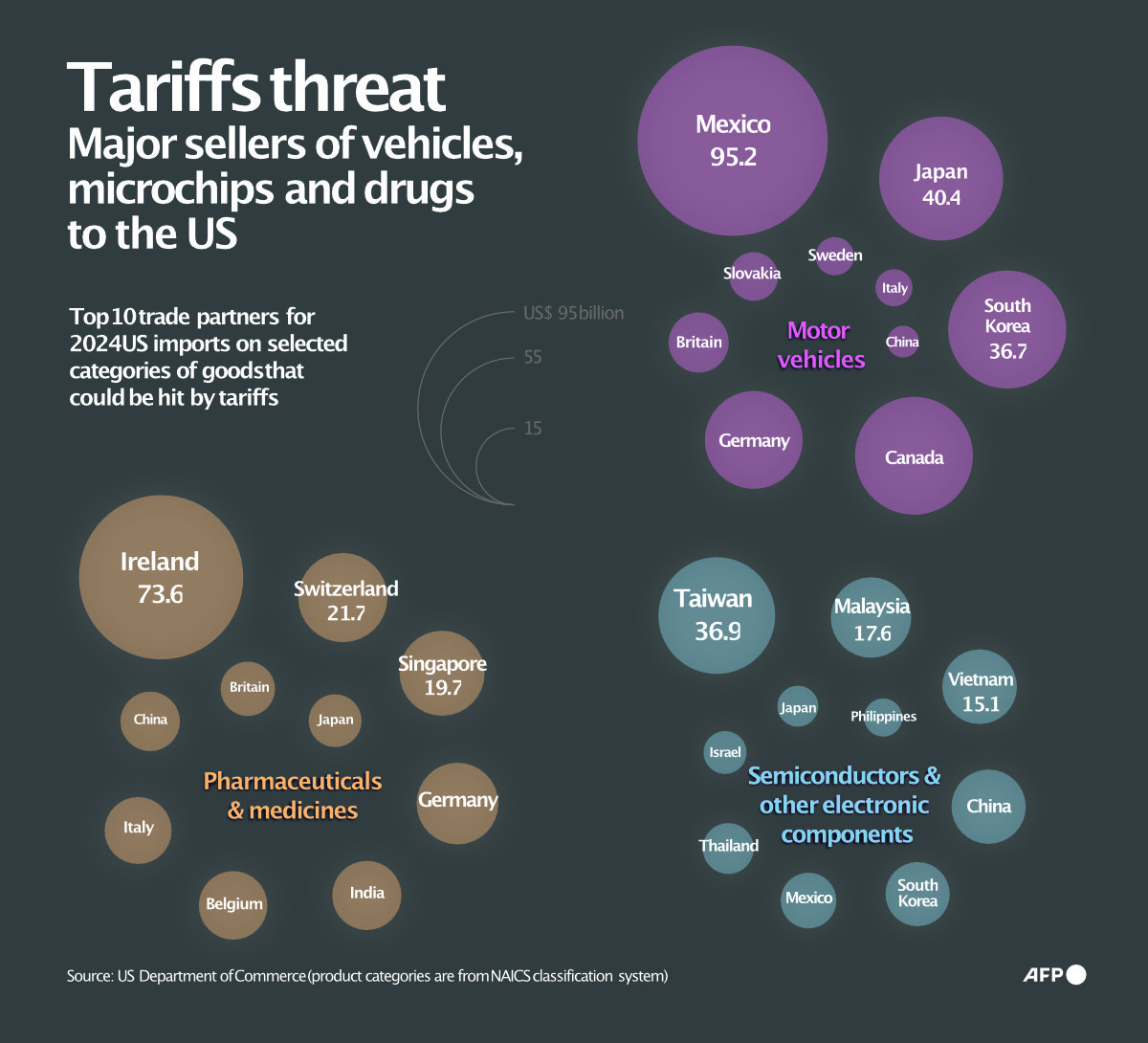
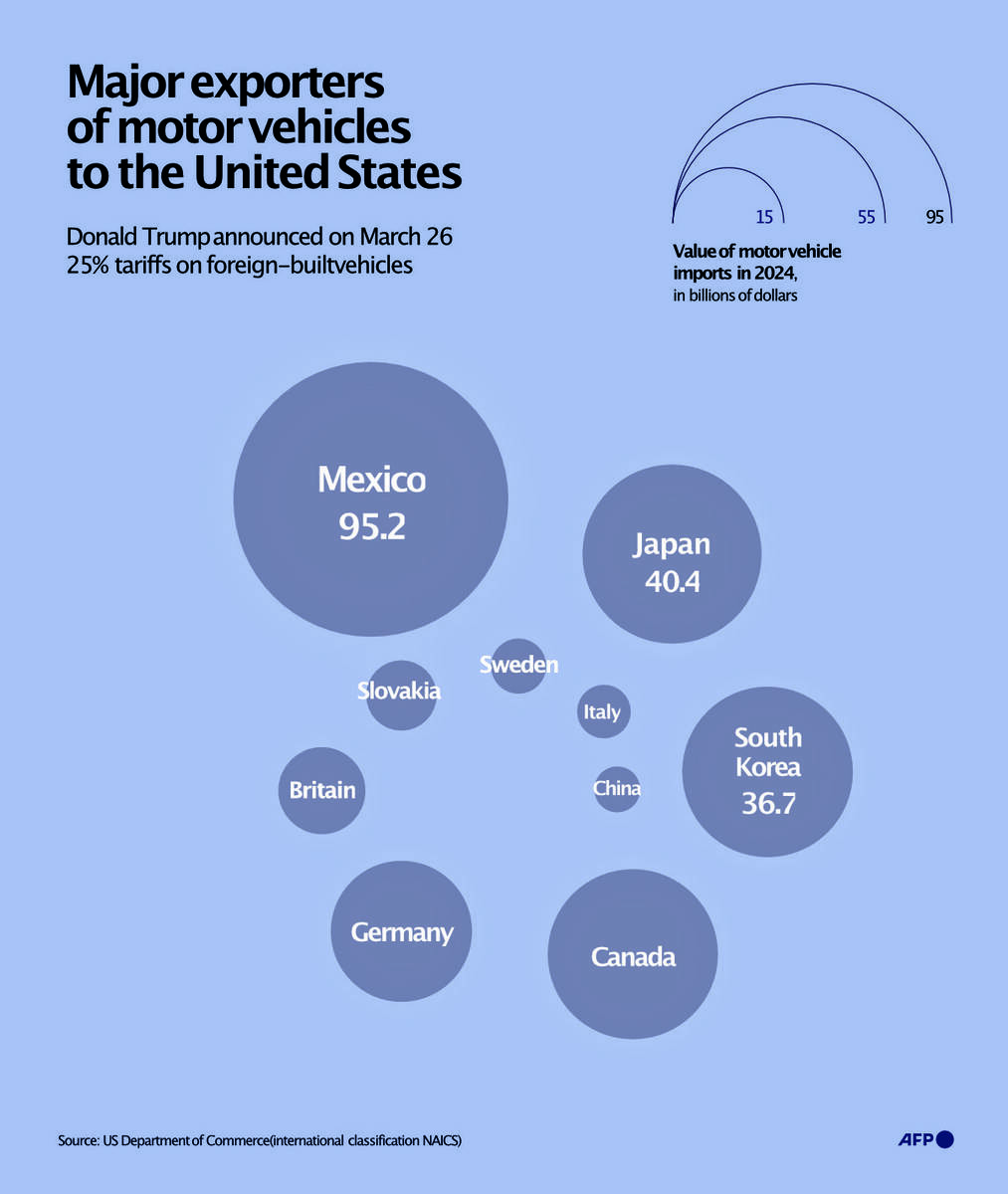
Spared for the moment from the latest round of tariffs were Mexico and Canada, so far as goods that already qualified under their free trade agreement with the United States. Yet, the previously announced 25 percent tariffs on auto imports were scheduled to take effect at midnight.
Mexico President Claudia Sheinbaum said Wednesday she would wait to take action on Thursday when it was clear how Trump’s announcement would affect Mexico.
“It’s not a question of if you impose tariffs on me, I’m going to impose tariffs on you,” she said in a news briefing Wednesday morning. “Our interest is in strengthening the Mexican economy.”
Canada had imposed retaliatory tariffs in response to the 25 percent tariffs that Trump tied to the trafficking of fentanyl. The European Union, in response to the steel and aluminum tariffs, imposed taxes on 26 billion euros’ worth ($28 billion) of US goods, including bourbon, prompting Trump to threaten a 200 percent tariff on European alcohol.
As Trump read down the list of countries that would be targeted Wednesday, he repeatedly said he didn’t blame them for the tariffs and non-tariff barriers they imposed to protect their own nations’ businesses. “But we’re doing the same thing right now,” he said.
“In the face of unrelenting economic warfare, the United States can no longer continue with a policy of unilateral economic surrender,” Trump said.
Speaking from a business forum in India, Chilean President Gabriel Boric warned that such measures, in addition to causing uncertainty, challenge the “mutually agreed rules” and the “principles that govern international trade.”
Ultimately, Trump announced Chile would face the baseline reciprocal tariff of 10 percent. The US is Chile’s second most important trading partner after China.
Analysts say there’s little to be gained from an all-out trade war, neither in the United States or in other countries.
“Once again, Trump has put Europe at a crossroads,” said Matteo Villa, senior analyst at Italy’s Institute for International Political Studies.
“If Trump really imposes high tariffs, Europe will have to respond, but the paradox is that the EU would be better off doing nothing,” he added.
Villa also noted that retaliation would certainly be a further “blow” to the United States, but it would hurt Europe even more, as the EU bloc depends more on exports to the US than vice versa.
“On the other hand, Trump seems to understand only the language of force, and this indicates the need for a strong and immediate response,” Villa said. “Probably the hope, in Brussels, is that the response will be strong enough to induce Trump to negotiate and, soon, to backtrack.”
(With Reuters)


