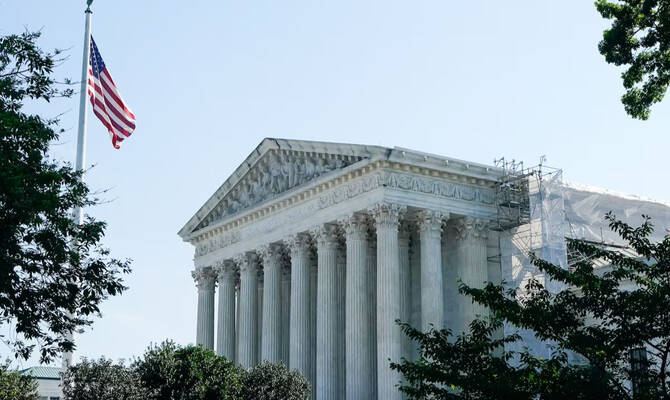
WASHINGTON: The US Supreme Court heard arguments on Tuesday on whether American victims of attacks in Israel and the West Bank can sue the Palestinian authorities for damages in US courts.
The long-running case involves the jurisdiction of US federal courts to hear lawsuits involving the Palestinian Authority (PA) and the Palestine Liberation Organization (PLO).
Americans killed or injured in attacks in Israel or the West Bank or their relatives have filed a number of suits seeking damages.
In one 2015 case, a jury awarded $654 million to the US victims of attacks which took place in the early 2000s.
Appeals courts dismissed the suits on jurisdiction grounds.
Congress passed a law in 2019 — the Promoting Security and Justice for Victims of Terrorism Act — that would make the PLO and PA subject to US jurisdiction if they were found to have made payments to the relatives of persons who killed or injured Americans.
Two lower courts ruled that the 2019 law was a violation of the due process rights of the Palestinian authorities but a majority of the justices on the conservative-majority Supreme Court appeared inclined on Tuesday to uphold it.
“Congress and the president are the ones who make fairness judgments when we’re talking about the national security and foreign policy of the United States,” said Justice Brett Kavanaugh.
Deputy Solicitor General Edwin Kneedler, representing the Trump administration, agreed, saying the courts should not substitute themselves for Congress or the president.
“Congress and the president made a judgment that is entitled to virtually absolute deference — that it is appropriate to subject the PA and the PLO to jurisdiction,” Kneedler said.
“In this case, respondents had a chance to avoid that by just stopping those activities, but they didn’t,” he said.
Mitchell Berger, representing the PA and PLO, said assigning jurisdiction is “over and above what Congress can prescribe.”
The Supreme Court is expected to issue a ruling before the end of its term in June.

Supreme Court may open door to US victim suits against Palestinian authorities
https://arab.news/vahmp
Supreme Court may open door to US victim suits against Palestinian authorities
- The long-running case involves the jurisdiction of US federal courts to hear lawsuits involving the Palestinian Authority and the Palestine Liberation Organization
Thai and Cambodian top diplomats meet in China to solidify ceasefire
- The ceasefire agreement comes with a 72-hour observation period, at the end of which Thailand agreed to repatriate 18 Cambodian soldiers it has held as prisoners since earlier fighting in July
BEIJING: Top diplomats from Thailand and Cambodia kicked off two days of talks in China on Sunday as Beijing seeks to strengthen its role in mediating the two countries’ border dispute, a day after they signed a new ceasefire.
The ceasefire agreement signed on Saturday calls for a halt to weeks of fighting along their contested border that has killed more than 100 people and displaced over half a million in both countries.
Thai Foreign Minister Sihasak Phuangketkeow and Cambodian Foreign Minister Prak Sokhonn were set to meet in China’s southwestern Yunnan province for talks mediated by their Chinese counterpart, Wang Yi.
The talks aim to ensure a sustained ceasefire and promote lasting peace between the countries, according to a statement by Sihasak’s office.
Wang was scheduled to join both bilateral meetings with each of the diplomats and a trilateral talk on Monday.
China has welcomed the ceasefire announcement, which freezes the front lines and allows for displaced civilians to return to their homes near the border.
“China stands ready to continue to provide (the) platform and create conditions for Cambodia and Thailand to have fuller and more detailed communication,” a Chinese Foreign Ministry statement read.
The ceasefire agreement comes with a 72-hour observation period, at the end of which Thailand agreed to repatriate 18 Cambodian soldiers it has held as prisoners since earlier fighting in July. Their release has been a major demand of the Cambodian side.
China has sought to position itself as a mediator in the crisis, along with the United States and Malaysia.
A July ceasefire was brokered by Malaysia and pushed through by pressure from US President Donald Trump, who threatened to withhold trade privileges unless Thailand and Cambodia agreed.
Despite those deals, Thailand and Cambodia carried on a bitter propaganda war, and minor cross-border violence continued, erupting into heavy fighting in early December.
Prak Sokhonn, in a statement after his meeting with Wang, expressed deep appreciation for China’s “vital role” in supporting the ceasefire.
China also announced 20 million yuan ($2.8 million) of emergency humanitarian aid for Cambodia to assist the displaced.
The first batch of Chinese aid, including food, tents and blankets, arrived in Cambodia on Sunday, Wang Wenbin, Chinese ambassador to Cambodia, wrote on Facebook.
Sihasak said Sunday he hoped the meetings would convey to China that it should both support a sustainable ceasefire and send a signal to Cambodia against reviving the conflict or attempting to create further ones.
“Thailand does not see China merely as a mediator in our conflict with Cambodia but wants China to play a constructive role in ensuring a sustainable ceasefire by sending such signals to Cambodia as well,” he said.


