Hunger returns to Gaza as Israeli blockade forces bakeries shut

1 / 2
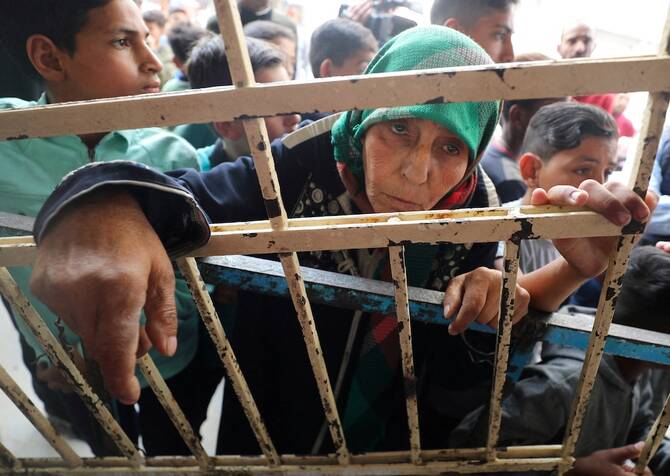
A Palestinian woman stands at a bakery that has stopped operating due to a lack of flour and fuel in Gaza City on April 1, 2025. (Reuters)
2 / 2
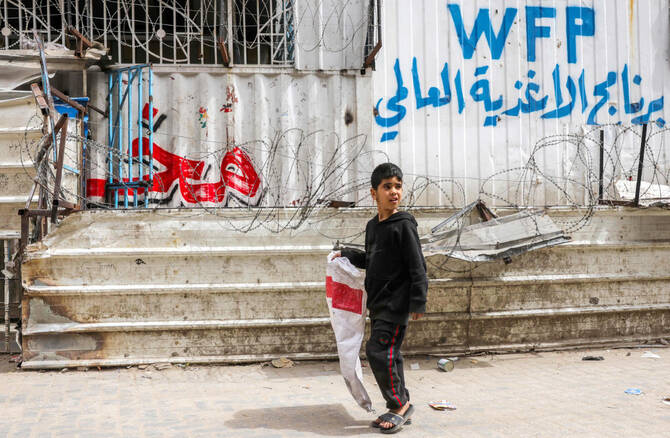
A Palestinian youngster walks with an empty sack past a closed-down bakery that ran out of flour in Gaza City on Tuesday. (AFP)
Short Url
Updated 02 April 2025
Follow

Hunger returns to Gaza as Israeli blockade forces bakeries shut

  • UN agency: All 25 WFP-supported bakeries in Gaza have shut down due to lack of fuel and flour
  • International charities working in Gaza warn that its 2.4 million people cannot endure more shortages

GAZA CITY, Palestinian Territories: At an industrial bakery in war-ravaged Gaza City, a conveyor belt that once churned out thousands of pitta breads every day has come to a standstill.

The Families Bakery is one of about two dozen supported by the World Food Programme (WFP) that have halted production in recent days due to flour and fuel shortages resulting from an Israeli blockade.

“All 25 WFP-supported bakeries in Gaza have shut down due to lack of fuel and flour,” the UN agency said in a statement on Tuesday, adding that it would “distribute its last food parcels in the next two days.”

Abed Al-Ajrami, chairman of the Bakery Owners Association in Gaza and owner of the Families Bakery, said that the WFP was the only sponsor of Gaza bakeries and provided them with “all their needs.”

“The repercussions from the closure of the bakeries will be very hard on citizens because they have no alternative to resort to,” he said.

Speaking in front of a large industrial oven that had not been fired up, he said that bakeries were central to the UN agency’s food distribution program, which delivered the bread to refugee camps across Gaza.

Despite a six-week truce that allowed displaced Gazans to return to what remained of their homes, negotiations for a lasting end to the fighting have stalled.

On March 2, Israel imposed a full blockade on the Palestinian territory, and cut off power to Gaza’s main water desalination plant.

On March 18, Israel resumed its strikes on Gaza. Days later, Hamas again began firing rockets at Israel.

The Palestinian militant group has accused Israel of using starvation as “a direct weapon in this brutal war,” pointing to the bakeries’ closure as an example.

It called on Arab and Muslim countries to “act urgently to save Gaza from famine and destruction.”

Residents of Gaza City were wary of the future.

“I got up in the morning to buy bread for my children but I found all the bakeries closed,” Mahmud Khalil said.

Fellow resident Amina Al-Sayed echoed his comments.

“I’ve been going from bakery to bakery all morning, but none of them are operating, they’re all closed,” she said, adding that she feared the threat of famine would soon stalk Gaza once again.

“The price of flour has risen... and we can’t afford it. We’re afraid of reliving the famine that we experienced in the south” of the territory.

International charities working in Gaza warn that its 2.4 million people cannot endure more shortages after many of them were displaced multiple times during the devastating military campaign Israel launched in response to Hamas’s October 2023 attack.

Those who took advantage of the six-week truce to return to bombed out homes have been “arriving in utter destitution,” said Gavin Kelleher of the Norwegian Refugee Council.

“We’ve been set up to fail as a humanitarian response. We’re not allowed to bring in supplies, we’re not able to meet needs,” he lamented.

Alexandra Saieh, of British charity Save The Children, echoed Kelleher’s remarks.

“When Save The Children does distribute food in Gaza, we see massive crowds because every single person in Gaza is relying on aid,” she said.

“That lifeline has been cut.”


How Israeli settlers are forcing Palestinian farmers off their land with near-total impunity

Updated 5 sec ago
Follow

How Israeli settlers are forcing Palestinian farmers off their land with near-total impunity

  • From pepper spray to armed threats, Palestinian farmers say intimidation has become routine in the Jordan Valley
  • Activists and rights groups say settler attacks on Palestinian farmers are not isolated events but part of a broader campaign

LONDON: In a scene that Palestinian officials and rights groups say has become routine in the occupied West Bank, Israeli settlers reportedly attacked farmers from the Bisharat family in mid-January as they plowed their land in Mofiya, in the northern Jordan Valley.
Witnesses said the settlers assaulted the farmers with pepper spray before calling in Israeli soldiers. Israeli forces later detained two sons of Youssef Hussein Asmar Bisharat, Hussein and Mohammed, according to Mutaz Bisharat, a Palestinian official from Tubas.
“This is the daily reality in the Jordan Valley,” Bisharat told Arab News. “It is repeated across all Palestinian communities.”
He described a consistent pattern: “Settlers assault citizens; the occupation army intervenes in favor of the settlers; Palestinians who try to defend themselves and their land are arrested; the occupation police file complaints against Palestinians.”
In late December, Israeli settlers ambushed farmers from the Palestinian Abu Al-Tayyib family as they worked their land east of the Khirbet Yarza area. The settlers held the farmers for more than three hours, filming the encounter as it unfolded, according to Bisharat.
The incident, which took place on Dec. 26 east of the Khirbet Yarza area, escalated further when a settler pointed a weapon at Mahdi Daraghmeh, head of the Malih village council, and threatened to shoot him.
The settler confiscated Daraghmeh’s car keys and detained him for nearly an hour.
Rights groups and activists say such attacks are not isolated but part of a broader strategy to force Palestinians off their land.
“The settlers who are perpetrating the attacks explicitly say their goal is expulsion of Palestinians,” Israeli activist Aviv Tatarsky told Arab News.
“Israeli police and army give no protection to the attacked communities but rather often join the attacking settlers and arrest, assault and at times shoot their Palestinian victims.”
He said that perpetrators “enjoy almost complete impunity.” Prosecution of settler crimes in the Israeli courts “rarely happens,” he said.
“The violent settlers enjoy vocal support from prominent Israeli rabbis and government ministers along with funding and weapons which the state gives them.
“All these indicate that the goal of expelling Palestinian communities, and ultimately ethnically cleansing the West Bank (to) become an Israeli state project.”
Data collected by humanitarian organizations underscore the scale of the violence. In a June 2025 report, Insecurity Insight said Palestinian farmers were attacked or threatened at least 276 times between Oct. 7, 2023, and Dec. 31, 2024.
Those incidents, the group said, involved settlers and Israeli security forces using firearms to intimidate farmers or physically assaulting them — in some cases with crowbars — “to force them to leave their land.” More than a third occurred during the olive harvest.
The Colonization and Wall Resistance Commission reported in November that at least 259 attacks against Palestinian farmers had been recorded since the harvest season began in October, including 41 carried out by the Israeli army and 218 by settlers.
UN data indicates a wider pattern. In 2025, the UN Office for the Coordination of Humanitarian Affairs, or OCHA, documented more than 1,800 settler attacks causing casualties or property damage across about 280 West Bank communities.
That amounts to an average of five incidents a day — the highest daily rate since OCHA began tracking such attacks in 2006, the agency said in a humanitarian update on Jan. 7.
Israeli human rights group B’Tselem said Israeli violence in the West Bank is part of a wider campaign across the occupied Palestinian territories.
In its July 2025 report, “Our Genocide,” the group said that alongside the onslaught on Gaza following the Hamas-led Oct. 7, 2023, attack, a parallel campaign has unfolded in the West Bank, including East Jerusalem.
“The regime and the military perpetrating genocide in Gaza are the same ones bombing refugee camps, killing hundreds of civilians, and carrying out policies of forcible transfer and dispossession on an unprecedented scale across the West Bank,” the organization wrote.
Local groups have echoed those warnings. On Jan. 13, Jordan Valley Solidarity, a grassroots community network, said Palestinian villages in the northern Jordan Valley face relentless attacks by “armed settlers and occupation forces.”
“Settlers are roaming around the villages, intimidating and attacking local Palestinians, often followed by occupation forces acting on spurious allegations, coming to arrest the victims of settler attacks or to issue further threats,” the group wrote on its website.
Days earlier, the Times of Israel reported that 26 Palestinian families fled Ras Ein El-Auja, one of the last remaining Palestinian Bedouin villages in the Jordan Valley, after harassment by settlers from nearby unauthorized outposts became unbearable.
The outlet said Israel’s military and the local settlement council did not respond to requests for comment.
Israel routinely says it condemns such violence and investigates specific incidents.
On the ground, however, rights groups and media reports allege the army and police largely enable or ignore attacks on Palestinian farmers, with only limited, case-by-case disciplinary action when abuses are exposed.
The Jordan Valley makes up about 30 percent of the West Bank. About 90 percent of its lands were categorized under the Oslo Agreement as Area C — over which Israel retains control of security and land-management.
The area was intended to form a core part of a future Palestinian state. However, there are 37 Israeli settlements and dozens of settler outposts in this area, according to Rasheed Khudeiri, a farmer and activist with the Jordan Valley Solidarity campaign.
He told Amnesty International in December that the outposts are not established by the state but by settlers who take over the land and natural resources with impunity.
Around 39 percent of the Jordan Valley lands are categorized by the Israeli authorities as natural reserves and military firing zones and are off limits for Palestinians.
Khudeiri said Israeli authorities have granted sweeping powers to settlement councils, allowing them to seize land and water resources. “In the northern Jordan Valley area alone, settlers have taken over seven water springs that Palestinians depend on for livelihoods,” he said.
“Herding settlers don’t only steal our natural resources, they also appropriate our culture, heritage and lifestyle. Settlers in outposts herd cattle and sheep, build mud houses and make Palestinian dairy products.”
Recent weeks have seen an escalation in land seizures. On Jan. 4, Bisharat said, settlers drove a herd of cattle into the Humsah Basaliya community, trampling wheat fields belonging to Palestinian farmers Hail Mahmoud Bisharat and Mahmoud Hail Mahmoud Bisharat.
In late December, settler groups fenced off land near homes in the Al-Hadidiya area “to besiege residents and prevent them from cultivating their land,” Bisharat said.
Despite the pressure, Palestinian farmers have returned in recent weeks to plow the fields they say were seized by settlers, seeking to reclaim their land amid mounting restrictions.
On Dec. 26, a settler attempted to stop farmers in the Humsah Al-Fouqa area from plowing their fields, threatening to involve the Israeli army and confiscate their tractors.
The Palestinian farmers, however, refused to comply and defied the settlers’ threats. They continued working and managed to plow more than 40 hectares by evening, Bisharat said.
Earlier, on Dec. 14, about 20 hectares in the Al-Farisiya area were plowed by Palestinian landowners and residents with support from the Al-Maleh and Bedouin Communities Village Council, international solidarity activists, and lawyers.
“These lands that we were able to cultivate had been seized and fenced off by settlers a month earlier,” Bisharat said.
The following day, however, Israeli forces raided agricultural land in Ein Al-Hilweh and Wadi Al-Faw while it was being cultivated. They confiscated tractors belonging to the Palestinian Ministry of Agriculture, but the tractors were later released after ownership documents were presented, Bisharat said.
On Dec. 16, “as part of continued efforts to reclaim seized land, about 300 dunams (30 hectares) in Khirbet Al-Farisiya and Ein Al-Hilweh were planted and plowed,” he added, noting that funding was provided by international institutions, the Colonization and Wall Resistance Commission, and local officials.
International reactions have increasingly framed attacks on Palestinian farmers as part of a broader pattern of forcible displacement and de facto annexation. Concrete consequences, however, have remained limited and largely symbolic.
In an October 2025 statement, UN human rights offices in Palestine said rising settler violence, often backed by Israeli forces, is being used to “consolidate annexation” in clear violation of international law, destroying livelihoods and pushing Palestinian communities off their land.