SEOUL: South Korea’s Constitutional Court will issue its long-awaited ruling on President Yoon Suk Yeol’s impeachment Friday, months after he was suspended for declaring martial law.
Yoon’s December 3 attempt to subvert civilian rule plunged South Korea into political chaos, after he sent armed soldiers into parliament.
Lawmakers defied the troops to vote the measure down and impeached Yoon soon after, but the months of political instability have hit South Korea’s economy and left the country in leadership limbo, even as US President Donald Trump targets the region with tariffs.
The court has held weeks of impeachment hearings to determine whether to officially remove Yoon from office, and then took weeks to deliberate on the case, giving rise to a surge in speculation with some suggesting the justices must be experiencing intense disagreements.
“The president’s impeachment case verdict will be on April 4, 2025 at the Constitutional Court,” the court said in a statement Tuesday.
For Yoon to be removed from office, at least six of the court’s eight justices must vote in favor. Confirmation of his impeachment would trigger elections which must be held within 60 days.
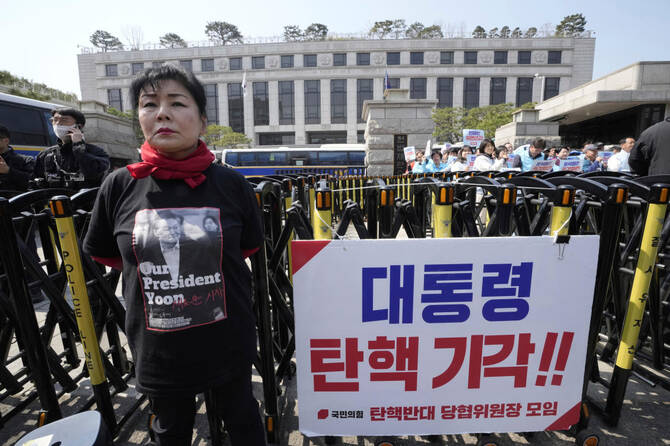
Hundreds of thousands of South Koreans have been rallying for and against Yoon every weekend in central Seoul.
Yoon, a former prosecutor, was detained in January on insurrection charges but was released in early March on procedural grounds. He has remained defiant throughout and blamed a “malicious” opposition.
He is also the first sitting South Korean president to stand trial in a criminal case, facing charges of insurrection over the martial law bid.
“After four long months of waiting, the Constitutional Court has finally responded to the people,” the opposition Democratic Party’s spokesperson said.
“We believe the Court will demonstrate its firm resolve to defend the constitutional order and founding principles of the Republic of Korea by removing Yoon Suk Yeol, the insurrectionist, from office.”
Yoon’s party said it welcomed the court’s move to issue a ruling, saying it hoped the verdict would be “fair and impartial” and would not lead to further social unrest.
The People Power Party “will respect and accept the court’s decision, and after the ruling, both the ruling and opposition parties... must take the lead in easing public divisions and promoting national unity,” Kweon Seong-dong PPP party floor leader said.
If the Constitutional Court decides to formally dismiss the president, it would trigger elections, which opposition leader Lee Jae-myung is currently frontrunner to win.
An appeals court last week overturned an election law conviction against Lee, potentially clearing the way for him to mount a presidential campaign.
But if it is reinstated on appeal before the election, he will be stripped of his parliamentary seat and barred from running for office for five years, including the next presidential vote.
Leif-Eric Easley, a professor at Ewha University in Seoul, said the ruling on Lee may have appeared “to many Koreans to be reading the political tea leaves.”
“This is the judiciary trying to unwind the lawfare of the past three years to allow South Korea’s political crisis to be resolved by an election rather than by the courts.”
In a separate case, the Constitutional Court last week dismissed the impeachment of Prime Minister Han Duck-soo, reinstating him as acting president – a role he took after the president was suspended for declaring martial law.
Experts said the ruling did not have a direct legal correlation with the pending decision on Yoon’s impeachment, as it was not focused on the legality of martial law itself.


![]()

South Korea’s Constitutional Court to issue ruling on Yoon Suk Yeol impeachment on Friday
Short Url
https://arab.news/mzz3y
South Korea’s Constitutional Court to issue ruling on Yoon Suk Yeol impeachment on Friday
- Yoon’s December 3 attempt to subvert civilian rule plunged South Korea into political chaos
- Lawmakers defied the troops to vote the measure down and impeached Yoon soon after


Latest updates


© 2026 SAUDI RESEARCH & PUBLISHING COMPANY, All Rights Reserved And subject to Terms of Use Agreement.