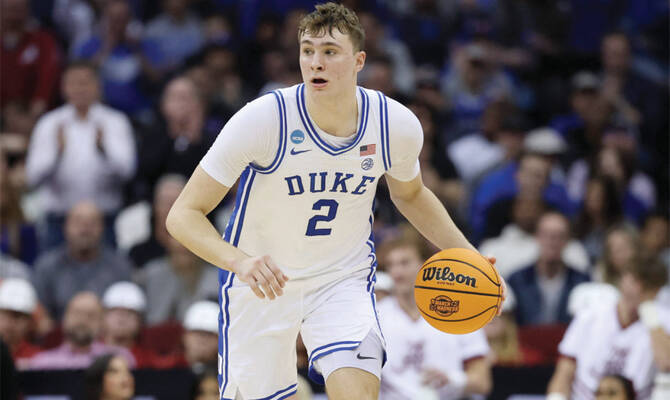

NEWARK, NJ: Duke’s stream of long, tall NBA-ready standouts smothered Alabama and papered over Cooper Flagg’s rough shooting night to lift the Blue Devils to the program’s 18th Final Four with an 85-65 victory Saturday night in the NCAA Tournament’s East Region final.
Flagg made only 6 of 16 shots, including a brick that got stuck in the flange of the rim, but still finished with 16 points. Kon Knueppel, another potential lottery pick, led the Blue Devils with 21 points.
But the most important stat: Alabama’s nation-leading offense, one coming off a record-setting night from 3 in the Sweet 16, failed to crack 70 points for only the second time this season.
The Crimson Tide’s 35.4 percent shooting from the floor was their worst all season and their 25 percent from behind the arc (8 for 32) matched their fourth-worst showing of 2024-25.
Mark Sears, who came one short of a tournament record with 10 3s two nights earlier, finished with one and only six points against the Blue Devils (35-3), who won their 15th straight.
At the Final Four in San Antonio, top-seeded Duke will play the winner of Sunday’s game between Houston and Tennessee. Its win erased any chance of an all-Southeastern Conference show at the Final Four, but with No. 1 Florida winning earlier, it kept alive the prospect of all four top seeds playing on the sport’s biggest stage for only the second time. Khaman Maluach scored 14 points on 6-of-7 shooting and Duke shot 53.6 percent despite its best player’s rough night.
Flagg was hardly bad in this one. He had nine rebounds, three assists and one mega-block that sent Mouhammed Dioubate’s floater flying over press row.
But in a game in which both teams were focused on taking away the other’s best player, it was Duke that did it more effectively, switching off on Sears, locking down the perimeter and never letting him find breathing room.
The fifth-year senior’s first bucket of any kind came nearly 18 minutes into the game and the shot was a 16-footer from the elbow — the exact kind of midrange shot Nate Oats’ team of dunkers and 3-point specialists avoids.
Sears’ first 3 came with 16:19 left in the game. His final line: 2 for 12 from the floor, 1 for 5 from 3. He also had six assists. Labaron Philon led the second-seeded Crimson Tide (28-9) with 16 points. Not a single Alabama player made more shots than he missed.
Duke coach Jon Scheyer, leading the program to the Final Four for the first time since his predecessor Mike Krzyzewski’s last season in 2022, has up to six NBA prospects on his roster.
They all chipped in on offense — Tyrese Proctor had 17 points — and even moreso on defense, where Alabama looked nothing like the team that set tournament records for makes and attempts by going 25 for 51 from 3 against BYU.
Final Four firsts
The only other Final Four to feature all No. 1 seeds was in 2008 when Kansas, Memphis, UCLA and North Carolina made it. The site: San Antonio.
Another title for Tide wheelchair team
It wasn’t a totally lost night for Tide fans. Shortly before tipoff, the Alabama women’s wheelchair hoops team beat Texas-Arlington 67-52 for its fifth straight national championship.