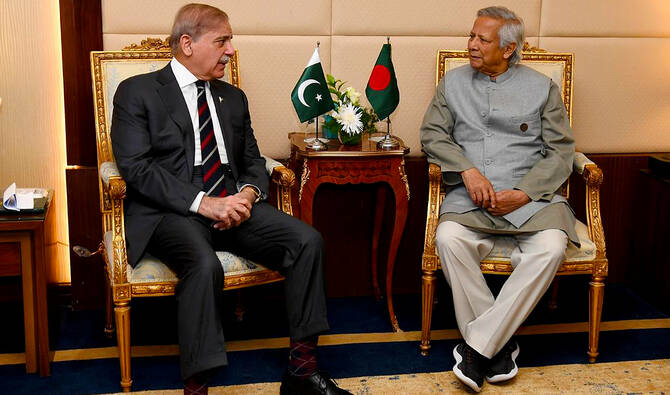
ISLAMABAD: Pakistan Prime Minister Shehbaz Sharif and Bangladesh’s Chief Adviser Dr. Muhammad Yunus on Monday resolved to strengthen trade and cultural relations between the two countries, Sharif’s office said, amid a thaw in ties between the two countries.
The statement came after Sharif’s telephonic conversation with Yunus on Eid Al-Fitr in which they recalled their “productive” meetings in New York and Cairo on the margins of the United Nations General Assembly (UNGA) and D-8 summits last year.
The Pakistan premier expressed his satisfaction at the positive momentum in bilateral relations between the two countries, particularly in trade and travel, according to Sharif’s office.
“The two leaders reaffirmed their shared desire to further strengthen bilateral relations between Pakistan and Bangladesh,” it said in a statement.
“In this regard, the Prime Minister said that Pakistan looked forward to the visit of the Deputy Prime Minister/Foreign Minister to Dhaka in April and said that a trade delegation would also accompany him.”
Pakistan and Bangladesh were once one nation, but they split in 1971 as a result of a bloody civil war, which saw the part previously referred to as East Pakistan seceding to form the independent nation of Bangladesh.
In the years since, Bangladeshi leaders, particularly ex-PM Sheikh Hasina, chose to maintain close ties with India. Ties between Pakistan and Bangladesh have warmed up since Hasina’s ouster as a result of a student-led uprising in August, witnessing a marked improvement.
Pakistani cargo ships have begun to arrive at Bangladesh’s main Chittagong port for the first time since the 1971 war, while Pakistani artists have been performing in Dhaka and Bangladeshi films have been screened at cinemas in Pakistan since December.
During his conversation with Yunus, Sharif also underscored the need to revive institutional mechanisms to reinvigorate the bilateral relationship at all levels.
“Exchange of cultural troupes to promote people-to-people contact was also discussed,” Sharif’s office said. “The Prime Minister invited a Bangladesh cultural troupe, comprising old and new artists, including the legendary Runa Laila, to visit Pakistan.”

Pakistan PM, Bangladesh chief adviser resolve to strengthen trade and cultural ties
https://arab.news/cec4j
Pakistan PM, Bangladesh chief adviser resolve to strengthen trade and cultural ties
- Pakistan and Bangladesh were once one nation, but split in 1971 as a result of a bloody civil war
- Ties between both nations have warmed up since PM Hasina’s ouster due to an uprising in August
Pakistan urges ‘time-bound and irreversible’ path to Palestinian statehood at UN
- Pakistan warns the Security Council Israeli settlement expansion has reached its highest level in the West Bank
- It says Islamabad backs sustained ceasefire, expanded humanitarian access, protection of UNRWA’s role in Gaza
ISLAMABAD: Pakistan on Tuesday called for a time-bound and irreversible political process leading to the establishment of a sovereign Palestinian state, urging the international community to move beyond declarations and turn long-standing commitments into concrete action.
Addressing a Security Council briefing on the Middle East, Pakistan’s ambassador to the United Nations said repeated diplomatic initiatives had underscored that the status quo was untenable and that only a credible political horizon, grounded in international law, could deliver durable peace.
His remarks came as the Security Council reviewed the implementation of Resolution 2334, which calls on Israel to halt settlement activity in occupied Palestinian territory.
Pakistan said recent diplomatic efforts — including a high-level conference in July and the General Assembly’s endorsement of the New York Declaration reaffirming the two-state framework — had sought to preserve the possibility of a negotiated settlement between Israelis and Palestinians.
It said follow-up meetings at Sharm El-Sheikh, along with US-led initiatives under President Donald Trump aimed at halting the fighting, were intended to reopen a political process toward Palestinian statehood.
“A time-bound and irreversible political process, anchored in relevant UN resolutions must lead to the establishment of a sovereign, independent and contiguous State of Palestine on the basis of pre-1967 borders, with Al-Quds Al-Sharif as its capital,” Pakistan’s Permanent Representative Asim Iftikhar Ahmad told the council.
“It is high time to turn promises into action and speed up this process,” he added.
Ahmad said Pakistan backed Security Council Resolution 2803, which calls for efforts to sustain the ceasefire, expand aid access and restart a political track toward Palestinian statehood.
He said settlement activity in the occupied West Bank, including East Jerusalem, had reached its highest levels since the United Nations began systematic monitoring, citing UN findings that more than 6,300 housing units were advanced during the reporting period.
Such actions, he said, had “no legal validity” under international law but continued to undermine the viability of the two-state solution.
Pakistan also defended the role of the UN Relief and Works Agency (UNRWA), saying it remained indispensable for Palestinian refugees and must not be weakened by what it called unfounded criticism.
Ahmad condemned the storming of UNRWA’s headquarters in East Jerusalem earlier this month, calling it a violation of international law and the inviolability of UN premises, and urged full, safe and unimpeded humanitarian access to Gaza, along with the immediate start of reconstruction without annexation or forced displacement.


