

Niger withdraws from Lake Chad military force fighting terrorist groups

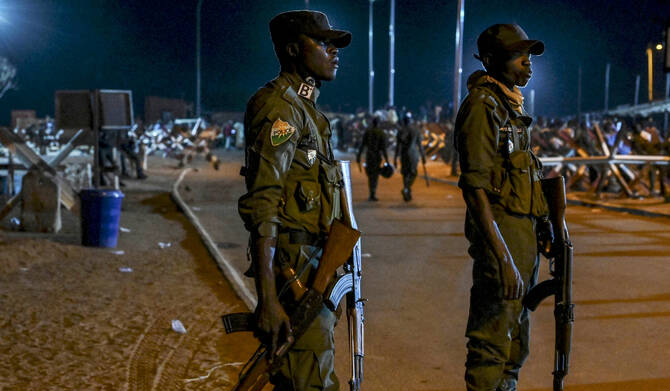
National police officers stand guard as supporters of Niger's National Council for Safeguard of the Homeland protest outside the French and Niger airbase in Niamey on September 9, 2023 to demand the departure of the French army from Niger. (AFP)
Short Url
Updated 30 March 2025
Follow

Niger withdraws from Lake Chad military force fighting terrorist groups

  • The ensuing conflict, which has drawn in other extremist groups, has killed over 40,000 people and displaced around two million, causing one of the world’s worst humanitarian crises

NIAMEY: Niger has withdrawn from the military coalition fighting terrorist groups in the Lake Chad region of west-central Africa, saying it will focus instead on protecting its oil operations from attacks.
The announcement comes amid rising tensions between the four countries bordering Lake Chad since a 2023 coup by Niger’s military.
In a bulletin read on state TV, the army said the operation under the Multinational Joint Task Force, active since 2015, would now be called “Nalewa Dole” following Niger’s withdrawal.
The move “reflects a stated intent to reinforce security for oil sites,” the bulletin stated, without further elaboration.
The four countries that surround Lake Chad — Cameroon, Chad, Niger and Nigeria — have been battling insurgencies since 2009, after a spate of violent campaigns by the Boko Haram group in Nigeria’s northeast spilled into its neighbous.
The ensuing conflict, which has drawn in other extremist groups, has killed over 40,000 people and displaced around two million, causing one of the world’s worst humanitarian crises.
But since the July 2023 coup, Niger’s military junta has accused Nigeria of supporting foreign forces in a bid to destabilize it, which Abuja denies.
Oil infrastructure in southeast Niger meanwhile, in particular a pipeline leading from the landlocked country to Benin, regularly face attacks by armed groups.
The governor of Niger’s Diffa region, General Ibrahim Bagadoma, said at a regional summit in February that “The problem is that some are making efforts, while others are undermining them. We must present a united front and end foreign regional interferences.”
Late last year, Chad had threatened to withdraw from the Joint Task Force after an attack killed around 40 of its soldiers, citing an “absence of mutualized efforts.”


Republican congressional candidate says she will not accept AIPAC funds

Updated 7 sec ago
Follow

Republican congressional candidate says she will not accept AIPAC funds

  • ‘I’m not somebody who can be bought,’ Niki Conforti tells Arab News, referring to pro-Israel lobby group
  • Arab Americans have accused Democratic incumbent Sean Casten of ignoring their concerns

CHICAGO: Niki Conforti, the Republican candidate for the Illinois 6th Congressional District, has told Arab News that she will not accept campaign funds from the American Israel Public Affairs Committee.

The powerful lobby group demands complete loyalty to Israel over Arab interests, donating hundreds of millions of dollars in each election, including nearly $300,000 to the district’s incumbent Democrat Sean Casten, according to the political group Track AIPAC.

“I’m not somebody who can be bought. I’ve made the commitment that I won’t take AIPAC money,” Conforti told Arab News. “First and foremost, I have to take care of the people of my district.”

Describing her views as being “America First,” she added: “I think we’ve given a lot of money to fund foreign wars. We need to turn that money internally to address mental health issues, to help the homeless, to help veterans, to lower crime. We have so many issues here at home where that money can be better spent.”

In Ukraine and the Middle East, “we need to work toward peace and stop the killing,” she said. “These are turning into perpetual wars and we need to really get respect in the regions, have accountability on both sides, and reach an agreement that everyone can adhere to and keep.”

A healthcare industry professional, Conforti said it is important that elected officials listen to all of the district’s residents regardless of political affiliation, race, ethnicity or religion.

“I’m a businesswoman. I’m going to listen to my constituents, whether we agree or not. Listening to my constituents is going to be very important to me,” she added.

The 6th District in Chicago’s western suburbs has a large concentration of Arab and Muslim voters, whose leaders have repeatedly complained that four-term incumbent Casten has rebuffed their views.

Conforti previously ran for the office twice, challenging Casten as the endorsed Republican in 2024, losing to him by about 30,000 of 363,000 votes cast.

Leaders of the Arab-American community have accused him of not being forceful enough in opposing Israel’s war in Gaza.

“Congressman Casten hasn’t seen fit to attend any of our events,” American Arab Chamber of Commerce President Hassan Nijem told Arab News. “It’s clear Casten isn’t interested in our views or our concerns, even though we’re a major constituency in the 6th Congressional District.”

Samir Khalil, founder of the Arab American Democracy Coalition, told Arab News: “Casten has been unresponsive to our community. He embraces a double standard, taking hundreds of thousands of dollars from AIPAC.

“He has sat back while our tax dollars have been used to fund Israel’s killing of Palestinians in Gaza and the total destruction of homes, businesses, schools, hospitals, mosques and churches.”

In the March 17 Republican primary, Conforti, 62, will face newcomer Skylar Duensing, 25, a protege of assassinated right-wing political activist Charlie Kirk.

Casten, 54, will face newcomer Joseph Ruzevich, 27, in the March 17 Democratic primary. Ruzevich has said he will not accept AIPAC money.

The winners of each primary will face off against each other on Nov. 3.

Nijem and Khalil both said the Arab-American community will oppose Casten in the March and November elections.

Casten did not respond to a request for comment from Arab News.