

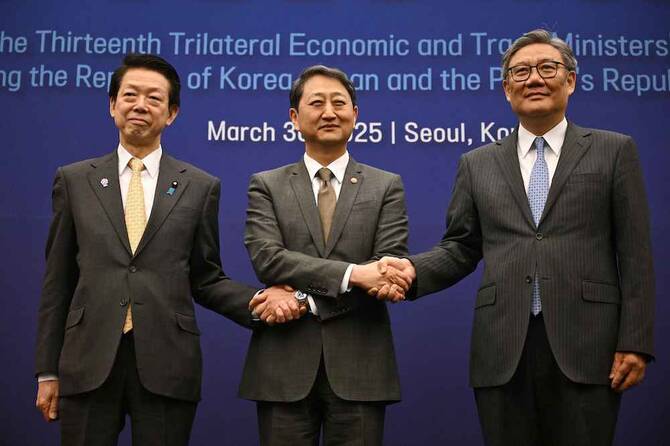

SEOUL: South Korea, China and Japan agreed to expand trade cooperation on Sunday, ahead of US President Donald Trump’s plans to impose reciprocal tariffs.
South Korean Industry Minister Ahn Duk-geun met with Japanese Trade Minister Yoji Muto and Chinese Commerce Minister Wang Wentao in Seoul for the first trilateral meeting among the three countries since 2019.
They agreed to speed up negotiations toward a trilateral free trade agreement, which have not progressed since talks first began in 2012.
“We will continue discussions to accelerate trilateral FTA negotiations with the goal of realizing a fair, comprehensive and high-quality FTA that is mutually beneficial,” the ministers said in a joint statement issued after the meeting.
Ahn said cooperation among the three countries was necessary amid “the rapidly changing global economic and trade” environment.
“There is a need for the three countries to cooperate on the basis of mutual respect and trust, in order to create a more stable environment for global trade and investment,” Ahn said during his opening remarks at the meeting.
Ahn and his counterparts also agreed to strengthen the Regional Comprehensive Economic Partnership, a trade framework among 15 Asia-Pacific countries aimed at lowering trade barriers, and to expand collaboration in rising industries, including renewable energy and digital transformation.
Sunday’s trilateral meet comes ahead of Trump’s expected announcement of “reciprocal tariffs” on April 2. US officials have previously cited China and South Korea as countries with whom Washington has had “persistent trade deficits.”
On Wednesday, Trump unveiled a 25 percent tariff on all cars and auto parts shipped to the US that is set to take effect on April 3. The move could deal a heavy blow to South Korea and Japan’s economies, which rely on auto exports to the North American country.
After Mexico, South Korea is the world’s largest exporter of vehicles to the US, followed by Japan, according to data from S&P.
“South Korea and Japan in particular are trying to decrease pressures from the US by increasing trade volume with China and Japan,” Park Duck-bae, an economics adjunct professor at Sungkyunkwan University, told Arab News.
“Since they are all facing similar threats from the US, they are getting together to pool their response to the US tariff policies.”
By increasing cooperation with South Korea and Japan, Beijing will be able to strengthen its position in the region, said Moon Heung-ho, an expert on China and honorary professor at the Graduate School of International Studies in Hanyang University.
“China is trying to exert its influence in the Middle East and Central Asia, but it is difficult due to the presence of the US and Russia. They are trying to cozy up with their neighbors first … The fact that the statement stresses norms like multilateralism and free trade is part of China’s strategy to claim the upper hand in its power struggle with the US,” Moon told Arab News.
“Increasing cooperation and driving a wedge between the US and its traditional allies, like South Korea and Japan, is an important win for China.”
China, Japan and South Korea are among Asia’s five largest economies, with the first two holding the top positions, as per gross domestic product. The three countries make up about 20 percent of the world’s population.


