JERUSALEM: Israeli Prime Minister Benjamin Netanyahu said Sunday that Israel’s intensified military pressure on Hamas in Gaza has been effective, stressing the Palestinian group must lay down its arms.
“We are negotiating under fire... We can see cracks beginning to appear” in what the group demanded in its negotiations, Netanyahu told a cabinet meeting.
Netanyahu’s remarks came as mediators — Egypt, Qatar, and the United States — continued efforts to broker a ceasefire and secure the release of Israeli hostages still held in Gaza.
A senior Hamas official stated on Saturday that the group had approved a new ceasefire proposal put forward by mediators and urged Israel to support it.
Netanyahu’s office confirmed receipt of the proposal and said Israel had submitted a counterproposal.
However, the details of the latest mediation efforts remain undisclosed.
On Sunday, Netanyahu rejected claims Israel was not interested in discussing a deal that would secure the release of hostages still held in Gaza, but insisted Hamas must surrender its weapons.
“We are willing. Hamas must lay down its arms... Its leaders will be allowed to leave” from Gaza, he said.
He said that Israel would ensure overall security in Gaza and “enable the implementation of the Trump plan — the voluntary migration plan.”
Days after taking office, US President Donald Trump had announced a plan that would relocate Gaza’s more than two million inhabitants to neighboring Egypt and Jordan.
His announcement was slammed by much of the international community.
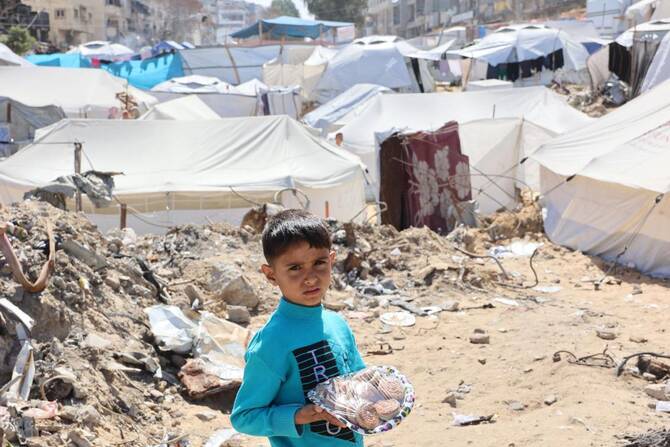
A fragile truce that had provided weeks of relative calm in the Gaza Strip collapsed on March 18 when Israel resumed its aerial bombardment and ground offensive in the Palestinian territory.
On Sunday, an Israeli air strike killed at least eight people in Gaza’s Khan Yunis area, including five children, the territory’s civil defense agency reported.

Netanyahu says military pressure on Hamas working, ‘cracks’ emerging in negotiations
https://arab.news/68wdq
Netanyahu says military pressure on Hamas working, ‘cracks’ emerging in negotiations
- Israeli Prime Minister Benjamin Netanyahu said Sunday that Israel’s intensified military pressure on Hamas in Gaza has been effective
Fledgling radio station aims to be ‘voice of the people’ in Gaza
- The electricity crisis is one of the most serious and difficult problems in the Gaza Strip, says Shereen Khalifa Broadcaster
DEIR EL-BALAH: From a small studio in the central city of Deir El-Balah, Sylvia Hassan’s voice echoes across the Gaza Strip, broadcast on one of the Palestinian territory’s first radio stations to hit the airwaves after two years of war.
Hassan, a radio host on fledgling station “Here Gaza,” delivers her broadcast from a well-lit room, as members of the technical team check levels and mix backing tracks on a sound deck. “This radio station was a dream we worked to achieve for many long months and sometimes without sleep,” Hassan said.
“It was a challenge for us, and a story of resilience.”
Hassan said the station would focus on social issues and the humanitarian situation in Gaza, which remains grave in the territory despite a US-brokered ceasefire between Israel and Hamas since October.
“The radio station’s goal is to be the voice of the people in the Gaza Strip and to express their problems and suffering, especially after the war,” said Shereen Khalifa, part of the broadcasting team.
“There are many issues that people need to voice.” Most of Gaza’s population of more than 2 million people were displaced at least once during the gruelling war.
Many still live in tents with little or no sanitation.
The war also decimated Gaza’s telecommunications and electricity infrastructure, compounding the challenges in reviving the territory’s local media landscape. “The electricity problem is one of the most serious and difficult problems in the Gaza Strip,” said Khalifa.
“We have solar power, but sometimes it doesn’t work well, so we have to rely on an external generator,” she added.
The station’s launch is funded by the EU and overseen by Filastiniyat, an organization that supports Palestinian women journalists, and the media center at the An-Najah National University in Nablus, in the occupied West Bank.
The station plans to broadcast for two hours per day from Gaza and for longer from Nablus. It is available on FM and online.
Khalifa said that stable internet access had been one of the biggest obstacles in setting up the station, but that it was now broadcasting uninterrupted audio.
The Gaza Strip, a tiny territory surrounded by Israel, Egypt, and the Mediterranean Sea, has been under Israeli blockade even before the attack on Oct. 7, 2023, which sparked the war. Despite the ceasefire, Israel continues to strictly control the entry of all goods and people to the territory.
“Under the siege, it is natural that modern equipment necessary for radio broadcasting cannot enter, so we have made the most of what is available,” she said.


