

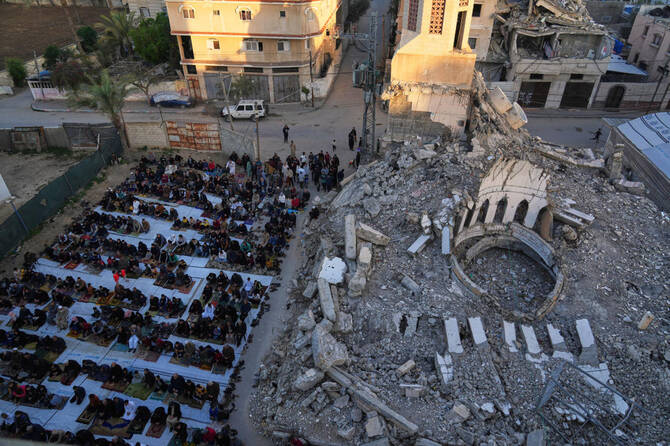

DEIR AL-BALAH, Gaza Strip: Palestinians in Gaza marked the normally festive Eid Al-Fitr on Sunday with rapidly dwindling food supplies and mourning for several children killed in Israel’s latest airstrikes.
There was anger as the bodies of 14 emergency responders were recovered in the southern city of Rafah a week after an Israeli attack, which the International Federation of Red Cross and Red Crescent Societies called the “single most deadly attack on Red Cross Red Crescent workers anywhere in the world since 2017.”
Many Palestinians prayed outside demolished mosques to mark the end of the Muslim fasting month of Ramadan. It’s supposed to be a joyous occasion when families feast and purchase new clothes for children, but most of Gaza’s 2 million people are just trying to survive.
“It’s the Eid of sadness,” Adel Al-Shaer said after attending prayers amid rubble in the central town of Deir Al-Balah. “We lost our loved ones, our children, our lives and our futures.”
Twenty members of his extended family have been killed by Israeli strikes, including four young nephews a few days ago, he said and began to cry.
Israel ended the ceasefire with Hamas and resumed the 17-month war earlier this month with a surprise bombardment that killed hundreds, after the militant group refused to accept changes to the truce reached in January. Israel has not allowed food, fuel or humanitarian aid to enter Gaza for a month.
“There is killing, displacement, hunger and a siege,” said Saed Al-Kourd, a worshipper. “We go out to perform God’s rituals in order to make the children happy, but as for the joy of Eid? There is no Eid.”
Arab mediators are trying to get the truce back on track. Hamas said Saturday it had accepted a new proposal from Egypt and Qatar. Israel said it made a counter-proposal in coordination with the United States, which has also been mediating. Details were not immediately known.
Emergency workers’ bodies found.
The Palestinian Red Crescent Society said the bodies of eight of its emergency medical technicians, and five members of Gaza’s Civil Defense, were recovered a week after they and their ambulances vanished in Rafah during heavy fire.
The PRCS said a ninth colleague was still missing, adding that the targeting of medics “cannot be seen as anything other than a war crime.”
Gaza’s Health Ministry asserted that some of the bodies had been bound and shot in the chest, and it called on the United Nations and other international organizations to investigate and hold Israel accountable.
There was no immediate comment from Israel’s military, which had said it fired on advancing “suspicious vehicles” and later discovered some were ambulances.
Netanyahu lays out conditions for ending the war
Israeli Prime Minister Benjamin Netanyahu said Israel would continue military operations while negotiating. He rejected claims that Israel does not want to end the war, while laying out conditions that go far beyond the ceasefire agreement and have been rejected by Hamas.
“Hamas will disarm. Its leaders will be allowed out. We will look out for the general security in the Gaza Strip and allow for the realization of (President Donald) Trump’s plan,” Netanyahu told a Cabinet meeting.
Trump has proposed that Gaza’s population be resettled in other countries so the US can redevelop Gaza for others. Palestinians say they do not want to leave their homeland. Human rights experts say the plan would likely violate international law.
Israeli strikes on Sunday morning killed at least 16 people, including nine children and three women, according to Nasser Hospital in the southern city of Khan Younis.
Two girls appeared to be wearing new clothes purchased for the holiday, according to an Associated Press cameraman, including spotless sneakers.
On Sunday evening, a strike hit a tent in Deir Al-Balah and killed at least two people, according to an AP journalist at the hospital.
The war began when Hamas-led militants stormed into Israel on Oct. 7, 2023, killing some 1,200 people, mostly civilians, and taking 251 hostages. Hamas is still holding 59 captives — 24 believed to be alive.
Israel’s offensive has killed over 50,000 Palestinians, according to Gaza’s Health Ministry, which does not distinguish between civilians and combatants in its tally. Israel says it has killed around 20,000 militants, without providing evidence, and blames civilian deaths on Hamas because it operates in densely populated areas.
Israel approves controversial project in West Bank
Netanyahu’s security Cabinet approved the construction of a road for Palestinians in the occupied West Bank. Critics say it will open the door for Israel to annex a key area just outside Jerusalem, further undermining the feasibility of a future Palestinian state.
Netanyahu’s office said the project is meant to streamline travel for Palestinians in communities near the large Jewish settlement of Maaleh Adumim.
Peace Now, an Israeli anti-settlement watchdog group, said the road will divert Palestinian traffic outside of Maaleh Adumim and the surrounding area known as E1, a tract of open land deemed essential for the territorial contiguity of a future state.
That will make it easier for Israel to annex E1, according to Hagit Ofran, a settlement expert with the group, because Israel can claim there is no disruption to Palestinian movement.
Critics say Israeli settlements and other land grabs make a contiguous future state increasingly impossible. Several roads in the West Bank are meant for use by either Israelis or Palestinians, which international rights groups say is part of an apartheid system, allegations Israel rejects.
Israel captured the West Bank, Gaza and east Jerusalem in the 1967 Mideast war. The Palestinians want all three for their future state. A two-state solution is widely seen as the only way to resolve the decades-old conflict.


