

World Bank approves $300 million loan to support Pakistan province’s plan to curb smog

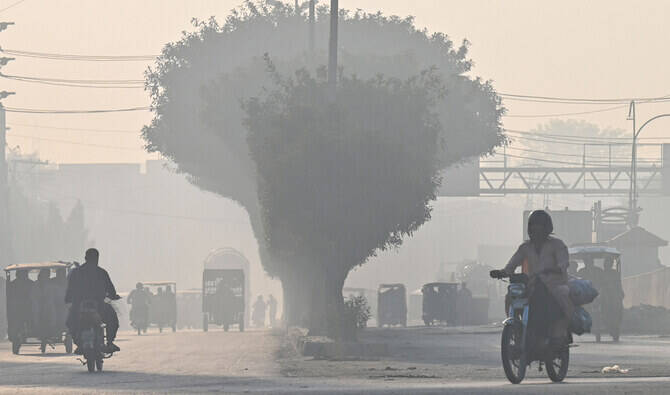
Commuters make their way amid smog in Lahore on November 1, 2024. (AFP/File)
Short Url
Updated 30 March 2025
Follow

World Bank approves $300 million loan to support Pakistan province’s plan to curb smog

  • Every year, thick smog triggered by factory and traffic emissions blankets cities in Punjab province
  • Punjab’s smog action plan aims to improve air quality in transport, agriculture, energy, other sectors

ISLAMABAD: The World Bank has approved a $300 million concessional loan to support efforts by Pakistan’s eastern Punjab province to improve air quality and battle smog, state-run media reported this week. 

Lahore, the provincial capital of Punjab, often ranks as the most polluted megacity in the world during the winter season between November and February. Experts say the pollution is primarily caused by factory and traffic emissions. It worsens in winter as farmers burn crop stubble and cooler temperatures and slow-moving winds trap the deadly pollutants.

Lahore’s 14 million residents spent six months breathing concentrations of PM2.5 — tiny particles that can penetrate the lungs and bloodstream — at levels 20 times or more than recommended by the World Health Organization last year, as per data analyzed by AFP.

“The World Bank has approved a concessional loan worth 300 million dollars under the International Development Association (IDA) to support the Punjab Clean Air Program (PCAP),” state broadcaster Radio Pakistan reported on Saturday. 

It said the initiative aims to strengthen air quality management and combat pollution across the province, adding that the PCAP will assist Punjab in implementing its Smog Mitigation Action Plan (SMAP). 

The SMAP will seek to introduce several measures to improve air quality, particularly in the transport, agriculture, industry, energy, and municipal services sectors, the state-run media said. 

As per the report, World Bank Country Director Pakistan Najy Benhassine described the program as a “landmark initiative” for improving air quality and public health. 

“He said the cleaner air will reduce respiratory and cardiovascular diseases, leading to a healthier and more livable environment,” Radio Pakistan said. 

The report added that the program will enhance air quality management infrastructure, strengthen regulatory institutions and promote public awareness about pollution control.

“Key interventions under the program include the introduction of 5,000 super seeders to curb crop residue burning, which is one of the main causes of seasonal smog, along with the deployment of 600 electric buses to encourage public transport use,” Radio Pakistan said. 

The loan will also be used to increase regulatory-grade air quality monitoring stations across Punjab, with two new fuel testing laboratories to be established to improve fuel quality standards.

The program will promote behavioral change through educational campaigns and citizen engagement, with schools and hospitals, along with other vulnerable groups, to receive targeted adviseries on air pollution health impacts and prevention measures.

This year the smog in Punjab was so thick it could be seen from space and prompted authorities to close schools serving millions of students across the province, including Lahore.

Air pollution can cause sore throats, stinging eyes and respiratory illnesses, while prolonged exposure can trigger strokes, heart disease and lung cancer

With inputs from AFP


Pakistan grants commercial license to Kuwait-backed Shariah-compliant digital bank

Updated 7 sec ago
Follow

Pakistan grants commercial license to Kuwait-backed Shariah-compliant digital bank

  • Pakistan has announced that Raqqami Islamic Digital Bank aims to launch operations this month with $100 million investment
  • Prime Minister Shehbaz Sharif calls for Kuwait and Pakistan to translate cordial political relations into strong economic ties

ISLAMABAD: Prime Minister Shehbaz Sharif granted the Kuwait Investment Authority-backed Raqqami Islamic Digital Bank (RIDB) the commercial license to operate in Pakistan on Tuesday, stressing the need to convert cordial political ties between the two countries into a strong economic relationship. 

Pakistan’s finance adviser Khurram Schehzad announced last month that RIDB intends to launch operations in the South Asian country from February with a $100 million investment. 

The RIDB describes itself as Pakistan’s first fully Shariah-compliant digital bank. The retail bank offers online financing, savings and payment services to individuals and small and medium-sized enterprises, also focusing on financial inclusion for underserved segments.

Prime Minister Sharif participated in a ceremony to grant the license to RIDB in Islamabad. The event was attended by top RIDB officials including its Chairman Abdullah Al-Mutairi and Chief Executive Officer Umair Aijaz. 

“This would go a long way in further strengthening our brotherly and our bilateral economic relations,” Sharif told participants. “You said very aptly that economic and brotherly relations go hand in hand. It cannot be that your political relations flourish but economic relations remain stagnant.”

He said the Shariah-compliant digital bank will also have features that will support and augment banking in Pakistan. 

Sharif called on both nations to join hands to promote their bilateral economic, investment and trade relations “like never before.” He vowed that Pakistan’s government was committed to enhancing bilateral trade and economic ties by working closely with the Kuwaiti government.

Pakistan’s banking sector is dominated by a handful of large lenders with strong capital buffers and profits driven largely by holdings of government securities.

Pakistan has intensified its efforts in recent years to secure foreign investment, particularly from Gulf nations, as it seeks to ensure sustained economic progress. Schehzad has said that the RIDB’s entry into Pakistan reflects strengthening investment ties between Islamabad and Kuwait, particularly in the financial and digital economy sectors.