

The science behind the powerful earthquake in Myanmar and Thailand

Short Url
Updated 30 March 2025
Follow

The science behind the powerful earthquake in Myanmar and Thailand

  • Myanmar lies on boundary between two tectonic plates, is one of world’s most seismically active countries
  • Friday’s event was “probably the biggest” to hit Myanmar’s mainland in three quarters of a century, experts said 

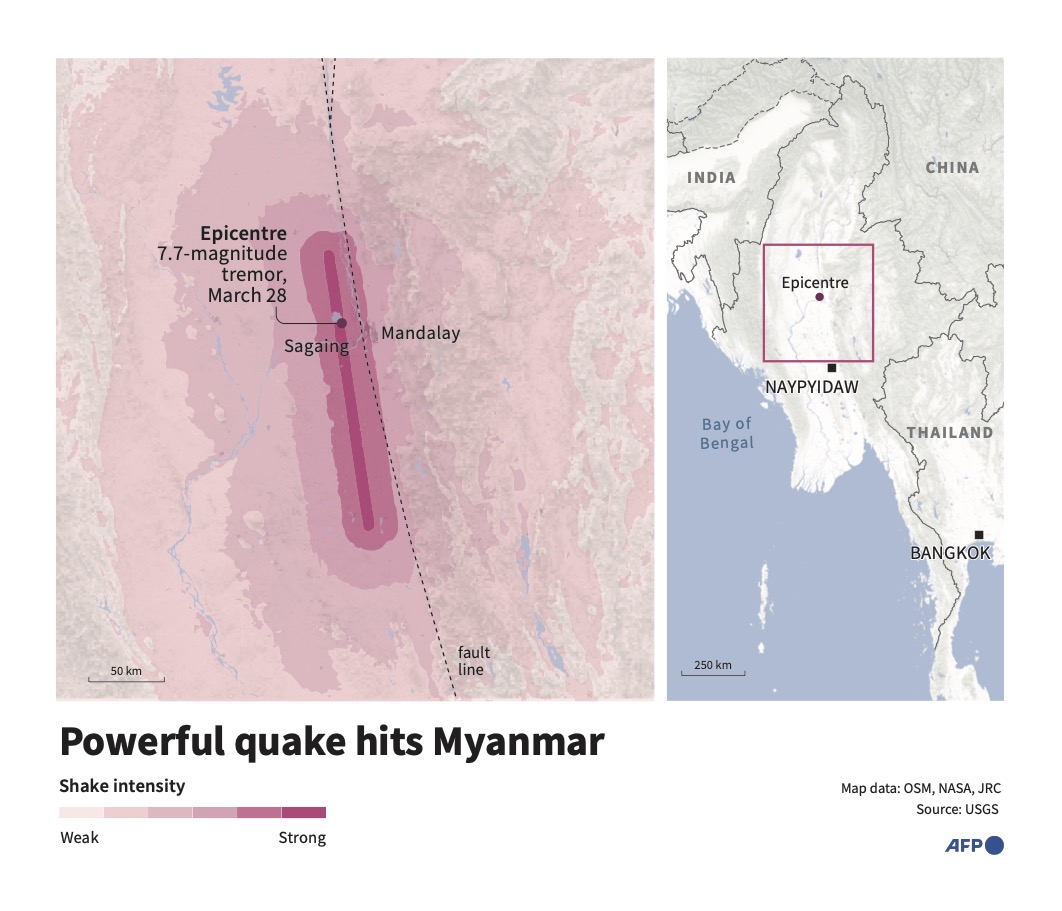
SINGAPORE: A powerful earthquake of magnitude 7.7 centered in the Sagaing region near the Myanmar city of Mandalay caused extensive damage in that country and also shook neighboring Thailand on Friday.

How vulnerable is Myanmar to earthquakes?

Myanmar lies on the boundary between two tectonic plates and is one of the world’s most seismically active countries, although large and destructive earthquakes have been relatively rare in the Sagaing region.

“The plate boundary between the India Plate and Eurasia Plate runs approximately north-south, cutting through the middle of the country,” said Joanna Faure Walker, a professor and earthquake expert at University College London.
She said the plates move past each other horizontally at different speeds. While this causes “strike slip” quakes that are normally less powerful than those seen in “subduction zones” like Sumatra, where one plate slides under another, they can still reach magnitudes of 7 to 8.
Why was Friday’s quake so damaging?
Sagaing has been hit by several quakes in recent years, with a 6.8 magnitude event causing at least 26 deaths and dozens of injuries in late 2012.
But Friday’s event was “probably the biggest” to hit Myanmar’s mainland in three quarters of a century, said Bill McGuire, another earthquake expert at UCL.
Roger Musson, honorary research fellow at the British Geological Survey, told Reuters that the shallow depth of the quake meant the damage would be more severe. The quake’s epicenter was at a depth of just 10 km (6.2 miles), according to the United States Geological Survey.
“This is very damaging because it has occurred at a shallow depth, so the shockwaves are not dissipated as they go from the focus of the earthquake up to the surface. The buildings received the full force of the shaking.”
“It’s important not to be focused on epicenters because the seismic waves don’t radiate out from the epicenter — they radiate out from the whole line of the fault,” he added.

How prepared was Myanmar?

The USGS Earthquake Hazards Program said on Friday that fatalities could be between 10,000 and 100,000 people, and the economic impact could be as high as 70 percent of Myanmar’s GDP.
Musson said such forecasts are based on data from past earthquakes and on Myanmar’s size, location and overall quake readiness.
The relative rarity of large seismic events in the Sagaing region — which is close to heavily populated Mandalay — means that infrastructure had not been built to withstand them. That means the damage could end up being far worse.
Musson said that the last major quake to hit the region was in 1956, and homes are unlikely to have been built to withstand seismic forces as powerful as those that hit on Friday.
“Most of the seismicity in Myanmar is further to the west whereas this is running down the center of the country,” he said.


India’s Parliament approves bill to open civil nuclear power sector to private firms

Updated 8 sec ago
Follow

India’s Parliament approves bill to open civil nuclear power sector to private firms

  • The government termed it a major policy shift to speed up clean energy expansion
  • The move carries global significance as India seeks to position itself as a major player in the next wave of nuclear energy

NEW DELHI: India’s Parliament approved new legislation Thursday that enables opening the tightly controlled civil nuclear power sector to private companies.
The government termed it a major policy shift to speed up clean energy expansion while the opposition political parties argued that it dilutes safety and liability safeguards.
The lower house of parliament passed the legislation Wednesday and the upper house on Thursday. It now needs the assent from the Indian president, which is a formality, to come into force.
The move carries global significance as India seeks to position itself as a major player in the next wave of nuclear energy, including with small modular reactors at a time many nations are reassessing nuclear power to meet climate targets and reduce dependence on fossil fuels.
Supporters argue the legislation marks a decisive break from decades of state dominance in nuclear energy while critics say it opens the door to risks, mainly health hazards, that could have long term consequences.
“It marks a momentous milestone for India and signals capable private sector players that the country is open for business in the nuclear energy space,” said Karthik Ganesan, director of strategic partnerships at the Council on Energy, Environment and Water, a think tank.
Junior Minister Jitendra Singh, who oversees the department of atomic energy, told lawmakers that the bill — which has been dubbed Sustainable Harnessing and Advancement of Nuclear Energy for Transforming India — seeks to modernize India’s nuclear framework in line with technological, economic and energy realities. It also retains and strengthens core safety, security and regulatory safeguards.
“India’s role in geopolitics is increasing. And if we have to be a global player effectively, we have to live up to global benchmarks, follow global parameters and adopt global strategies,” Singh said in the lower house, adding that the legislation was necessary to address the country’s growing energy needs.
India wants more nuclear power and has pledged over $2 billion in recent months toward research and allied activities. Nuclear power is a way to make electricity that doesn’t emit planet-warming gases, although it does create radioactive waste.
India is one of the world’s biggest emitters of planet-heating gases and over 75 percent of its power is still generated by burning fossil fuels, mostly coal. India wants to install 100 gigawatts of nuclear power by 2047 — enough to power nearly 60 million Indian homes a year.
Energy experts say that for the world to move away from carbon-polluting fuels like coal, oil and gas, sources like nuclear that don’t rely on the sun and the wind — which aren’t always available — are needed. But some are skeptical about India’s ambitions as the country’s nuclear sector is still very small, and negative public perceptions about the industry remain.
Opposition parties flagged concerns related to several provisions of the bill and urged the government to refer it to a parliamentary panel for examination. The government didn’t adhere to the request.
“The bill doesn’t have sufficient safeguards when it comes to mitigating the bad health of those impacted by living in areas closer to nuclear plants,” Ashok Mittal, a lawmaker from the opposition Aam Admi Party, told The Associated Press.
G. Sundarrajan, an anti-nuclear energy activist, called the bill a “disastrous law,” saying it takes away essential safeguards that are needed to make sure companies invest in safety and reduce the chances of a major disaster that can impact millions from occurring.
“It also provides little recourse for any Indian citizen to claim damages from nuclear companies even if they are affected by radiation leaks or suffer from any other health impact as a result of a nuclear plant in their region,” he said.