Russia says it reserves the right to resume striking Ukrainian energy targets if Kyiv flouts moratorium

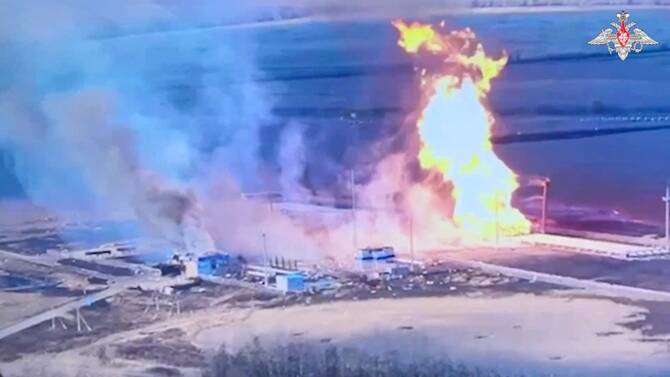
A drone view shows the destroyed Sudzha gas metering station in what Russian military officials called a Ukrainian missile strike on March 28, 2025. (Russian defense ministry via Reuters)
Short Url
Updated 28 March 2025
Follow

Russia says it reserves the right to resume striking Ukrainian energy targets if Kyiv flouts moratorium

  • The US announced separate agreements with Ukraine and Russia on Tuesday to pause their strikes against each other’s energy targets
  • Russia earlier Friday said it retook a border village from Ukraine in its Kursk region

MOSCOW: Russia reserves the right to withdraw from a US-brokered moratorium on Moscow and Kyiv striking each other’s energy infrastructure if Ukraine continues to attack such targets, the Kremlin warned on Friday.

The United States announced separate agreements with Ukraine and Russia on Tuesday to pause their strikes against each other’s energy targets — a potential stepping stone that Washington hopes will lead to a full ceasefire and peace talks to bring a definitive end to the three-year war.

But Russia and Ukraine earlier on Friday accused each other of attacking a Russian gas metering station in Russia’s western Kursk region, an important facility via which Moscow used to pump its gas to Europe by pipeline until the end of last year.

Kremlin spokesman Dmitry Peskov, who has previously said the idea that Russia would attack its own energy infrastructure is absurd, suggested Moscow’s patience with the moratorium was running out.

“Of course, the Russian side reserves the right, in the event that the Kyiv regime fails to observe this moratorium, not to observe it either,” he told reporters.

“It would be illogical for us to comply and every night face attempts to strike at our energy infrastructure facilities.”

But for now, Peskov said Russia would continue to respect the moratorium, a deal that Ukraine in turn has accused Moscow of flouting.

President Vladimir Putin has suggested that Ukraine could be placed under a form of temporary administration to allow for new elections to be held with the aim of reaching a settlement in the war, an idea Kyiv considers to be outrageous.

Peskov said that Putin had not discussed the idea with US President Donald Trump in previous phone conversations which the Kremlin had announced. Putin had floated the idea now because Russia was worried that armed nationalist forces in Ukraine were gaining strength, he said.

“No, there have been no discussions on this topic; this is the point of view of the president of the Russian Federation, which is based on irrefutable facts related to the real status quo that we now have in Ukraine,” Peskov said.

Russia earlier Friday said it retook a border village from Ukraine in its Kursk region, where Moscow has this month reclaimed much of the territory that Kyiv held on to since last summer.

Ukraine launched a ground assault into the Russian border region in August, capturing large swathes of territory including the town of Sudzha, but over the past three weeks Moscow has taken much of it back.

Russia’s defense ministry said its troops had taken control of the village of Gogolevka, which lies close to the Ukrainian border and west of the town of Sudzha, which Moscow claimed back control of earlier in March.


Nobel laureate Machado says US helped her leave Venezuela, vows return

Updated 6 sec ago
Follow

Nobel laureate Machado says US helped her leave Venezuela, vows return

  • Machado emerged on a hotel balcony in Oslo to cheering supporters early Thursday
  • “We did get support from the United States government to get here,” Machado said

OSLO: Nobel Peace laureate Maria Corina Machado said on Thursday that the United States helped her get to Norway from hiding in Venezuela, expressing support for US military action against her country and vowing to return home.
Machado, who vanished in January after challenging the rule of President Nicolas Maduro, emerged on a hotel balcony in Oslo to cheering supporters early Thursday after several days of confusion over her whereabouts.
“We did get support from the United States government to get here,” Machado told a press conference when asked by AFP about whether Washington had helped.
The Wall Street Journal reported that she wore a wig and a disguise on the high-risk journey, leaving her hide-out in a Caracas suburb on Monday for a coastal fishing village, where she took a fishing skiff across the Caribbean Sea to Curacao.
The newspaper said the US military was informed to avoid the boat being targeted by airstrikes. Once on the island, she took a private jet to Oslo early on Wednesday.
Machado thanked those who “risked their lives” to get her to Norway but it was not immediately clear how or when she will return to Venezuela, which has said it would consider her a fugitive if she left.
“Of course, the risk of going back, perhaps it’s higher, but it’s always worthwhile. And I’ll be back in Venezuela, I have no doubt,” she added.
Machado has been hailed for her fight for democracy but also criticized for aligning herself with US President Donald Trump, to whom she has dedicated her Nobel, and for inviting foreign intervention in her country.

- Military build-up -

The United States has launched a military build-up in the Caribbean in recent weeks and deadly strikes on what Washington says are drug-smuggling boats.
“I believe every country has the right to defend themselves,” Machado told reporters Thursday.
“I believe that President Trump’s actions have been decisive to reach the point where we are right now, in which the regime is weaker than ever, because the regime previously thought that they could do anything,” she continued.
Late Wednesday, Trump said the United States had seized a “very large” oil tanker near Venezuela, which Caracas denounced as “blatant theft.”
Maduro maintains that US operations are aimed at toppling his government and seizing Venezuela’s oil reserves.
Machado first appeared on a balcony of the Grand Hotel in the middle of the night, waving and blowing kisses to supporters chanting “libertad” (“freedom“) below.
On the ground, she climbed over metal barriers to get closer to her supporters, many of whom hugged her and presented her with rosaries.
She said she has missed much of her children’s lives while hiding, including graduations and weddings.

- ‘ Political risk’ -

Machado won the Peace Prize for “her struggle to achieve a just and peaceful transition from dictatorship to democracy.”
She has accused Maduro of stealing Venezuela’s July 2024 election, from which she was banned — a claim backed by much of the international community.
She last appeared in public on January 9 in Caracas, where she protested Maduro’s inauguration for his third term.
The decision to leave Venezuela and join the Nobel festivities in Oslo comes at both personal and political risk.
“She risks being arrested if she returns even if the authorities have shown more restraint with her than with many others, because arresting her would have a very strong symbolic value,” said Benedicte Bull, a professor specializing in Latin America at the University of Oslo.
While Machado is the ” undisputed” leader of the opposition, “if she were to stay away in exile for a long time, I think that would change and she would gradually lose political influence,” Bull said.
In her acceptance speech read by one of her daughters Wednesday, Machado denounced kidnappings and torture under Maduro’s tenure, calling them “crimes against humanity” and “state terrorism, deployed to bury the will of the people.”