

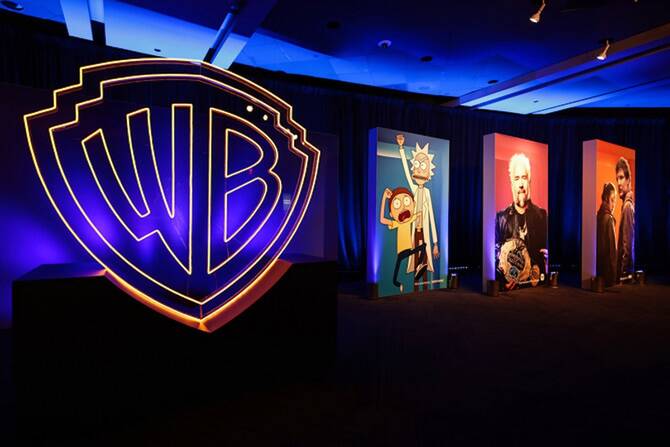
Warner Bros. Discovery investment in OSN Streaming signals broader industry shift, says CEO

Deal is reportedly valued at $57 million for a third of OSN Streaming; will take place in phases and is subject to customary conditions, including regulatory approvals. (File)
Short Url
Updated 28 March 2025
Follow

Warner Bros. Discovery investment in OSN Streaming signals broader industry shift, says CEO

  • Middle East ‘no longer a peripheral market’ — Joe Kawkabani

DUBAI: Warner Bros. Discovery this week announced a minority investment in OSN Streaming in a move that “reinforces its commitment to the region’s rapidly growing streaming landscape.”

The deal is reportedly valued at $57 million for a third of OSN Streaming. It will take place in phases and is subject to customary conditions, including regulatory approvals.

Joe Kawkabani, OSN’s group CEO, said the deal “signals a broader shift in the industry” as global players recognize “that substantial growth in the Middle East and North Africa region requires more than just exporting content.”

He told Arab News: “It’s about investing in local platforms, collaborating with regional talent, and tailoring content specifically to the market. That’s precisely what we’re doing here, and I believe it sets a new standard for successful partnerships in the region.”

Warner Bros. Discovery opened its first office in the region in Dubai in 2012. The investment reflects its “prioritization of working with the best creative talent, advancing technologies and forging key partnerships to fuel continued growth.”

It also serves as an opportunity for the company to “deepen their regional presence through a trusted platform that truly understands the market's nuances,” Kawkabani said.

The two companies have had a long-standing history, with OSN being the exclusive home for HBO content in the region. Just last year, OSN acquired the rights to all first-run Max Originals and the full Warner Bros. Pictures feature film library as part of a multi-year deal.

Jamie Cooke, executive vice president and managing director for Central Europe, Turkey and Middle East, at Warner Bros. Discovery said this was a “natural step” for the company, as “OSN has been a great partner and custodian of our content.”

He added: “We recognize that alongside enjoying the latest global hits, regional audiences also want stories from and about the region that reflect their own cultures and experiences.”

Kawkabani highlighted the importance of the MENA market on the global map.

He said: “It is no longer a peripheral market — it’s becoming central to the future of streaming. Our role is to drive this transformation from within the region, not just import it from the outside.”

Saudi Arabia has emerged as a key player in the region’s media and entertainment industry. In 2018, the Kingdom announced it would invest $64 billion in its entertainment sector over the coming decade. Since then, it has implemented several initiatives and investments to bolster these sectors.

Most recently, in January, Saudi Arabia’s General Entertainment Authority unveiled 29 investment opportunities aimed at expanding the entertainment landscape while fostering private sector participation and aligning with Vision 2030 objectives.

Saudi Arabia is “one of the most exciting and dynamic entertainment markets in the world right now” and the deal “aligns seamlessly with Saudi Arabia’s broader vision for its entertainment sector — one that prioritizes creativity, local talent, and global collaboration,” said Kawkabani.

“We view Saudi Arabia not just as a key market but as a creative hub that can lead the region forward,” he added.

Going forward, the deal will see the two companies invest in “high-quality, locally produced content, ensuring a richer and more diverse offering for viewers,” according to Cooke.

For OSN, Kawkabani said it wasn’t just about content licensing or capital, but rather about “two companies aligning on a vision to sustainably grow the regional streaming market in a way that resonates locally.”

He added: “We’re not here to follow trends; we’re here to shape them.”


To infinity and beyond: Grendizer’s 50 years of inspiring Arabs

Updated 27 December 2025
Follow

To infinity and beyond: Grendizer’s 50 years of inspiring Arabs

  • ⁠ ⁠50 years after its creation, the Grendizer anime series continues to capture Arab imagination
  • ⁠ ⁠⁠Arab News Japan speaks to creator Go Nagai, Middle Eastern fans and retells the story behind the UFO Robot tasked with protecting our planet

LONDON: Few cultural imports have crossed borders as unexpectedly, or as powerfully, as Grendizer, the Japanese giant robot that half a century ago became a childhood hero across the Arab world, nowhere more so than in Saudi Arabia.

Created in Japan in the mid-1970s by manga artist Go Nagai, Grendizer was part of the “mecha” tradition of giant robots. The genre was shaped by Japan’s experience during the Second World War, and explored themes of invasion, resistance and loss through the medium of science fiction.

But while the series enjoyed moderate success in Japan, its true legacy was established thousands of kilometers away in the Middle East.

By the early 1980s, “Grendizer” had spread across the Middle East, inspiring fandoms in Saudi Arabia, Kuwait, Iraq and beyond. (Supplied)

The anime “UFO Robot Grendizer” arrived on television in the region in 1979, dubbed into Arabic and initially broadcast in Lebanon during the Lebanese civil war. The story it told of the heroic Duke Fleed, a displaced prince whose planet had been destroyed by alien invaders, struck a chord with children growing up amid regional conflict and occupation by Israel.

Its themes of defending one’s homeland, standing up to aggression and protecting the innocent were painfully relevant in the region, transforming the series from mere entertainment into a kind of emotional refuge.

Much of the show’s impact came from its successful Arabization. The powerful Arabic dubbing and emotionally charged voice-acting, especially by Lebanese actor Jihad El-Atrash as Duke Fleed, lent the show a moral gravity unmatched by other cartoons of the era.

While the series enjoyed moderate success in Japan, its true legacy was established thousands of kilometers away in the Middle East. (Supplied)

The theme song for the series, performed by Sami Clark, became an anthem that the Lebanese singer continued to perform at concerts and festivals right up until his death in 2022.

By the early 1980s, “Grendizer” had spread across the Middle East, inspiring fandoms in Saudi Arabia, Kuwait, Iraq and beyond. For many, it was not only their first exposure to anime, it also delivered lessons on values such as justice and honor.

Grendizer was so influential in the region that it became the subject of scholarly research, which in addition to recognizing the ways in which the plight of the show’s characters resonated with the audience in the Middle East, also linked the show’s popularity to generational memories of displacement, particularly the Palestinian Nakba.

By the early 1980s, “Grendizer” had spread across the Middle East, inspiring fandoms in Saudi Arabia, Kuwait, Iraq and beyond. (Supplied)

Half a century later, “Grendizer” remains culturally alive and relevant in the region. In Saudi Arabia, which embraced the original version of the show wholeheartedly, Manga Productions is now introducing a new generation of fans to a modernized version of the character, through a video game, The Feast of The Wolves, which is available in Arabic and eight other languages on platforms including PlayStation, Xbox and Nintendo Switch, and a new Arabic-language anime series, “Grendizer U,” which was broadcast last year.

Fifty years after the debut of the show, “Grendizer” is back — although to a generation of fans of the original series, their shelves still full of merchandise and memorabilia, it never really went away.


Grendizer at 50
The anime that conquered Arab hearts and minds
Enter
keywords