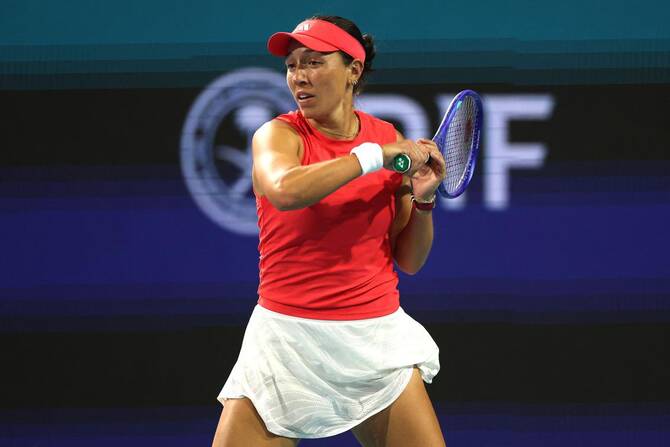
Jessica Pegula ends Alexandra Eala’s fairytale run, sets up final with Aryna Sabalenka

Fourth-seeded American Pegula emerged with a 7-6 (7/3), 5-7, 6-3 win against Alexandra Eala to seal a place in Saturday’s final against world number one Aryna Sabalenka. (Getty Images via AFP)
Short Url
Updated 28 March 2025
Follow

Jessica Pegula ends Alexandra Eala’s fairytale run, sets up final with Aryna Sabalenka

  • The 19-year-old Eala, ranked 140th in the world, had only two WTA main draw victories to her name before arriving in Miami
  • Filipina phenom proceeded to beat three Grand Slam winners in Jelena Ostapenko, Madison Keys and world number two Iga Swiatek

MIAMI GARDENS, United States: Philippines sensation Alexandra Eala’s remarkable run at the Miami Open came to a brave end with a three-set loss to Jessica Pegula in the semifinals on Thursday.
In an enthralling battle over 2hrs 24mins, fourth-seeded American Pegula emerged with a 7-6 (7/3), 5-7, 6-3 win to seal a place in Saturday’s final against world number one Aryna Sabalenka.
Sabalenka blasted her way into the final with a 6-2, 6-2 demolition of Italy’s Jasmine Paolini.
The 19-year-old Eala, ranked 140th in the world, had only two WTA main draw victories to her name before arriving in Miami.
She proceeded to beat three Grand Slam winners in Jelena Ostapenko, Madison Keys and world number two Iga Swiatek.
The lowest-ranked semifinalist in the tournament’s history, Eala seriously threatened to go one step further with another accomplished and effervescent display.
The tide looked to have turned against her when Pegula broke to go 3-1 up in the second set, but Eala broke back and her fist pump and look of determination was a sign of things to come.
Eala broke Pegula three times in the set and was broken twice herself but crucially was able to hold when serving for the set at 6-5.
Both players protected their serve better in the deciding set but Eala’s forehand let her down when the American broke to go 5-3 up and she served out for a victory that brought her visible relief.
“Of course there is disappointment right after the match,” said Eala.
“But there are just so many times in tennis where you have to dig through the dirt to look for the positive and I’m just enjoying because there is so much positive around me and I don’t know how many times that happens,” she added.
Playing with a strapped thigh from the outset, Eala turned her ankle mid-way through the second set but said she had not been impacted by the injury.
“I literally gave everything I had, I’m half tape, I’m like a mummy. I did everything and I have no regrets,” she said.
“To have a week like this, the stars need to align and they did this week, and hopefully I can keep that up — that is my goal now, to keep this up,” she added.
Pegula said it had been difficult to play an opponent like Eala.
“I let her back in the match at 3-1 up (second set) and she just started ripping her balls, going for her shots and you just have to weather the storm with people like that. She competes really well,” said the American.
Sabalenka needed just 71 minutes to wrap up her win against the sixth seed Paolini.
The Belarusian, beaten in the Indian Wells final earlier this month by Mirra Andreeva, will appear in the Miami final for the first time in her career.
“I’m super happy with the level I played today. Of course super happy to be in my first Miami Open final,” said Sabalenka.
Sabalenka was never behind against Paolini. She served six aces and broke the Italian’s serve four times.
“I definitely would say that this was one of the best matches in the season so far. I don’t know. I was just so focused on myself, on the things I had to do today,” she said.
“It felt like everything was just going smoothly my way.”
Sabalenka will be keen to banish the memory of defeat in the Indian Wells final and in the Australian Open final, where she lost to Keys.
“The lessons (of those defeats) was I believe focus on myself, not on what’s going on the other side,” she said.
“I think in those finals I was more focusing on my opponents than on myself. I think I just have to bring the same attitude, the same mindset that I had today, I think I have to bring it in the finals,” she said.
“I really feel this time I’m going to do better than I did in the last two finals,” added the 26-year-old.
She is only the sixth woman to reach the finals of both stops on the American ‘Sunshine Swing’ in the same season.


The Hundred player auction changes lives

Updated 9 sec ago
Follow

The Hundred player auction changes lives

  • The auction, which replaced the previous draft system, was justified on the basis of needing to attract the best male and female players in the world

The realities of the England and Wales Cricket Board’s decision to sell equity stakes in The Hundred competition became more evident in London on March 11 and 12.

In keeping with other franchise leagues, a player auction replaced the previous draft system of acquiring players. It was justified on the basis of needing to attract the best male and female players in the world and maintaining a competitive balance between the squads. No doubt the change is also a result of external investors, mainly Indians, pushing to bring in a system similar to that deployed in the Indian Premier League.

Almost 1,000 men and women players submitted their entries for the auction by the closing date of Feb. 16, 2026. Their submission had to state a base price, effectively a self-valuation. This carried a risk of going unsold if set too high or being stuck on a low salary for the duration of the contract, if set too low.

Two weeks prior to player registration, each of the eight franchises had submitted a shortlist of between 75 and 100 players in whom they were most interested. Cross analysis of these two lists resulted in a shortened list, ironically called a longlist, of 175 women and 247 men, to go under the gavel. This was wielded by Richard Madley, who was the auctioneer at the IPL between 2008 and 2018 and at the ILT20 auction in October 2025, when he was interviewed by Arab News.

At auction, each of the franchises must select a minimum of 14 players and a maximum of 16. In a pre-auction phase between November 2025 and January 2026, each franchise was allowed up to four advance signings. One retention from their 2025 squad was mandatory, accompanied by a maximum of three direct signings, overseas or England centrally contracted players. A total of 60 players were locked in, unsurprisingly including top performers, such as England’s white ball captain Harry Brook and Australia’s legendary Elyse Perry. All eight of the men’s franchises locked in four players, while four of the women’s franchises did so, the other four locking in three.

At the auction, players were divided into three groups, which were auctioned in sequence. The top 50 most nominated players by the franchises formed a “Hero” group, which was subdivided by role: batter, bowler, all-rounder. These players were the first to be offered. In the next phase, each franchise nominated a further 25 players. They were anyone from the auction longlist, plus players who missed out in the first stage. The final phase was Ranked Players. Teams nominated an unsold player one by one. The nomination order was determined by a random draw. If any other franchise wished to acquire the player, bidding was opened.

As if this were not complicated enough, the 50 “Hero” players were divided into 10 sets. The first two sets were designated as marquee players, five domestic and five international. After that, came five Tier 1 sets, sequentially including batters, fast bowlers, all-rounders, spin bowlers and wicketkeepers. These were followed by five Tier 2 sets, using the same player type groupings. Each franchise was allowed to pick a maximum of four overseas players, both in their squad and the playing XI. Given that every franchise had already signed two men’s and two women’s overseas players in the pre-auction, bidding in this early stage was expected to be strategic.

The valuation of these players was made according to a “tiered cumulative cap model” as used in the IPL. This recommended a pre-auction deduction per men’s franchise of $465,000 for one player, $863,000 for two players, $1.128 million for three players and $1.26 million for four players. In the women’s competition, the tiers of deduction were $172,000, $318,000, $411,000 and $478,000.

The size of the overall salary pot per franchise in 2026 is $2.72 million for men, a rise of 45 percent from 2025, and $1.19 million for women, an increase of 100 percent from 2025. Since all of the men’s franchises used $1.26 million of their purse, each was left with $1.46 million to be spent at auction. The eight women’s franchises had spent either $411,000 or $478,000 of their purse, depending on whether they pre-signed three or four players, leaving them with either $757,000 or $690,000 to spend at auction. 

In the “Hero” stage of the women’s auction, the first player to be subject to a £100,000 ($133,000) bid was the England all-rounder Danielle Gibson, who previously played for the London Spirit. She was subject to a fierce bidding war, which was won by Sunrisers Leeds for a record $132,000. This figure was soon beaten when New Zealand’s Sophie Devine was bought by the Welsh Fire for $279,000, which was also the price paid for Australia’s wicketkeeper-batter, Beth Mooney. She had played for the Manchester Originals, now the Manchester Super Giants, in 2024 and 2025. They clearly wanted to keep her but lost in a bidding war to the Trent Rockets. She will earn significantly more with them than she did in Australia’s Big Bash. 

It was instructive to observe the differing strategies adopted by the franchises to build their squads. The Trent Rockets and Sunrisers Leeds, who spent big in the beginning, seemed to go quiet and were the two that were left with the largest number of players to acquire in the final stage of the auction. Meanwhile, the other franchises were active in constructing their bowling attacks. Tier 1 spinners were in demand. Birmingham Phoenix spent $132,000 to acquire England leftarm spinner Linsey Smith, who had played for the Northern Superchargers since 2021. She will be joined by Australia’s leg-spinner Alana King. One of England’s most promising young spinners, Tilly Corteen-Coleman, will return to Southern Brave, who outbid MI London in paying $140,000. Her fee is a clear example of how the auction system and the new investment are benefiting women’s cricket. In 2025, the top salary was capped at $100,000.

Going into the final stage, franchises were asked to nominate a player who was previously unsold. Neither Manchester Super Giants nor London Spirit could participate because they had picked the minimum of 14 players and did not have enough funds. The same fate befell other franchises as the stage progressed, until only the Rockets and Leeds Sunrisers remained to close their squads and the auction. Each franchise has a residual purse left, ranging from $6,000 to $35,175. This is earmarked for a wildcard draft, which is used to select players who perform well in the domestic T20 Vitality Blast, played in June and July.

The men’s auction had a flying, even frantic start. Joe Root was the first name out of the hat. He generated rapid bidding, starting with the Manchester Super Giants, then the Southern Brave, followed by the Sunrisers, before the Welsh Fire bought him for $319,000. Root was followed by Adil Rashid, who was hunted by Southern Brave, challenged by Trent Rockets and the Sunrisers, but Southern Brave won out at $332,000. Even fiercer bidding burst out over Jordan Cox, who was initially chased by Trent Rockets and Birmingham Phoenix, joined by MI London and the Sunrisers, before they were outbid by the Welsh Fire for $398,000. Then came James Vince, a seasoned franchise player, associated throughout his career with the Southern Brave and Hampshire, for whom bidding was slow to start. Eventually, he was bought by MI London, who held off London Spirit and the Super Giants for $252,000. Jonny Bairstow was sought by four teams but taken by London Spirit for $212,000.

Attention shifted to the marquee internationals. New Zealand’s Daryl Mitchell was unsold, as was Pakistan’s Haris Rauf. South Africa’s David Miller attracted bids from Trent Rockets and the Sunrisers, but both were pipped by Southern Brave for $146,000. Aiden Markram, of South Africa, was chased by Manchester Super Giants and Trent Rockets, who, together, forced the bidding up to $265,000, sufficient to secure his place with the Super Giants, for whom he also plays in the SA20 and IPL.

At the end of the marquee player auction, the Welsh Fire had spent over half of its purse, whereas the Trent Rockets, Birmingham Phoenix and Sunrisers Leeds had not managed to spend any, despite displaying high levels of activity. As was observed in the women’s auction, evidence of differing strategies adopted by each franchise began to emerge. There had been rumors that Indian-owned franchises would not be willing to acquire Pakistani players. This had caused the ECB to write formally to all franchises, reminding them of their responsibilities and warning them that action would be taken if there was any evidence of discrimination.

Therefore, eyebrows may have been raised when the first two Pakistani players on offer went unsold. The third one, Usman Tariq, the man with an unusual, but legal, bowling action, did receive bids from the Trent Rockets and the Birmingham Phoenix, both of which have a mix of local and American ownership. It was the Phoenix who won out with a bid of $185,000. In the Tier 2 bidding, several fierce contests occurred. One led to the highest price paid in the auction — £390,000 for the young, uncapped, England all-rounder, James Coles. Another battle erupted over Sam Billings, a proven leader and winner on the franchise circuit, including The Hundred in 2025 with Oval Invincibles. In 2026, Trent Rockets acquired him for $239,000.

In the final nomination stage, franchises jostled to complete their squads, looking to acquire players at close to their base price. The most expensive of these was Mustafizur Rahman of Bangladesh, acquired by Birmingham Phoenix. Oval-based MI London displayed some late loyalty to Surrey players, including the last pick of the auction, Jason Roy.

There can be little doubt that the auction represents a landmark event for cricket in England and Wales. Squads that were carefully assembled in previous years have been reconstructed, old allegiances broken. It has also been life-changing for certain players, especially women. In 23 days, some of them will earn in excess of their annual domestic salary. Truly, the times have been changed by the first auction in any professional sporting competition in the UK.