JARAMANA: Rana Al-Ahmad opens her fridge after breaking fast at sundown with her husband and four children during the Islamic holy month of Ramadan.
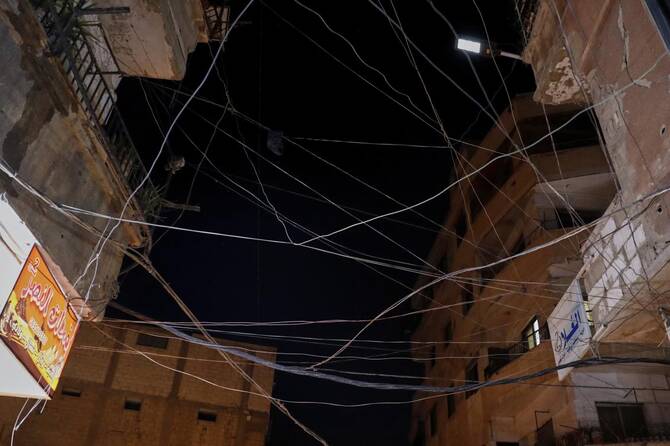
Apart from eggs, potatoes and some bread, it’s empty because state electricity in Syria only comes two hours a day.
“We can’t leave our food in the fridge because it will spoil,” she said.
Her husband, a taxi driver in Damascus, is struggling to make ends meet, so the family can’t afford to install a solar panel in their two-room apartment in Jaramana on the outskirts of the capital.
Months after a lightning insurgency ended over half a century of the Assad dynasty’s rule in Syria, the Islamist interim government has been struggling to fix battered infrastructure after a 14-year conflict decimated much of the country. Severe electricity shortages continue to plague the war-torn country.
The United Nations estimates that 90 percent of Syrians live in poverty and the Syrian government has only been able to provide about two hours of electricity every day. Millions of Syrians, like Al-Ahmad and her family, can’t afford to pay hefty fees for private generator services or install solar panels.
Syria’s new authorities under interim leader Ahmad Al-Sharaa have tried to ease the country’s electricity crisis, but have been unable to stop the outages with patchwork solutions.
Even with a recent gas deal with Qatar and an agreement with Kurdish-led authorities that will give them access to Syria’s oil fields, the country spends most of its days with virtually no power. Reports of oil shipments coming from Russia, a key military and political ally of Assad, shows the desperation.
Pitch black
At Al-Ahmad’s home, she and her husband were only able to get a small battery that could power some lights.
“The battery we have is small and its charge runs out quickly,” said Al-Ahmad, 37. It’s just enough that her children can huddle in the living room to finish their homework after school.
And the family is not alone. Everywhere in Syria, from Damascus to Daraa in the south, neighborhoods turn pitch black once the sun sets, lit only from street lamps, mosque minarets and car headlights.
The downfall of Assad in December brought rare hope to Syrians. But the new interim authorities have scrambled to establish control across the country and convince Western nations to lift economic sanctions to make its economy viable again.
The United States in January eased some restrictions for six months, authorizing some energy-related transactions. But it doesn’t appear to have made a significant difference on the ground just yet.
Battered and bruised fields
Washington and other Western governments face a delicate balance with Syria’s new authorities, and appear to be keen on lifting restrictions only if the war-torn country’s political transition is democratic and inclusive of Syrian civil society, women and non-Sunni Muslim communities.
Some minority groups have been concerned about the new authorities, especially incidents of revenge attacks targeting the Alawite community during a counter-offensive against an insurgency of Assad loyalists.
Fixing Syria’s damaged power plants and oil fields takes time, so Damascus is racing to get as much fuel as it can to produce more energy.
Damascus is now looking toward the northeastern provinces, where its oil fields under Kurdish-led authorities are to boost its capacity, especially after reaching a landmark ceasefire deal with them.
Political economist Karam Shaar said 85 percent of the country’s oil production is based in those areas, and Syria once exported crude oil in exchange for refined oil to boost local production, though the fields are battered and bruised from years of conflict.
These crucial oil fields fell into the hands of the extremist Daesh group, which carved out a so-called caliphate across large swaths of Syria and Iraq from 2014 to 2017.
“It’s during that period where much of the damage to the (oil) sector happened,” said Shaar, highlighting intense airstrikes and fighting against the group by a US-led international coalition.
After IS fell, the US-backed Kurdish-led Syrian Democratic Forces took control of key fields, leaving them away from the central government in Damascus. The new authorities hope to resolve this in a landmark deal with the SDF signed earlier this month.
Kamran Omar, who oversees oil production in the Rmeilan oil fields in the northeastern city of Hassakeh, says shortages in equipment and supplies and clashes that persisted with Turkiye and Turkish-backed forces have slowed down production, but told the AP that some of that production will eventually go to households and factories in other parts of Syria.
The fields only produce a fraction of what they once did. The Rmeilan field sends just 15,000 of the approximately 100,000 barrels they produce to other parts of Syria to ease some of the burden on the state.
The authorities in Damascus also hope that a recent deal with Qatar that would supply them with gas through Jordan to a major plant south of the capital will be the first of more agreements.
The cornerstone of recovery
Syria’s authorities have not acknowledged reports of Russia sending oil shipments to the country. Moscow once aided Assad in the conflict against armed Islamist group Hayat Tahrir Al-Sham that toppled the former president, but this shows that they are willing to stock up on fuel from whoever is offering.
Interim Electricity Minister Omar Shaqrouq admitted in a news conference that bringing back electricity to Syrian homes 24 hours a day is not on the horizon.
“It will soon be four hours, but maybe some more in the coming days.”
Increasing that supply will be critical for the battered country, which hopes to ease the economic woes of millions and bring about calm and stability. Shaar, who has visited and met with Syria’s new authorities, says that the focus on trying to bring fuel in the absence of funding for major infrastructural overhauls is the best Damascus can do given how critical the situation is.
“Electricity is the cornerstone of economic recovery,” said Shaar. “Without electricity you can’t have a productive sector, (or any) meaningful industries.”


![]()

Syrians left in the dark as the interim government struggles to restore electricity
Short Url
https://arab.news/2j8cp
Syrians left in the dark as the interim government struggles to restore electricity
- Months after a lightning insurgency ended over half a century of the Assad dynasty’s rule in Syria, the country’s new interim government has been struggling to fix battered infrastructure


Latest updates



© 2026 SAUDI RESEARCH & PUBLISHING COMPANY, All Rights Reserved And subject to Terms of Use Agreement.