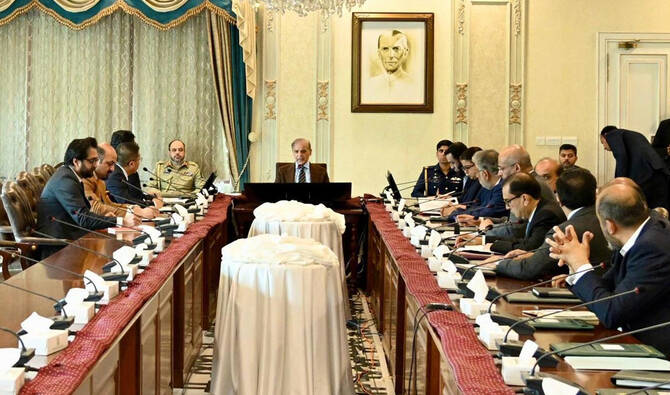
PM Sharif says Huawei’s program to train 300,000 Pakistanis will boost exports, generate jobs

Prime Minister Shehbaz Sharif (center) meets a delegation of the Chinese multinational technology company Huawei in Islamabad, Pakistan, on March 27, 2025. (PID)
Short Url
Updated 28 March 2025
Follow

PM Sharif says Huawei’s program to train 300,000 Pakistanis will boost exports, generate jobs

  • Pakistan, Huawei last year signed agreement to train 300,000 Pakistanis in information and communication technologies
  • Program, scheduled to conclude by the end of 2025, will see 60,000 Pakistanis receive high-tech training, says state media

ISLAMABAD: Prime Minister Shehbaz Sharif this week said Chinese multinational technology company Huawei’s program to train 300,000 Pakistanis will generate employment in the country and boost its exports, state-run media reported. 

Pakistan and Huawei last year signed an agreement to train 300,000 Pakistani youths in information and communication technology (ICT) skills to match international standards. Huawei is providing training to Pakistani youth in artificial intelligence (AI), cybersecurity, cloud computing and other advanced technologies under the initiative.

The Pakistani prime minister met a five-member delegation of the company, headed by its Chief Executive Officer Ethen Sun on Thursday, state broadcaster Radio Pakistan reported. 

“Shehbaz Sharif said the government seeks a solid and long-term partnership with Huawei,” it said. “He highlighted that Huawei’s ICT training program will not only boost IT exports but will also help create employment opportunities for youth.”

Sharif’s office said earlier this month that Huawei has trained over 20,000 Pakistanis under the program. He was briefed by the delegation that 240,000 youths will receive basic training while 60,000 will undergo high-tech training under the initiative.

“The training is expected to be completed by the end of this year,” Radio Pakistan said. 

The state media said Huawei has additionally, in collaboration with the Higher Education Commission, introduced courses in AI, cloud computing, big data and cybersecurity in 15 Pakistani universities.

Pakistan views ICT as a driver of economic change and seeks to transform the sector into a cornerstone of its strategy for financial stability, courting foreign investment from countries like China and the Gulf states.

In its bid to generate more jobs countrywide, Sharif launched the Digital Youth Hub portal in Islamabad on Thursday. 

The initiative will connect young people to jobs, educational opportunities and enhance skills development in the country. 

Sharif’s government has repeatedly spoken of putting Pakistan on the track to economic recovery by increasing its exports. In its economic transformation plan issued this year, the government says it hopes to achieve $60 billion in exports in the next five years. 


Pakistani companies likely to raise over $89 million in new stock listings this year

Updated 5 sec ago
Follow

Pakistani companies likely to raise over $89 million in new stock listings this year

  • Farrukh H. Sabzwari says approvals for two listings already granted while 10 more Initial Public Offerings are expected over next 12 months
  • Economists expect KSE-100 index to reach 208,000 points by Dec., reflecting pent-up demand, strategic expansions and broader investor appetite

KARACHI: The Pakistan Stock Exchange (PSX) expects at least a dozen new listings this year, the PSX chief executive officer said on Monday, with the new entrants likely to raise as much as Rs25 billion ($89.3 million) in funding through the equity market.

Pakistan’s benchmark KSE-100 index has rallied to new highs and recorded returns of around 50 percent in Calendar Year (CY) 2025. The market closed at 182,384 points on Monday.

Around 135,000 new investors have also joined the PSX over the last 18 months, according to Pakistani state media.

“Continuing with the momentum, in CY2026, approvals for two Main Board listings have been granted,” PSX CEO Farrukh H. Sabzwari, who has previously served as a local partner of BoA Merrill Lynch and country head of CLSA Emerging Markets in Pakistan, told Arab News.

“PSX is expecting 10 more IPOs (Initial Public Offerings) over next 12 months across various sectors.”

Pakistan’s growing stocks mirror the country’s stabilizing economy which Prime Minister Shehbaz Sharif’s government expects would expand 3.9 percent this fiscal year through June with the help of the International Monetary Fund’s reforms-oriented $7 billion loan program.

The new IPOs would cover food, pharmaceutical, real estate investment trust (REIT), engineering, technology, oil and gas marketing, insurance, auto parts, manufacturing and energy sectors of the economy, according to Sabzwari.

Last year, the PSX listed Zarea Limited, Barkat Frisian Agro Limited, Image REIT, Pak Qatar Family Takaful, Blue-Ex Limited, Nets International Communication Limited and the Pakistan Credit Rating Agency Limited. These listings helped companies raise Rs4.3 billion ($15.4 million) of funding.

In addition, the PSX debt market witnessed seven issuances, valuing Rs10.5 billion ($37.5 million). Pakistan’s finance ministry raises funds through PSX by selling borrowing instruments like Islamic sukuk.

The PSX recorded the highest eight IPOs in a single year in 2021, according to Shankar Talreja, head of research at Topline Securities Ltd. It would be a record if the market lists 12 new entrants this year.

Sana Tawfiq, an economist at Karachi-based brokerage research firm AHL, described the market performance last year as “exceptional.”

“With projected fundraising of up to Rs25 billion ($89.3 million), the upcoming pipeline reflects pent-up demand, strategic expansions, and a broader investor appetite,” she said.

Tawfiq expects the KSE-100 index to reach 208,000 points by Dec. this year.

“As we look toward 2026, Pakistan’s equity market is entering a phase defined by stability, depth, and sustainable growth,” the economist said.

“The market is now transitioning toward a more measured trajectory.”

Key drivers in 2026 would likely include sustained domestic liquidity in equities, strengthening foreign reserves and a contained current account deficit, successful completion of the Pakistan International Airlines (PIA) privatization alongside accelerating progress on privatization and restructuring of power distribution companies (DISCOs), continued efforts to resolve circular debt in both power and gas sectors, and supportive global commodity prices, according to Tawfiq.

In a recent note to its clients, Topline Securities said the current IPO momentum was driven by macroeconomic stability under the IMF program, improving investor confidence and a declining interest rate environment.

Pakistan’s central bank last month cut its interest rate by 50 basis points to 10.5 percent in a surprising move aimed at boosting economic growth in the inflation-hit country.

“Despite ongoing geopolitical and macroeconomic uncertainties, investor sentiment continues to improve,” it said.