


BEIRUT: Lebanese Druze leader Walid Jumblatt has accused Israel of exploiting followers of his minority faith in Syria as part of a broader plan to divide the Middle East along sectarian lines.
Israel wants “to implement the plan it has always had... which is to break up the region into confessional entities and extend the chaos,” said Jumblatt, a key figure in Lebanese politics for more than four decades.
“They want to annihilate Gaza, then it will be the West Bank’s turn... they are trying to destabilize Syria, through the Druze but also others,” he told AFP in an interview Wednesday.
“It’s a dangerous game.”
Israel has been making overtures toward Syria’s Druze community since Islamist-led rebels ousted longtime ruler Bashar Assad in December after more than 13 years of war.
Since then, Israel has sent troops into the UN-patrolled buffer zone along the armistice line on the Golan Heights, and war monitor the Syrian Observatory for Human Rights has reported regular Israeli incursions deeper into southern Syria.
The Druze faith has followers in Israel, Lebanon and Syria, including the Israeli-annexed Golan Heights.
They account for about three percent of Syria’s population and are concentrated in the southern province of Sweida.
This month, Israeli government spokesman David Mencer said 10,000 humanitarian aid packages had been sent to “the Druze community in battle areas of Syria” over the past few weeks.
“Israel has a bold alliance with our Druze brothers and sisters,” he told journalists.
Israel also authorized the first pilgrimage in decades by Syrian Druze clerics to a revered shrine in Israel.
Defense Minister Israel Katz said Israel would not allow Syria’s new rulers “to harm the Druze,” following a deadly clash between government-linked forces and Druze fighters in the suburbs of Damascus.
Druze leaders rejected Katz’s warning and declared their loyalty to a united Syria.
Druze representatives have been negotiating with Syria’s new authorities on an agreement that would see their armed groups integrated into the new national army.
The talks had almost reached completion but “Israeli pressure” on some parties prevented the accord from being finalized, a source close to the negotiations told AFP, requesting anonymity as the matter is sensitive.
Jumblatt noted that during the French mandate in the 1920s and 1930s, “Syria was divided into four entities: an Alawite state, a Druze state, the state of Damascus and the state of Aleppo,” the latter two being Sunni Muslim.
“The Druze, with the other Syrian nationalists, were able to prevent the division of Syria” by launching a revolt and the plan later collapsed, he said.
He expressed hope that any new division of Syria could be avoided, appealing to Arab leaders to support interim President Ahmed Al-Sharaa.
Jumblatt in December was the first Lebanese official to meet Sharaa after his Islamist group spearheaded the offensive that ousted Assad.
Sharaa told Jumblatt that Syria would no longer exert “negative interference” in Lebanon, after Assad’s dynasty was accused of destabilising Lebanon for years and assassinating numerous Lebanese officials, including Jumblatt’s father.
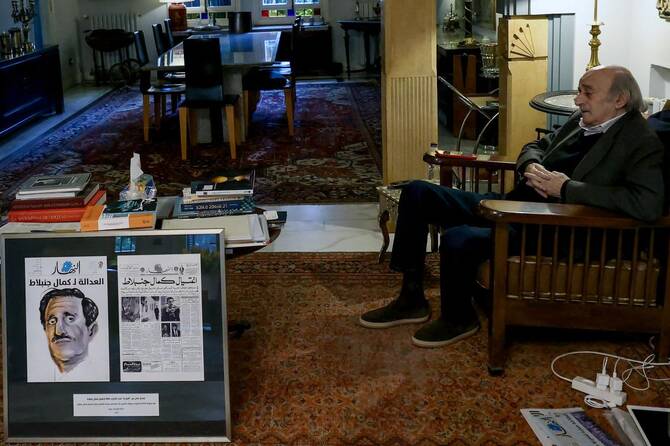
Kamal Jumblatt, who founded the Progressive Socialist Party and opposed Assad’s father Hafez over his troops’ intervention in the Lebanese civil war, was killed near the Syrian border in 1977.
This month, Syrian security forces arrested former intelligence officer Ibrahim Huweija, suspected of numerous killings including that of Jumblatt’s father.
“He’s a big criminal, he also committed crimes against the Syrian people and should be tried in Syria,” Jumblatt said.
Lebanon’s new authorities have been under pressure since a devastating war between Israel and the Iran-backed Hezbollah group, an Assad ally, Jumblatt said.
“The Americans want Lebanon to normalize ties with Israel,” he said.
Under a November ceasefire, Hezbollah was to withdraw fighters from the border area and dismantle its military infrastructure there.
The Israeli army was also to withdraw but troops are still deployed in five positions inside Lebanon that it deems strategic.


