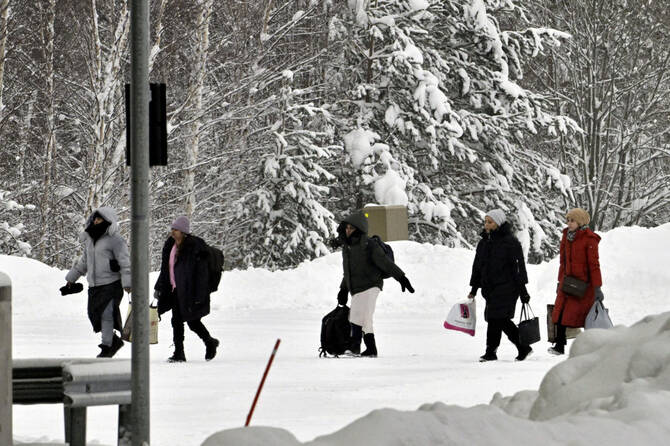
HELSINKI: Finland’s right-wing government has asked parliament to extend until the end of 2026 a law that allows it to reject asylum applications from migrants crossing its closed eastern border with Russia and to send them back, it said on Thursday.
NATO member Finland has accused Russia of weaponizing migration by encouraging migrants from third countries to cross their shared border, an assertion the Kremlin has repeatedly denied.
“The threat of instrumentalized migration at Finland’s eastern border remains high and unpredictable,” Interior Minister Mari Rantanen said in a statement, adding the situation at the border was tense but stable.
While Finland’s non-discrimination ombudsman says the law is at odds with international human rights commitments and EU asylum rules, the government of Prime Minister Petteri Orpo has said it must be extended to prevent possible future arrivals.
The exceptional emergency law, initially approved for a year in July 2024, was part of the government’s response to more than 1,300 migrants from countries such as Syria, Iraq and Yemen entering Finland from Russia in 2023. That phenomenon also prompted Finland to close the border with Russia.
The flow of migrants stopped after Finland closed down all official border crossing points at the end of 2023, and in 2024 only eight people crossed the border illegally after January, interior ministry data showed.
The government needs the support of three quarters of lawmakers in the 200-strong parliament to secure an extension of the law, a high bar reflecting the fundamental principles at stake.
The independent senior official charged with overseeing the legality of government actions said this month that the proposal to extend the asylum ban had insufficient reasoning, emphasising that emergency legislation must only be temporary in nature.
The official, known as the chancellor of justice, also said the threat assessment regarding migrants was insufficient and urged the government to explore alternatives.
The current emergency legislation expires on July 21.

Finnish government seeks to extend ban on migrants seeking asylum on Russia border
Short Url
https://arab.news/jp4jd
Finnish government seeks to extend ban on migrants seeking asylum on Russia border
- “The threat of instrumentalized migration at Finland’s eastern border remains high and unpredictable,” Interior Minister Mari Rantanen said
- The exceptional emergency law was part of the government’s response to more than 1,300 migrants from countries such as Syria, Iraq and Yemen
Ghana’s president urged to rally African leaders behind push for slavery reparations
Ghana’s President John Dramani Mahama held talks with a global delegation seeking reparations for transatlantic slavery and colonialism, who urged him to rally other African leaders to choose “courage over comfort” and support the growing movement.
The delegation, made up of experts from Africa, the Caribbean, Europe, Latin America, and the United States, presented Mahama with priority actions under the African Union’s (AU) reparations agenda, it said in a statement on Friday. In February, the AU launched a drive to create a “unified vision” on what reparations may look like, from financial compensation and formal acknowledgments of past wrongs to policy reforms. At least 12.5 million Africans were kidnapped and forcibly transported by European ships, then sold into slavery from the 15th to the 19th centuries. Advocates say action is needed to confront today’s legacies, including racism. Calls for reparations have gained momentum but there is also a growing backlash. Many European leaders have opposed even discussing the matter, with opponents arguing today’s states and institutions should not be held responsible for historical wrongs.
While Ghana has been at the forefront of reparations advocacy in Africa, the delegation emphasized the need for “strategic coherence and unity” among political leaders across the continent.
They urged Mahama to encourage other leaders to “choose courage over comfort” by standing with civil society and affected communities in Africa and the diaspora in demanding reparations.
The delegation also met on Wednesday with Ghana’s Foreign Minister Samuel Okudzeto Ablakwa and Mahama’s envoy on reparations Ekwow Spio-Garbrah.
At a European Union–AU summit in Luanda, Angola’s capital, last month, leaders from both regions acknowledged the “untold suffering” caused by slavery and colonialism but stopped short of committing to reparations.
During the summit, Ghana’s Vice President Jane Opoku-Agyemang urged EU member states to support a UN resolution Ghana is preparing to recognize slavery as one of the “gravest crimes against humanity.”
The delegation, made up of experts from Africa, the Caribbean, Europe, Latin America, and the United States, presented Mahama with priority actions under the African Union’s (AU) reparations agenda, it said in a statement on Friday. In February, the AU launched a drive to create a “unified vision” on what reparations may look like, from financial compensation and formal acknowledgments of past wrongs to policy reforms. At least 12.5 million Africans were kidnapped and forcibly transported by European ships, then sold into slavery from the 15th to the 19th centuries. Advocates say action is needed to confront today’s legacies, including racism. Calls for reparations have gained momentum but there is also a growing backlash. Many European leaders have opposed even discussing the matter, with opponents arguing today’s states and institutions should not be held responsible for historical wrongs.
While Ghana has been at the forefront of reparations advocacy in Africa, the delegation emphasized the need for “strategic coherence and unity” among political leaders across the continent.
They urged Mahama to encourage other leaders to “choose courage over comfort” by standing with civil society and affected communities in Africa and the diaspora in demanding reparations.
The delegation also met on Wednesday with Ghana’s Foreign Minister Samuel Okudzeto Ablakwa and Mahama’s envoy on reparations Ekwow Spio-Garbrah.
At a European Union–AU summit in Luanda, Angola’s capital, last month, leaders from both regions acknowledged the “untold suffering” caused by slavery and colonialism but stopped short of committing to reparations.
During the summit, Ghana’s Vice President Jane Opoku-Agyemang urged EU member states to support a UN resolution Ghana is preparing to recognize slavery as one of the “gravest crimes against humanity.”
© 2025 SAUDI RESEARCH & PUBLISHING COMPANY, All Rights Reserved And subject to Terms of Use Agreement.