MURMANSK: Russia on Thursday hailed “record” cargo volumes through its Northern Sea Route, which cuts travel time between Europe and Asia, as Arctic ice melts and helps Moscow redirect trade hit by sanctions over Ukraine.
Before launching his Ukraine offensive, President Vladimir Putin had promoted the Arctic route as a strategic priority, with Russia developing a fleet of eight nuclear icebreaker ships.
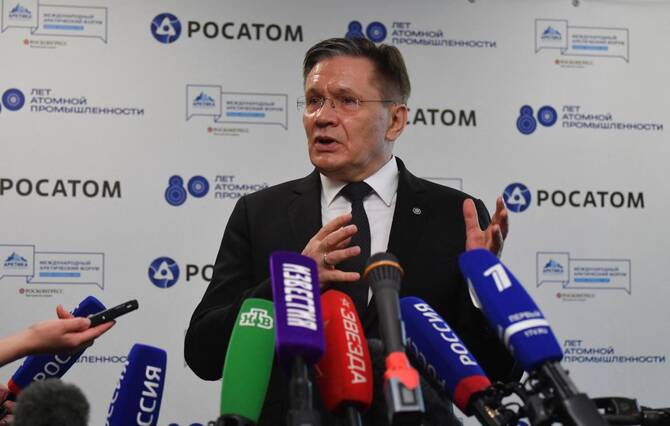
“Last year ended with a record, with around 38 million tons,” of cargo shipped via the route, said Alexey Likhachev, director of Russia’s nuclear agency Rosatom, which operates the icebreakers.
Putin was due to address the issue later on Thursday at a forum on Arctic development in the northern Russian port city of Murmansk.
Competition over Arctic resources has heated up as a warming climate opens up previously iced sea lanes.
And US President Donald Trump’s campaign to annex Greenland has also intensified the geopolitical and security dimensions of the tussle for influence in the region.
Moscow has invested heavily in the Northern Sea Route, which can cut travel time for cargo ships by 15 days compared to sailing via the Suez Canal.
Climate change has meant Russia’s nuclear icebreakers can pass along its entire northern coast, though at times with difficulty.
Vladimir Panov, a special representative for Arctic development at Rosatom said Moscow has seen “shippers in summer and autumn redirect their cargoes” via the route to Asia.
“In the last two years, for the first time we have switched to year-round operation of icebreakers,” he said at the forum on Wednesday.
Russia has also clashed with the West over its ambitions for Arctic development.
Foreign ministry official Vladislav Maslennikov on Wednesday accused the West of having a “provocative” Arctic policy.
“Under the guise of protecting the environment and combating climate change, we are witnessing ongoing attempts at de facto unfair competition,” he said.
Despite increasing volumes of cargo transported, Moscow has faced a series of logistical issues on the route.
In 2018 Putin had set a target of 80 million tons a year in annual cargo by 2024.


![]()

Russia hails ‘record’ Arctic shipping as sanctions pivot trade to Asia
Short Url
https://arab.news/vctg6
Russia hails ‘record’ Arctic shipping as sanctions pivot trade to Asia
- Competition over Arctic resources has heated up as a warming climate opens up previously iced sea lanes


Latest updates


© 2026 SAUDI RESEARCH & PUBLISHING COMPANY, All Rights Reserved And subject to Terms of Use Agreement.