UN experts demand Pakistan release Baloch rights activists

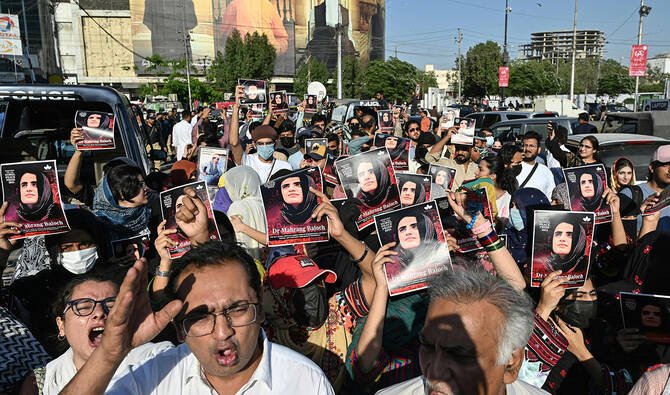
Activists from Baloch Yakjehti Committee (BYC) and civil society hold portraits of Mahrang Baloch and participate in a protest demanding her and other missing Baloch persons' release in Karachi, Pakistan, on March 24, 2025. (AFP)
Short Url
Updated 27 March 2025
Follow

UN experts demand Pakistan release Baloch rights activists

  • Police launched pre-dawn raid on Saturday to arrest the activists who had been protesting detention of peers
  • On Sunday, protesters were charged with terrorism, sedition and murder, as per police charge sheet

GENEVA: More than a dozen United Nations experts demanded Wednesday that Pakistan immediately release detained Baloch rights defenders and halt its crackdown on peaceful protests.
Among those arrested in recent days was Mahrang Baloch, one of Pakistan’s most prominent human rights advocates, who has long campaigned for the Baloch ethnic group.
She and other activists took part in a sit-in protest on Friday outside the University of Balochistan in the provincial capital of Quetta.
They demanded the release of members of their support group, whom they allege had been detained by security agencies.
“We have been monitoring with growing concern reports of alleged arrests and enforced disappearances of Baloch activists over the past number of months,” the independent experts said in a statement.
Police launched a pre-dawn raid on Saturday, arresting Baloch and other activists, during which at least three protesters died. Both sides blamed each other for the deaths.
On Sunday, Baloch and other protesters were charged with terrorism, sedition and murder, according to the police charge sheet seen by AFP.
In their statement, the experts, including the UN special rapporteurs on the situation of human rights defenders, on minority issues and on counter-terrorism and human rights, decried “the use of excessive force as a first response to peaceful protests.”
Pakistan has been battling a separatist insurgency in Balochistan for decades, where militants target state forces and foreign nationals in the mineral-rich southwestern province bordering Afghanistan and Iran.
Police actions against Baloch activists have intensified after Baloch separatists earlier this month launched a dramatic train siege that officials said ended in around 60 deaths, half of whom were separatists behind the assault.
“We understand the deeply traumatic impact of the March 11 terrorist attack, and we express our deepest sympathy to the victims,” said the experts, who are mandated by the UN Human Rights Council but who do not speak on behalf of the United Nations itself.
“Yet a response which relies on arbitrary detention, enforced disappearances, and violent crackdowns on freedom of assembly cannot alleviate that trauma.”
In addition to Mahrang Baloch’s case, the experts highlighted the arrest on Monday of another woman human rights defender, Sammi Deen Baloch, along with others in front of the Karachi Press Club as they protested against the crackdown.
“We urge the Pakistani authorities to immediately release them and to refrain from abusing counter-terrorism or public safety measures against human rights defenders,” the experts said.
Pakistan’s foreign affairs ministry said it had “taken note of the press release issued by certain UN experts, which appears to be based on selective and unverified media reports.”
“Regrettably, these comments lack balance and proportionality, downplaying civilian casualties inflicted by terrorist attacks,” the foreign ministry statement added.



Pakistan parliament demands national response against ‘external sponsors’ of terror after Balochistan attacks

Updated 10 sec ago
Follow

Pakistan parliament demands national response against ‘external sponsors’ of terror after Balochistan attacks

ISLAMABAD: Pakistan’s National Assembly adopted a resolution on Tuesday condemning recent militant attacks in the southwestern Balochistan province, calling for an immediate national response against “external sponsors” of terror in the country. 

Separatist militants launched coordinated gun and bomb attacks across multiple districts in Balochistan on Friday and Saturday, targeting security installations and government facilities. Pakistan’s State Minister for Interior Tallal Chaudry said 50 people were killed in the attacks, which included 33 civilians and 17 law enforcement personnel. Meanwhile, Pakistan’s state media said on Monday that security forces have killed 177 militants since Friday. 

Pakistan’s Interior Minister Mohsin Naqvi said last week that the militant attacks, which were claimed by the separatist Baloch Liberation Army, were planned by India. New Delhi denied the allegations as “baseless,” saying it was an attempt by Islamabad to deflect from its internal failings. Pakistan regularly accuses India of funding militants in its Balochistan and northwestern Khyber Pakhtunkhwa provinces, charges New Delhi has always denied. 

The resolution, tabled by Minister for Parliamentary Affairs Dr. Tariq Fazal Chaudhry, said that in several militant attacks, evidence has shed light on the “external patronage” of militants and drawn attention to “serious concerns, particularly regarding the role of India.”

“This house demands that an immediate, comprehensive, coordinated and multi-dimensional national response be ensured against these external sponsors and internal facilitators, including funding, smuggling, and propaganda networks, bringing together the political, diplomatic, military, intelligence, legal and narrative fronts,” a copy of the resolution seen by Arab News stated. 


The resolution said “terrorism” in Pakistan is being facilitated through logistical and operational support, financial assistance, training, medical treatment and propaganda networks by certain neighboring countries. 

It expressed solidarity with the victims and relatives of the Balochistan attacks, praising Pakistan’s security forces for taking effective action against militants. The resolution also expressed concern over militant networks using women in the attacks. 

“This house expresses profound grief, sorrow, and concern over the fact that terrorist networks are attempting to exploit women and use them against the state and society through coercion, psychological pressure and blackmail,” it said. 

The resolution called for national unity and rising above political differences. It vowed that the state will not compromise on the protection of its people and national security. 

Balochistan, Pakistan’s largest province by land area, has long been gripped by a separatist insurgency that has intensified in recent years. Militants frequently target security forces, government officials, infrastructure projects, foreigners and non-local workers in the area.

Balochistan is home to vast reserves of minerals and hydrocarbons, and also to the multibillion-dollar China-Pakistan Economic Corridor (CPEC), a flagship component of China’s Belt and Road Initiative.

Separatist militant groups such as the BLA blame Islamabad for exploiting Balochistan’s natural resources and denying locals a share in them. The military and civilian government reject these allegations and say they are investing in the province’s development.