GENEVA: More than a dozen United Nations experts demanded Wednesday that Pakistan immediately release detained Baloch rights defenders and halt its crackdown on peaceful protests.
Among those arrested in recent days was Mahrang Baloch, one of Pakistan’s most prominent human rights advocates, who has long campaigned for the Baloch ethnic group.
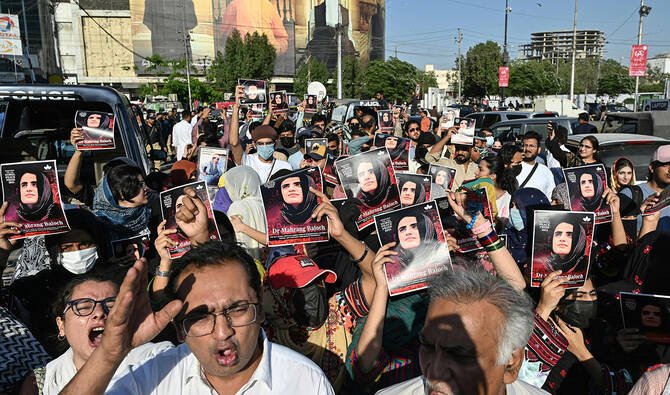
She and other activists took part in a sit-in protest on Friday outside the University of Balochistan in the provincial capital of Quetta.
They demanded the release of members of their support group, whom they allege had been detained by security agencies.
“We have been monitoring with growing concern reports of alleged arrests and enforced disappearances of Baloch activists over the past number of months,” the independent experts said in a statement.
Police launched a pre-dawn raid on Saturday, arresting Baloch and other activists, during which at least three protesters died. Both sides blamed each other for the deaths.
On Sunday, Baloch and other protesters were charged with terrorism, sedition and murder, according to the police charge sheet seen by AFP.
In their statement, the experts, including the UN special rapporteurs on the situation of human rights defenders, on minority issues and on counter-terrorism and human rights, decried “the use of excessive force as a first response to peaceful protests.”
Pakistan has been battling a separatist insurgency in Balochistan for decades, where militants target state forces and foreign nationals in the mineral-rich southwestern province bordering Afghanistan and Iran.
Police actions against Baloch activists have intensified after Baloch separatists earlier this month launched a dramatic train siege that officials said ended in around 60 deaths, half of whom were separatists behind the assault.
“We understand the deeply traumatic impact of the March 11 terrorist attack, and we express our deepest sympathy to the victims,” said the experts, who are mandated by the UN Human Rights Council but who do not speak on behalf of the United Nations itself.
“Yet a response which relies on arbitrary detention, enforced disappearances, and violent crackdowns on freedom of assembly cannot alleviate that trauma.”
In addition to Mahrang Baloch’s case, the experts highlighted the arrest on Monday of another woman human rights defender, Sammi Deen Baloch, along with others in front of the Karachi Press Club as they protested against the crackdown.
“We urge the Pakistani authorities to immediately release them and to refrain from abusing counter-terrorism or public safety measures against human rights defenders,” the experts said.
Pakistan’s foreign affairs ministry said it had “taken note of the press release issued by certain UN experts, which appears to be based on selective and unverified media reports.”
“Regrettably, these comments lack balance and proportionality, downplaying civilian casualties inflicted by terrorist attacks,” the foreign ministry statement added.

UN experts demand Pakistan release Baloch rights activists
https://arab.news/p6qga
UN experts demand Pakistan release Baloch rights activists
- Police launched pre-dawn raid on Saturday to arrest the activists who had been protesting detention of peers
- On Sunday, protesters were charged with terrorism, sedition and murder, as per police charge sheet
Tens of thousands flee northwest Pakistan over fears of military operation
- More than 70,000 people, mostly women and children, have fled remote Tirah region bordering Afghanistan
- Government says no military operation underway or planned in Tirah, a town in Khyber Pakhtunkhwa province
BARA, Pakistan: More than 70,000 people, mostly women and children, have fled a remote region in northwestern Pakistan bordering Afghanistan over uncertainty of a military operation against the Pakistani Taliban, residents and officials said Tuesday.
Pakistan’s Defense Minister Khawaja Mohammad Asif has denied the claim by residents and provincial authorities. He said no military operation was underway or planned in Tirah, a town in Khyber Pakhtunkhwa province.
Speaking at a news conference in Islamabad, he said harsh weather, rather than military action, was driving the migration. His comments came weeks after residents started fleeing Tirah over fears of a possible army operation.
The exodus began a month after mosque loudspeakers urged residents to leave Tirah by Jan. 23 to avoid potential fighting. Last August, Pakistan launched a military operation against Pakistani Taliban in the Bajau r district in the northwest, displacing hundreds of thousands of people.
Shafi Jan, a spokesman for the provincial government in Khyber Pakhtunkhwa, posted on X that he held the federal government responsible for the ordeal of the displaced people, saying authorities in Islamabad were retracting their earlier position about the military operation.
Khyber Pakhtunkhwa Chief Minister Suhail Afridi, whose party is led by imprisoned former Prime Minister Imran Khan, has criticized the military and said his government will not allow troops to launch a full-scale operation in Tirah.
The military says it will continue intelligence-based operations against Pakistani Taliban, who are known as Tehrik-e-Taliban Pakistan, or TTP. Though a separate group, it has been emboldened since the Afghan
Taliban returned to power in 2021. Authorities say many TTP leaders and fighters have found sanctuary in Afghanistan and that hundreds of them have crossed into Tirah, often using residents as human shields when militant hideouts are raided.
Caught in the middle are the residents of Tirah, who continued arriving in Bara.
So far, local authorities have registered roughly 10,000 families — about 70,000 people — from Tirah, which has a population of around 150,000, said Talha Rafiq Alam, a local government administrator overseeing the relief effort. He said the registration deadline, originally set for Jan. 23, has been extended to Feb. 5.
He said the displaced would be able to return once the law-and-order situation improves.
Among those arriving in Bara and nearby towns was 35-year-old Zar Badshah, who said he left with his wife and four children after the authorities ordered an evacuation. He said mortar shells had exploded in villages in recent weeks, killing a woman and wounding four children in his village. “Community elders told us to leave. They instructed us to evacuate to safer places,” he said.
At a government school in Bara, hundreds of displaced lined up outside registration centers, waiting to be enrolled to receive government assistance. Many complained the process was slow.
Narendra Singh, 27, said members of the minority Sikh community also fled Tirah after food shortages worsened, exacerbated by heavy snowfall and uncertain security.
“There was a severe shortage of food items in Tirah, and that forced us to leave,” he said.
Tirah gained national attention in September, after an explosion at a compound allegedly used to store bomb-making materials killed at least 24 people. Authorities said most of the dead were militants linked to the TTP, though local leaders disputed that account, saying civilians, including women and children, were among the dead.