

Fitness enthusiasts challenge themselves with pre-iftar hikes in Pakistani capital

Participants hike up the mountain at the Margalla Hills National Park in Islamabad on March 25, 2025, during an Arab News’ Ramadan special coverage of a pre-iftar hiking trend in Pakistani capital. (Photo courtesy: Handout/IRU)
Short Url
Updated 27 March 2025
Follow

Fitness enthusiasts challenge themselves with pre-iftar hikes in Pakistani capital

  • Hikers set out hour before sunset, break fast on trails on Margalla Hills National Park
  • Participants say pre-iftar hikes help boost fat burning, maintain weight in Ramadan

ISLAMABAD: Zarnab Tahir struggled to catch her breath as the steep incline of the hiking trail at Islamabad’s picturesque Margalla Hills tested her endurance. Hiking can put one through physical exertion, especially when they do it on an empty stomach. 

An hour before the sun sets and the call to prayer blares out from various mosques located in Pakistan’s capital city, a group of fitness enthusiasts take to the hiking trails in Margalla Hills National Park. 

Islamabad Run With Us (IRU), which describes itself as Pakistan’s “pioneering running community,” is behind the pre-iftar hiking initiative. 

“When you engage in pre-iftar [physical] activities during Ramadan, it gives you extra energy, an extra boost,” Qasim Naz, who founded IRU in 2016, told Arab News on hiking trail number three. 

“And when someone joins in on an activity once or twice, they figure out it’s not that hard and they can sustain it comfortably.”
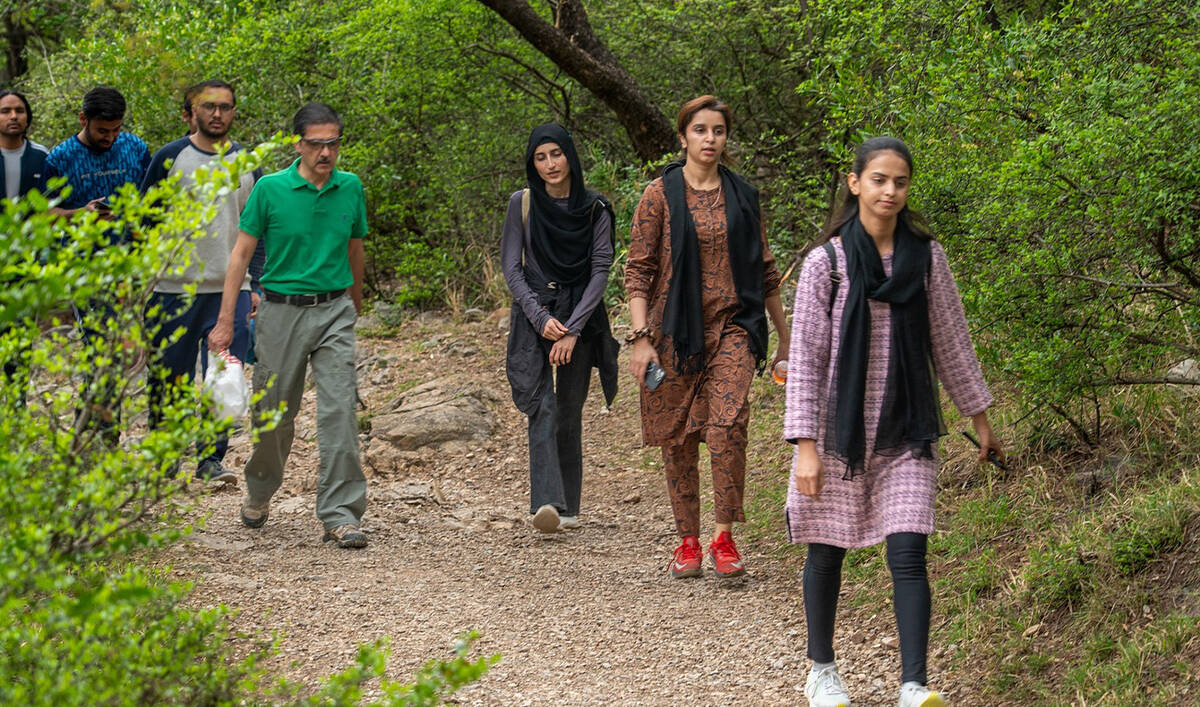


Participants hike up the mountain at the Margalla Hills National Park in Islamabad on March 25, 2025, during an Arab News’ Ramadan special coverage of a pre-iftar hiking trend in Pakistani capital. (Photo courtesy: Handout/IRU)

Naz stresses that staying active during the holy month is essential. The IRU organizes five activities a week, which include two runs and three hikes.

“Either we can maintain our weight, or if our goal is weight loss, we can achieve it by being in a calorie deficit while eating a healthy diet and exercising,” Naz explained.

Tahir, 22, meanwhile said she was committed to reaching the top of hiking trail before sunset. This was the second time she was hiking with IRU. 

She agreed with Naz that group activities are “much easier” to sustain. 

“I think it is important to go at your own pace and it’s so much easier with the group,” Tahir, a content creator, told Arab News. 

“If you go alone, it’s kind of more difficult and you are like really slow but if you go with the group you can maintain that pace and I think it’s much easier that way.”
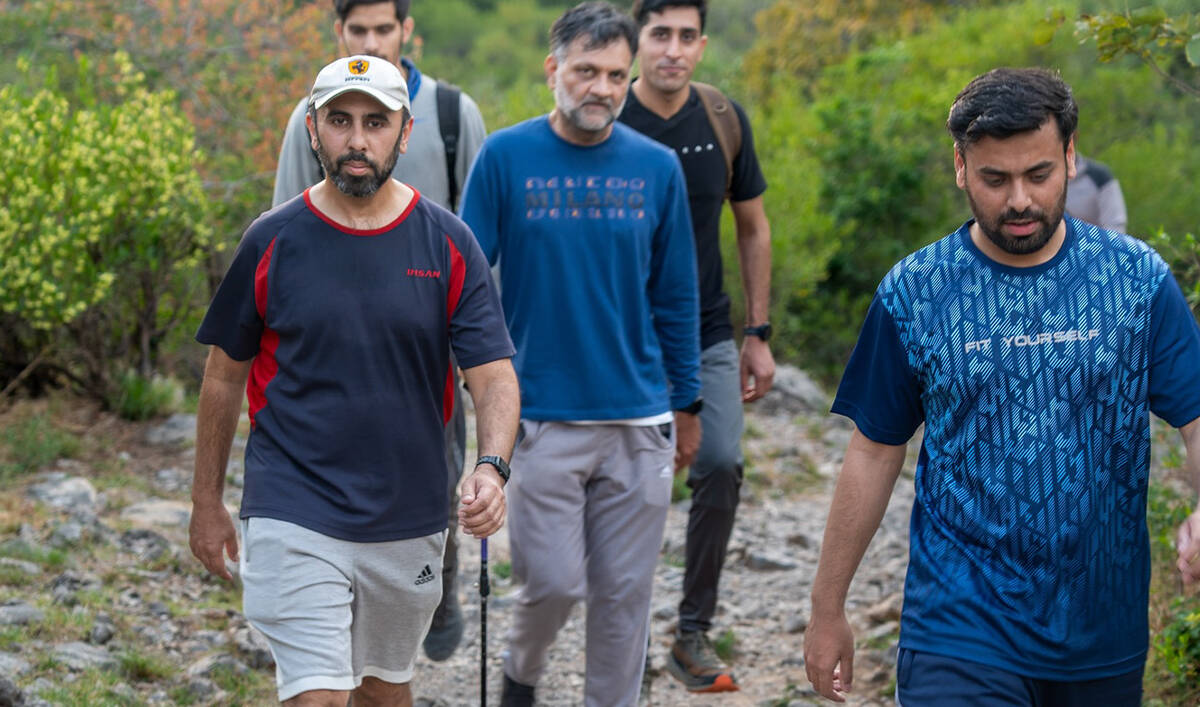


Participants hike up the mountain at the Margalla Hills National Park in Islamabad on March 25, 2025, during an Arab News’ Ramadan special coverage of a pre-iftar hiking trend in Pakistani capital. (Photo courtesy: Handout/IRU)

Mahwish Ashraf, a journalist associated with a foreign diplomatic mission in Islamabad, shared how she struggled the first time she went on a pre-iftar hike with IRU. 

“The first time I was hiking, I returned from in between, I couldn’t complete it,” she admitted. “So, this is my second time hiking with the IRU, and gladly, I’m at the main point, the meeting point.”

Eraj Khan, a commercial specialist visiting from Australia to spend Ramadan with his family, said pre-iftar hikes give one “lots of energy.” 

“For fat burning, it’s a great activity,” Khan said. “Especially because the last two hours of fasting are the hardest, most people feel really hungry. But so far, I’m loving it.”

As the clock continued to tick and evening settled in, the hikers began to pick up their pace. For Tahir, reaching the top of the trail before sunset was a victory in itself. 
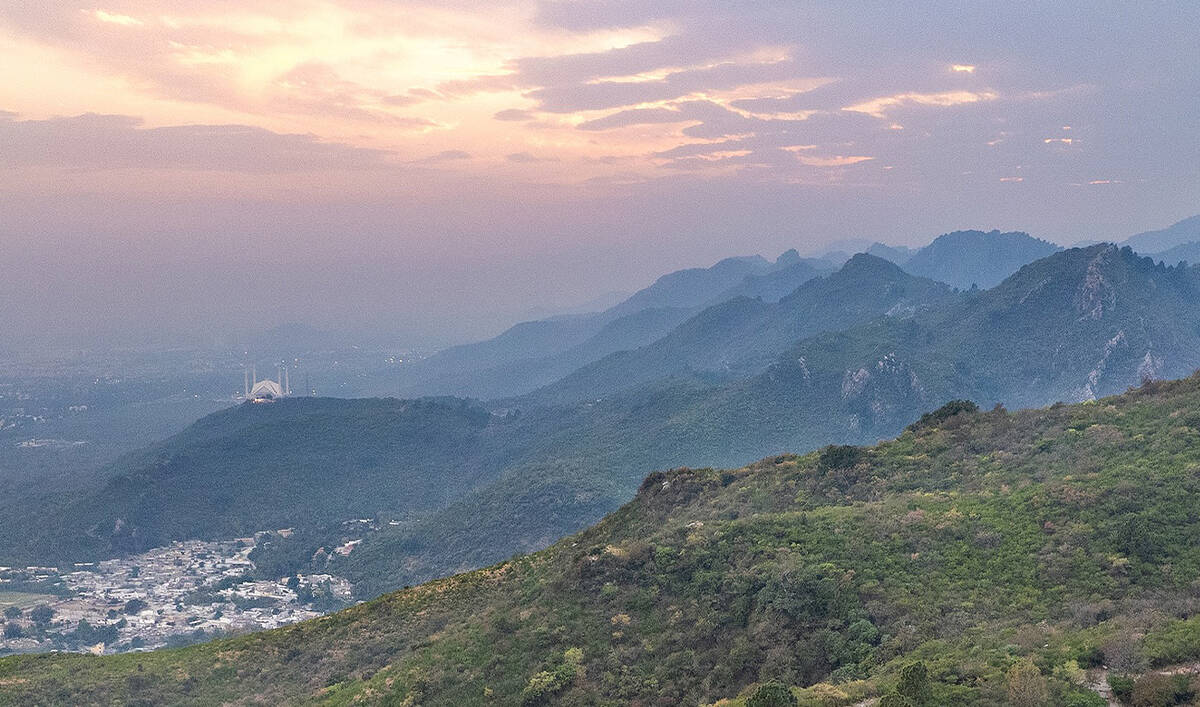


This aerial view shows the Margalla Hills National Park in Islamabad on March 25, 2025, during an Arab News’ Ramadan special coverage of a pre-iftar hiking trend in Pakistani capital. (Photo courtesy: Handout/IRU)

She had pushed past exhaustion, embraced the challenge and proved to herself that she was capable of more than she thought she could achieve.

And according to her, hiking with the group made all the difference. 

“The energy of the group keeps you going,” she said. “Even when you feel like stopping, you see everyone else moving forward, and you push through.”


‘The Wild Within’ sees artists breathe new life into Mideast buildings

Updated 16 December 2025
Follow

‘The Wild Within’ sees artists breathe new life into Mideast buildings

DUBAI: Lens-based artist Ryan Koopmans and digital artist Alice Wexell are staging a showcase at Dubai’s Leila Heller Gallery that breathes new life into regional buildings.

The series of digital artworks is part of the exhibition “The Wild Within,” featuring images of old structures in Beirut, Istanbul, and Abu Dhabi filled with wild flowers.

Two of the largest works, “Heartbeats” and “The Wish,” are displayed using Ventana, a microLED architectural display surface created by visual technology company Megapixel.

'Around Us' by Ryan Koopmans and Alice Wexell. (Supplied) 

The former artwork depicts the entrance hall of Qasr Al-Watan, the UAE’s presidential palace in Abu Dhabi, while the latter reimagines the upper floors of the Emirates Palace Mandarin Oriental in Abu Dhabi.

“Each building we work with comes to us through a combination of research, travel, and intuition,” the artists told Arab News in a joint statement.

'Constellations' by Ryan Koopmans and Alice Wexell. (Supplied) 

“We are drawn to structures that carry both emotional and historical resonance, often buildings that once embodied human ambition and now exist in a state of quiet transformation.”

Koopans and Wexell made sure to research the context of each building they choose to recreate, saying “an old villa in Jeddah or a former school in Sharjah each hold their own cultural memory, influencing everything from the lighting and atmosphere to the plants and flowers that we digitally sculpt and implement into the photographs.”

'Heart of Sharjah' by Ryan Koopmans and Alice Wexell. (Supplied) 

The hypnotic works depict the interior of buildings in the region, with digitally rendered flowers carpeting the floor in a bid to “(reimage) these spaces (and) explore the relationship between nature, place, and time, while celebrating each site as a unique work of architecture with its own spirit and story,” the artists said.

Koopmans is of dual Canadian and Dutch heritage, while Wexell is Swedish and based in Stockholm, so it is noteworthy that both artists chose to explore the Middle East for their latest project.

'Blossom of the Ancestors' by Ryan Koopmans and Alice Wexell. (Supplied) 

“In the Middle East especially, the architecture reflects a layered past that merges different styles and eras, while also expressing a sense of renewal and forward-looking energy, particularly in the region’s fantastic contemporary buildings. We are drawn to the symmetry, geometry and patterns that are found not only in nature itself, but in the architectural language of the region both past and present,” they said.

The series — featuring works such as “Adore You,” “Between Worlds,” and “Blossom of the Ancestors” — explores contrasts between the natural world and human-made forms, as well as the traditional and contemporary worlds.

“We are interested in how these elements coexist and merge into one another, creating a sense of hyperrealism that feels both familiar and imaginary. By merging photography with digital sculpture, the artworks question where the boundary lies between documentation and invention, and how technology can extend rather than replace our sense of the natural world.”

'Under the Rain of Light' by Ryan Koopmans and Alice Wexell. (Supplied) 

Although the scale of the artworks ensures they leave the viewer entranced, it did pose challenges, according to the artists.

“Presented at a large scale, every texture in these artworks becomes visible, which can be demanding but is also incredibly rewarding. The magnified detail allows the visceral and atmospheric layers of the pieces to come through with greater impact,” they said, adding that each piece took “many months” to create.

“Ultimately, we want our collectors to experience a sense of wonder and contemplation, as if they are standing inside a dream that feels both entirely real yet unreal.”

The exhibition runs until Jan. 15, 2026.