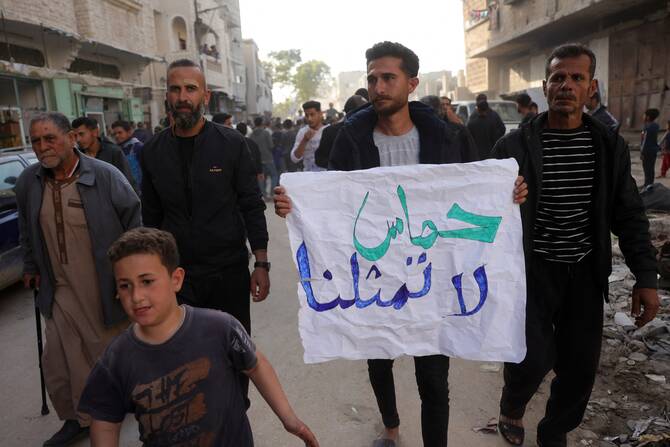
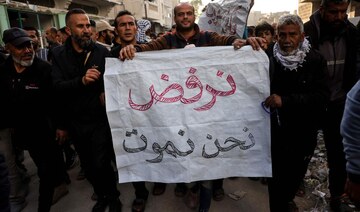
CAIRO: Thousands of Palestinians marched between the wreckage of a heavily destroyed town in northern Gaza on Wednesday in the second day of anti-war protests, with many chanting against Hamas in a rare display of public anger against the militant group.
The protests, which centered mainly on Gaza’s north, appeared to be aimed generally against the war, with protesters calling for an end to 17 months of deadly fighting with Israel that has made life in Gaza insufferable.
But the public calls against Hamas, which has long repressed dissent and still rules the territory months into the war with Israel, were rare.
In the town of Beit Lahiya, where a similar protest took place Tuesday, about 3,000 people demonstrated, with many chanting “the people want the fall of Hamas.” In the hard-hit Shijaiyah neighborhood of Gaza City, dozens of men chanted “Out, out out! Hamas get out!”
“Our children have been killed. Our houses have been destroyed,” said Abed Radwan, who said he joined the protest in Beit Lahiya “against the war, against Hamas, and the (Palestinian political) factions, against Israel and against the world’s silence.”
Ammar Hassan, who took part in a protest Tuesday, said it started as an anti-war protest with a few dozen people but swelled to more than 2,000, with people chanting against Hamas.
“It’s the only party we can affect,” he said by phone. “Protests won’t stop the (Israeli) occupation, but it can affect Hamas.”
The militant group has violently cracked down on previous protests. This time no outright intervention was apparent, perhaps because Hamas is keeping a lower profile since Israel resumed its war against it.
Senior Hamas official Bassem Naim, in a post on Facebook, wrote that people had the right to protest but that their focus should be on the “criminal aggressor,” Israel.
’We want to stop the killing’
Family elders from Beit Lahiya expressed support for the protests against Israel’s renewed offensive and its tightened blockade on all supplies into Gaza. Their statement said the community fully supports armed resistance against Israel.
“The protest was not about politics. It was about people’s lives,” said Mohammed Abu Saker, a father of three from the nearby town of Beit Hanoun, who joined a demonstration Tuesday.
“We want to stop the killing and displacement, no matter the price. We can’t stop Israel from killing us, but we can press Hamas to give concessions,” he said.
A similar protest occurred in the heavily destroyed area of Jabaliya on Tuesday, according to witnesses.
One protester in Jabaliya, who spoke on condition of anonymity for fear of retribution, said they joined the demonstration because “everyone failed us.”
They said they chanted against Israel, Hamas, the Western-backed Palestinian Authority and Arab mediators. They said there were no Hamas security forces at the protest but scuffles broke out between supporters and opponents of the group.
Later, they said they regretted participating because of Israeli media coverage, which emphasized the opposition to Hamas.
Israeli Defense Minister Israel Katz urged Palestinians to join the protests.
“You too should demand the removal of Hamas from Gaza and the immediate release of all Israeli hostages. That is the only way to stop the war,” he said.
A 19-year-old Palestinian, who also spoke on condition of anonymity for fear of retribution said he planned to join demonstrations on Wednesday. His mother has cancer and his 10-year-old brother is hospitalized with cerebral palsy, and he said the family has been displaced multiple times since their home was destroyed.
“People are angry at the whole world,” including the United States, Israel and Hamas, he said. “We want Hamas to resolve this situation, return the hostages and end this whole thing.”
Renewed fighting
The protests erupted a week after Israel ended its ceasefire with Hamas by launching a surprise wave of strikes that killed hundreds of people. Earlier this month, Israel halted deliveries of food, fuel, medicine and humanitarian aid to Gaza’s roughly 2 million Palestinians.
Israel has vowed to escalate the war until Hamas returns the 59 hostages it still holds — 24 of them believed to be alive. Israel is also demanding that the group give up power, disarm and send its leaders into exile.
Hamas has said it will only release the remaining captives in exchange for Palestinian prisoners, a lasting ceasefire and an Israeli withdrawal from Gaza.
The war was triggered by Hamas’ Oct. 7, 2023, attack into Israel, in which Palestinian militants killed some 1,200 people, mostly civilians, and abducted 251.
Israel’s retaliatory offensive has killed over 50,000 people, according to Gaza’s Health Ministry. Israel’s bombardment and ground operations have caused vast destruction and at their height displaced some 90 percent of Gaza’s population.
Hamas won a landslide victory in the last Palestinian elections, held in 2006. It seized power in Gaza from the Western-backed Palestinian Authority, dominated by the secular Fatah movement, the following year after months of factional unrest and a week of heavy street battles.


![]()

Palestinians protest Hamas in a rare public show of dissent in Gaza
Short Url
https://arab.news/2p53j
Palestinians protest Hamas in a rare public show of dissent in Gaza
- Protesters called for an end to 17 months of deadly fighting with Israel that has made life in Gaza insufferable
- Public calls against Hamas, which still rules the territory months into the war with Israel, were rare

Latest updates


Recommended


© 2026 SAUDI RESEARCH & PUBLISHING COMPANY, All Rights Reserved And subject to Terms of Use Agreement.