Tunisian president urges increased migrant returns

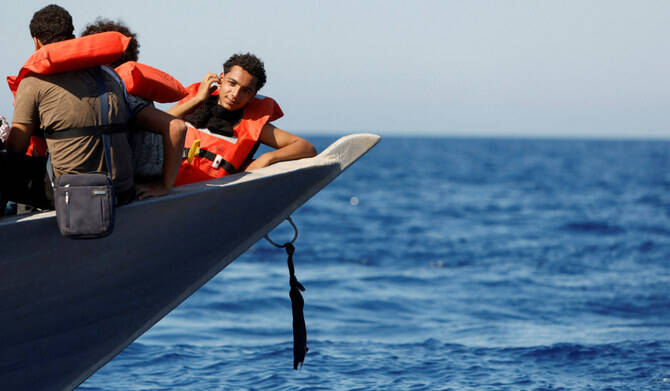
Tunisian President Kais Saied has called on the International Organization for Migration to accelerate efforts in conducting voluntary returns for irregular migrants to their home countries. (Reuters/File)
Short Url
Updated 26 March 2025
Follow

Tunisian president urges increased migrant returns

  • The presidency said that “only 1,544 migrants have been repatriated” since the start of the year
  • The figure “could have been much higher if greater efforts had been made to put a final end to this phenomenon“

TUNIS: Tunisian President Kais Saied has called on the International Organization for Migration to accelerate efforts in conducting voluntary returns for irregular migrants to their home countries.
In a statement posted on Facebook late Tuesday, the presidency said that “only 1,544 migrants have been repatriated” since the start of the year.
It said the figure “could have been much higher if greater efforts had been made to put a final end to this phenomenon.”
Tunisia has in recent years become a key departure point in North Africa for migrants making the perilous Mediterranean Sea crossing in hopes of reaching Europe.
Each year, tens of thousands of mainly sub-Saharan African migrants attempt the crossing.
In some areas, Tunisia’s coastline lies less than 150 kilometers (90 miles) from the Italian island of Lampedusa, often their first stop.
However, with mounting European Union efforts to curb migrant arrivals, many migrants find themselves stranded in Tunisia.
The IOM offers free flights to migrants volunteering for return and provides reintegration assistance in their home countries.
Tunisian authorities said 7,250 migrants had been repatriated through the program last year.
So far this year, the IOM says 343 people have died or gone missing attempting the Mediterranean crossing. Last year, 2,476 migrants died or went missing.
Earlier this month, Tunisia’s national guard rescued 612 migrants and recovered 18 bodies off the country’s coast.
About 8,743 migrants have arrived in Italy so far this year, a slight increase over the same period last year, according to Italy’s interior ministry.


Italy wants military to stay in Lebanon after peacekeepers leave

Updated 2 sec ago
Follow

Italy wants military to stay in Lebanon after peacekeepers leave

  • Defense Minister Guido Crosetto says Italy will continue to 'do its part' even after UNIFIL mission ends next year
ROME: Italy said Monday it intends to keep a military presence in Lebanon even after the UN peacekeeping force it belongs to leaves as planned from December 31, 2026.
“Even after (the peacekeeping force) UNIFIL, Italy will continue to do its part, supporting with conviction the international presence and supporting the capacity development of the Lebanese armed forces,” Defense Minister Guido Crosetto said during a visit to Lebanon, according to a statement.
Asked by AFP if this meant Italy wanted to maintain a military presence in the country, a ministry spokesman confirmed that this was the case.
The United Nations Interim Force in Lebanon (UNIFIL) has acted as a buffer between Israel and Lebanon since 1978, remaining after Israel ended an occupation of southern Lebanon in 2000.
Lebanon had wanted UNIFIL to stay.
But the UN Security Council voted in August to allow only one final extension for UNIFIL after pressure from Israel and its US ally to end the mandate.
UNIFIL is currently led by Italian Major General Diodato Abagnara and numbers 9,923 troops from 49 countries, according to the force’s website.
Italy is the second biggest contributing country with 1,099 soldiers deployed after Indonesia which has 1,232 soldiers.
Israel has hailed the termination of UNIFIL and urged the Beirut government to exert its authority after an Israeli military campaign which devastated Iranian-backed militia Hezbollah.
Under a truce between Israel and Hezbollah, the long-fledgling Lebanese national army has been deploying in southern Lebanon and dismantling Hezbollah’s infrastructure.
“Support is needed to strengthen the Lebanese armed forces, so that they are in the best possible position to defend the country, ensuring security and respect for its borders,” Crosetto said in Monday’s statement.
“We will guarantee our presence in multilateral and bilateral contexts,” he said.