

Al-Oudah Mosque restoration in Diriyah revives Najdi heritage

1 / 7
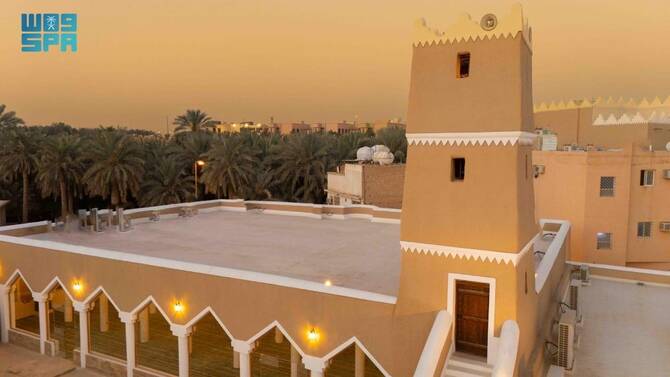
Al-Oudah Mosque in Diriyah, a key heritage site in Riyadh region, is being restored as part of a national project. (SPA)
2 / 7
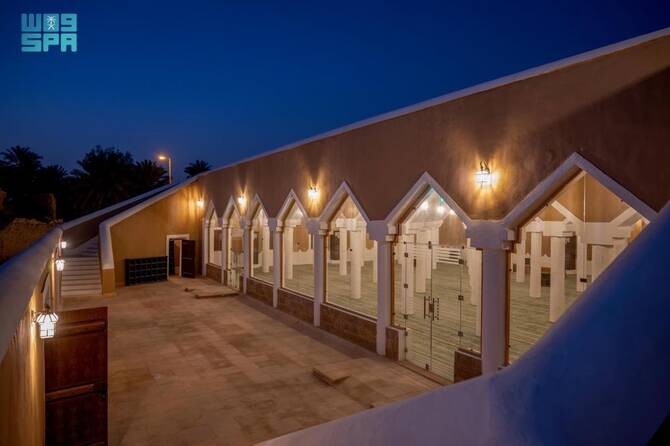
Al-Oudah Mosque in Diriyah, a key heritage site in Riyadh region, is being restored as part of a national project. (SPA)
3 / 7
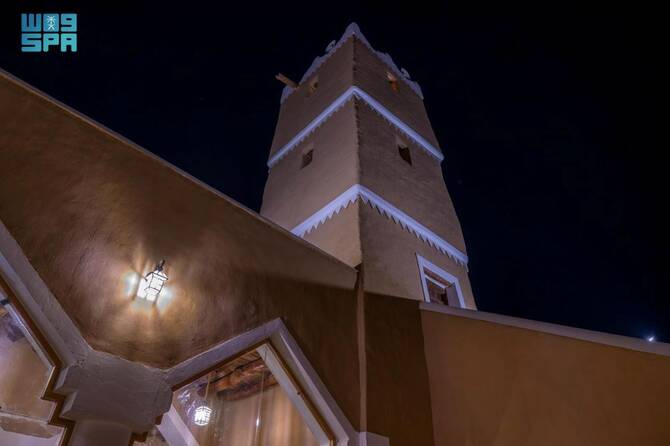
Al-Oudah Mosque in Diriyah, a key heritage site in Riyadh region, is being restored as part of a national project. (SPA)
4 / 7
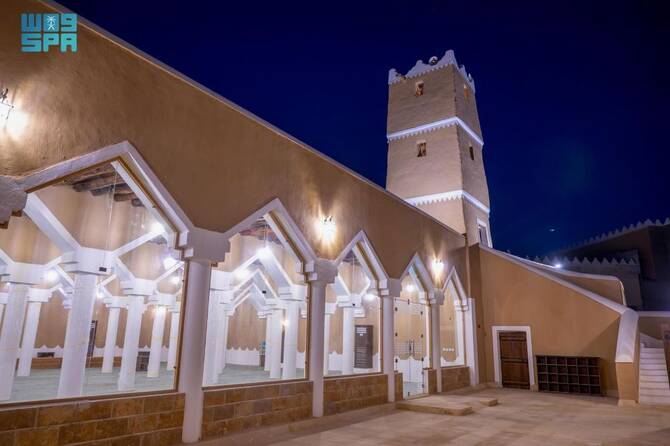
Al-Oudah Mosque in Diriyah, a key heritage site in Riyadh region, is being restored as part of a national project. (SPA)
5 / 7
Al-Oudah Mosque in Diriyah, a key heritage site in Riyadh region, is being restored as part of a national project. (SPA)
6 / 7
Al-Oudah Mosque in Diriyah, a key heritage site in Riyadh region, is being restored as part of a national project. (SPA)
7 / 7
Al-Oudah Mosque in Diriyah, a key heritage site in Riyadh region, is being restored as part of a national project. (SPA)
Short Url
Updated 26 March 2025
Follow

Al-Oudah Mosque restoration in Diriyah revives Najdi heritage

  • Second phase of the Prince Mohammed bin Salman Project for Historic Mosques aims to preserve the mosque’s rich history and Najdi architectural heritage
  • Recognizing its cultural significance, the project will use traditional Najdi construction methods, including mud and natural materials suited to the desert climate

RIYADH: The historic Al-Oudah Mosque in Diriyah, a key heritage site in Riyadh region, is being restored as part of a national project, the Saudi Press Agency reported.

The second phase of the Prince Mohammed bin Salman Project for Historic Mosques aims to preserve the mosque’s rich history and Najdi architectural heritage, restoring it to its former splendor.

One of the region’s oldest worship sites, Al-Oudah Mosque has been restored three times, with the last renovation about 15 years ago, according to the SPA.

Recognizing its cultural significance, the project will use traditional Najdi construction methods, including mud and natural materials suited to the desert climate.

The renovation will expand the mosque from 794 sq. m for 510 worshippers to 1,369 sq. m for 992 worshippers.

This expansion reflects a commitment to preserving history while meeting the community’s evolving needs, the SPA reported.

It is one of 30 mosques in 13 regions in phase two of the project, which includes six in Riyadh, five in Makkah, four in Madinah, three in Asir, and two each in the Eastern Province, Jouf and Jazan. The Northern Borders, Tabuk, Baha, Najran, Hail and Qassim each have one mosque in the scheme.

Phase two follows phase one, completed in 2018, in which 30 mosques were restored in 10 regions. Saudi companies and heritage restoration experts are leading the development efforts, the SPA reported.

The project balances traditional and modern construction standards, ensuring the sustainability of mosque components while preserving heritage.

Saudi companies and engineers specializing in heritage restoration are leading the development efforts, according to the report.

The project’s four strategic objectives include restoring historic mosques for worship, preserving architectural authenticity, highlighting the Kingdom’s cultural heritage, and enhancing the religious and cultural significance of religious sites.


At Jazan festival, Suad Al-Asiri paints memory, land and leadership

Updated 13 January 2026
Follow

At Jazan festival, Suad Al-Asiri paints memory, land and leadership

  • Local artist channels personal hardship into works that reflect Jazan’s identity, heritage
  • Jazan: A Nation and a Prince, places region at the heart of a composition featuring Prince Mohammed bin Abdulaziz and Prince Nasser bin Mohammed bin Abdullah bin Jalawi

RIYADH: At the Ahad Al-Masarihah pavilion at Jazan Festival 2026, Suad Al-Asiri’s paintings blend memory, place and personal history, offering visual narratives shaped by beauty and hardship. 

A novelist and visual artist, Al-Asiri has long used art as a storytelling tool. After a near-fatal car accident in March 2024, her work took on a new urgency. Bedridden for 11 months, cut off from the public world for more than a year, she describes that period as one of the most painful in her life — yet also transformative. 

“First of all, praise be to God for granting me life, as the accident was extremely severe,” she said. “By God’s grace, I was given a new life. All my thinking after the accident was about becoming an inspiration to others — about enduring pain and obstacles, and still leaving an impact.” 

Her return to public life came in 2025, when she participated in National Day celebrations with the ministry of interior. By the time she arrived at Jazan Festival, she was ready to channel that experience into her art. 

The centerpiece of her display, “Jazan: A Nation and a Prince,” places the region at the heart of a composition featuring Prince Mohammed bin Abdulaziz and Prince Nasser bin Mohammed bin Abdullah bin Jalawi, governor and deputy governor of Jazan respectively. 

Visitors linger over the details: the painting incorporates coffee beans, sesame and khudair — materials drawn from local products.

“I wanted people to recognize these products immediately,” she said. “They are part of Jazan’s daily life, and using them makes the work more tangible, more connected to everyday experience.” 

The painting sparks conversation. Visitors discuss leadership, identity, and the intimate relationship between people and their environment. 

Beyond the central piece, Al-Asiri presents individual portraits of the two princes, expanding the dialogue into a broader exploration of heritage and memory.  

Her journey into art is tied to her life as a storyteller. Early experiments with charcoal and pencil evolved into abstract art, drawn by its expressive freedom. 

From there, she explored realism, surrealism, and eventually modern art, particularly pop art, which has earned her wide recognition in artistic circles. Her novels and media work complement her visual practice, earning her the title “the comprehensive artist” from the governor.

Yet what stands out most in this exhibition is how Al-Asiri’s personal resilience flows through each piece. Her experience of surviving a devastating accident, enduring months of immobility, and returning to the public eye informs every brushstroke. 

Visitors sense not just her artistic skill, but her determination to turn life’s hardships into inspiration for others. 

Walking through the pavilion, one can see it in the way she blends heritage symbols, southern landscapes, and scenes of daily life. 

Each painting becomes both a document and a dialogue — a celebration of Jazan’s culture, a reflection on identity, and a testament to the power of human perseverance. 

At Jazan Festival 2026, Suad Al-Asiri’s art is a quiet, persistent inspiration for anyone who pauses long enough to listen.