

Historic Al-Qalaah Mosque in Riyadh restored in traditional Najdi style

1 / 3
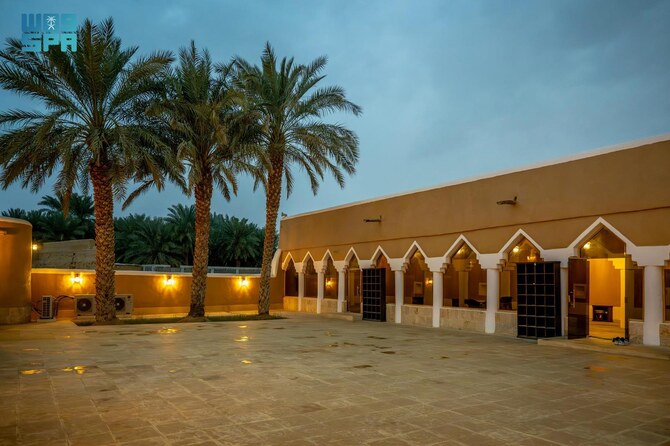
Upon completion, the mosque will cover 625 sq. meters, accommodating up to 180 worshippers. (SPA)
2 / 3
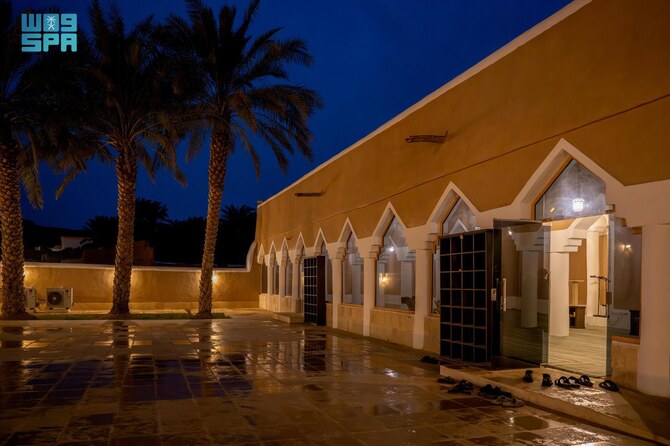
Upon completion, the mosque will cover 625 sq. meters, accommodating up to 180 worshippers. (SPA)
3 / 3
Upon completion, the mosque will cover 625 sq. meters, accommodating up to 180 worshippers. (SPA)
Short Url
Updated 22 March 2025
Follow

Historic Al-Qalaah Mosque in Riyadh restored in traditional Najdi style

RIYADH: The historic Al-Qalaah Mosque in Hotat Bani Tamim, Riyadh, is among the places of worship restored as part of a national project, the Saudi Press Agency reported.

The second phase of the Prince Mohammed bin Salman Project for the Development of Historic Mosques aims to safeguard Islamic heritage and highlight traditional architectural styles.

Established in 1835 and named after the castle of Imam Turki bin Abdullah that once stood on its premises, Al-Qalaah Mosque holds significant historical value, which the project seeks to preserve.

Upon completion, the mosque will cover 625 sq. meters, accommodating up to 180 worshipers, the SPA reported.

Built in the Najdi style, the mosque primarily uses clay, with a construction method involving a clay and hay mixture placed in wooden molds to form brick-like structures.

This technique is known for its economic efficiency compared to other materials, offering advantages such as thermal resistance and maintaining a moderate indoor temperature.

It is one of 30 mosques across 13 regions included in phase two, featuring six in Riyadh, five in Makkah, four in Madinah, three in Asir, and two each in the Eastern Province, Jouf and Jazan. One mosque is included in each of the Northern Borders, Tabuk, Baha, Najran, Hail and Qassim.

Phase two follows the completion of phase one in 2018, which restored 30 mosques in 10 regions, according to the SPA.

The project balances traditional and modern construction standards, ensuring the sustainability of mosque components while preserving heritage.

Saudi companies and engineers specializing in heritage restoration are leading the development efforts, according to the report.

The project’s four strategic objectives include restoring historic mosques for worship, preserving architectural authenticity, highlighting the Kingdom’s cultural heritage, and enhancing the religious and cultural significance of religious sites.


Winter at Tantora Festival returns to AlUla, showcasing rich cultural heritage

The festival derives its name from the Tantora, an ancient sundial situated in the Old Town’s center. (SPA)
Updated 19 December 2025
Follow

Winter at Tantora Festival returns to AlUla, showcasing rich cultural heritage

  • Festival now established as a premier annual event

AlUla: The Winter at Tantora Festival launched on Thursday in AlUla. It runs until Jan. 10 and presents a cultural season which celebrates the region’s rich civilizational, cultural, and historic legacy.

The festival’s program includes a wide array of cultural, artistic, and traditional activities, reported the Saudi Press Agency. 

Attractions include Old Town Nights, Shorfat Tantora, When Shadow Tracks Us, and the Al-Manshiyah Carnival.

FASTFACT

In the past, AlUla’s inhabitants used this clock to measure time and coordinate their agricultural activities.

In addition, there are guided tours of street art through the Old Town, special events commemorating the Year of Handicrafts, culinary experiences, and artistic and musical performances.

The festival derives its name from the Tantora, an ancient sundial situated in the Old Town’s center. In the past, AlUla’s inhabitants used this clock to measure time and coordinate their agricultural activities. The modern festival honors this tradition by marking the onset of winter and the start of the planting season.

This year’s edition offers a range of experiences to celebrate heritage, genuine local culture, and traditional craftsmanship. 

As part of AlUla Moments, the Winter at Tantora Festival supports efforts to boost cultural and tourist engagement while enhancing the visitor experience.

The initiative reflects Saudi Vision 2030’s commitment to advancing cultural tourism and promoting the Kingdom’s historic landmarks.

The festival has established itself as one of AlUla’s premier annual events, consistently attracting both domestic and international audiences.