


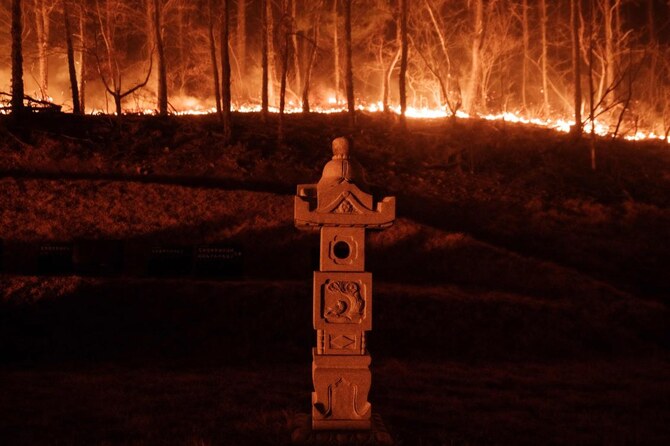
ANDONG, South Korea: One of South Korea’s worst-ever wildfire outbreaks has killed at least 24 people, officials said Wednesday, with multiple raging blazes causing “unprecedented damage” and threatening two UNESCO-listed sites.
More than a dozen fires broke out over the weekend, scorching wide swathes of the southeast, forcing around 27,000 people to urgently evacuate, with the fire cutting off roads and downing communications lines as residents fled in panic.
The death toll jumped to 24 on Wednesday, as wind-driven flames tore through neighborhoods and razed an ancient temple.
“Twenty four people are confirmed dead in the wildfires so far,” with 12 seriously injured, a ministry of interior and safety official said, adding that these were “preliminary figures” and the toll could rise.
Most of those killed were local residents, but at least three firefighters were killed, and a pilot in a firefighting helicopter died when his aircraft crashed in a mountain area, officials said.
According to the interior ministry, the wildfires have charred 17,398 hectares (42,991 acres), with the blaze in Uiseong county alone accounting for 87 percent of the total.
The extent of damage already makes it South Korea’s second largest, after the inferno in April 2000 that scorched 23,913 hectares across the east coast.
The government has raised the crisis alert to its highest level and taken the rare step of transferring some inmates out of prisons in the area.
“Wildfires burning for a fifth consecutive day... are causing unprecedented damage,” South Korea’s acting president Han Duck-soo said.
He told an emergency safety and disaster meeting that the blazes were “developing in a way that is exceeding both existing prediction models and earlier expectations.”
“Throughout the night, chaos continued as power and communication lines were cut in several areas and roads were blocked,” he added.
In the city of Andong, some evacuees sheltering in an elementary school gym said they had to flee so quickly they could bring nothing with them.
“The wind was so strong,” Kwon So-han, a 79-year-old resident in Andong said, adding that as soon as he got the evacuation order he fled.
“The fire came from the mountain and fell on my house,” he said.
“Those who haven’t experienced it won’t know. I could only bring my body.”
Authorities had been using helicopters to battle the blazes, but suspended all such operations after a helicopter crashed Wednesday, killing the pilot on board.
Authorities said changing wind patterns and dry weather had revealed the limitations of conventional firefighting methods.
The fires are “the most devastating” yet in South Korea, acting president Han added.
By Wednesday, two UNESCO-listed sites popular with tourists — historic Hahoe Folk Village and Byeongsan Seowon — were under threat.
Authorities said late Wednesday that the fire was just five kilometers away from Hahoe, a village where some houses were covered with thatched roofs.
Firefighters were also on standby at nearby Byeongsan Seowon, known for its pavillion-style ancient academies.
Huge plumes of smoke turned the sky over the village grey and huge chunks of ash floated in the air, with fire trucks spraying water and fire-retardants onto the historic site in a desperate bit to save it.
Last year was South Korea’s hottest year on record, with the Korea Meteorological Administration saying that the average annual temperature was 14.5 degrees Celsius — two degrees higher than the preceding 30-year average of 12.5 degrees.
The fire-hit region had been experiencing unusually dry weather with below-average precipitation, authorities have said, with the South experiencing more than double the number of fires this year than last.
Some types of extreme weather have a well-established link with climate change, such as heatwaves or heavy rainfall.
Other phenomena, such as forest fires, droughts, snowstorms and tropical storms can result from a combination of complex factors.
“We can’t say that it’s only due to climate change, but climate change is directly (and) indirectly affecting the changes we are experiencing now. This is a sheer fact,” Yeh Sang-Wook, professor of climatology at Seoul’s Hanyang University, said.
“Wildfires will become more frequent,” he added.
“As the atmosphere becomes warmer due to climate change, the water vapor in the ground evaporates more easily, so the amount of moisture contained in the ground decreases. So, all this creates the conditions wildfires can occur more frequently.”
The major fire in Uiseong was reportedly caused by a person tending to a family grave who accidentally ignited the blaze.
Apple farmer Cho Jae-oak said that he and his wife had sprayed water around their house all day to protect it.
“We kept spraying and guarding it. When the fire was burning on the mountain, fireballs flew here,” he said, adding that the encroaching flames eventually forced them to leave.


