

Pakistan’s FIA registers case against journalist Waheed Murad under cybercrime law

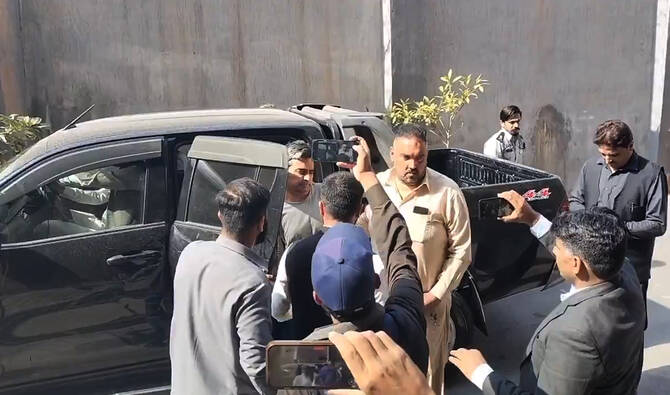
Pakistan’s Federal Investigation Agency officials present journalist Waheed Murad (second, left) at a local court in Islamabad on March 26, 2025. (AN Photo)
Short Url
Updated 27 March 2025
Follow

Pakistan’s FIA registers case against journalist Waheed Murad under cybercrime law

  • Islamabad judicial magistrate grants Federal Investigation Agency two-day physical demand of Murad
  • International rights organizations have expressed concern over deteriorating press freedom in Pakistan

ISLAMABAD: Pakistan’s Federal Investigation Agency (FIA) registered a case against journalist Waheed Murad under a controversial cybercrime law on Wednesday, accusing him of sharing “misleading” information on social media causing “hatred” against government functionaries.

Murad was taken away from his residence in Islamabad by masked men early Wednesday morning, his family said, provoking an outcry from prominent members of the media community who called for his immediate recovery.

Murad works with Urdu News, a digital media outlet catering to Urdu-speaking audiences in Pakistan and abroad. He was produced before Judicial Magistrate Abbas Shah in the District and Sessions Court of Islamabad on Wednesday afternoon. The judge granted the FIA a two-day physical remand of the journalist. 

“Accused Muhammad Waheed s/o Bara Khan is found sharing highly intimidating content/post on social media/Facebook and X Corp. on Wednesday, 12-03-2025 at 07:33 p.m. and 10:21 pm, in which the alleged profile has knowingly disseminated/propagated, fake, false, misleading and misinterpreted information leading to hatred against the government functionaries by stating therein that,” a copy of the complaint seen by Arab News said. 

The complaint said that a case against the journalist has been registered under the Prevention of Electronic Crimes Act (PECA) under sections 9, 10, 20 and 26-A. 

 The issue came to the fore when Murad’s wife, journalist Shinza Nawaz, wrote on social media platform X on Wednesday that masked men had taken Murad forcibly away. 

“My mother was also at home,” she wrote. “They misbehaved with her as well — she was pushed. My mother is a heart patient. They took my mother’s phone, both of Waheed’s phones, and some documents.”

In a video clip circulated after the incident, Murad’s mother-in-law, Abida Nawaz, said the masked men who arrived at their residence identified themselves as police.

“There were three vehicles and around 15 to 20 people,” she continued. “They did not show any warrant or documents. They broke down the doors and dragged Waheed away.”

Murad’s disappearance comes just days after the disappearance of the brothers of exiled Pakistani journalist Ahmad Noorani.

On March 18, around midnight, approximately two dozen individuals identifying themselves as police forcibly entered Noorani’s family home in Islamabad, assaulted his two brothers and took them to an undisclosed location.

Two days later, on March 20, the Federal Investigation Agency (FIA) arrested journalist Farhan Mallick in Karachi. Mallick, founder of the digital media platform Raftar, was detained on allegations of airing “anti-state” content on his YouTube channel.

International rights organizations, including the Committee to Protect Journalists (CPJ), have expressed increasing concern over the deteriorating climate for press freedom in Pakistan.

CPJ and other advocacy groups have repeatedly urged the government to address such incidents and to ensure the safety of journalists operating in the country.

Such incidents targeting journalists are not new in Pakistan and are widely viewed as a tool to stifle dissent and silence independent reporting.

Rights defenders say the pattern reflects a shrinking space for democratic discourse in Pakistan, where journalists critical of state policies or security agencies are frequently subjected to intimidation tactics.


Pakistan warns social media firms of Brazil-style action over failure to curb terror content

Updated 4 sec ago
Follow

Pakistan warns social media firms of Brazil-style action over failure to curb terror content

  • Government says TikTok, Telegram showed highest cooperation while X remained least responsive
  • Pakistan authorities demand platforms share IP data, deploy AI filters and comply with local laws

ISLAMABAD: Pakistan on Thursday issued a final warning to major social media platforms, urging them to comply with local laws and proactively curb militant content or face action similar to measures taken by Brazil against X, where the platform was briefly banned last year.

Briefing foreign media in Islamabad, Minister of State for Interior Talal Chaudhry and Minister of State for Law and Justice Aqeel Malik said the government had formally raised concerns with platforms including X, Meta, Facebook, WhatsApp, YouTube, TikTok and Telegram. The officials said Pakistan expected these companies to strengthen moderation systems, improve cooperation with law enforcement and adopt tools capable of detecting extremist activity before it spreads.

 “This is our last warning. These companies must comply with Pakistani laws, establish offices in Pakistan, and use AI and algorithmic tools to identify terror-linked accounts,” Chaudhry told reporters.

He said authorities had detected dozens of accounts linked to regional militant networks operating across multiple platforms. 

“These accounts are linked to organizations already proscribed by the United States and the United Nations,” he noted, underscoring what officials described as cross-border online activity contributing to radicalization and security threats.

The warning comes as Pakistan cites Brazil’s precedent. In June last year, Brazil’s Supreme Court blocked access to X after the platform refused to ban accounts accused of spreading misinformation during the 2022 presidential election. Access was restored in October after X paid a $5.1 million fine and appointed a local representative, as required under Brazilian law.

Chaudhry said Pakistan had raised its concerns repeatedly, including a detailed briefing to platforms on July 24 this year, but responses “remained insufficient,” describing X as the least cooperative platform, while TikTok and Telegram showed the highest compliance.

Officials said Islamabad has also asked platforms to share IP addresses of accounts linked with militancy and to block the creation of mirror accounts through advanced filters. 

Malik said the issue had been taken up not only with companies but also with governments where these platforms are headquartered.

“Pakistan is a frontline state against terrorism and continues to pay the price for global terrorism. The world must cooperate with Pakistan in this war,” he added, warning that failure to comply could force the government to take action against non-cooperative platforms.