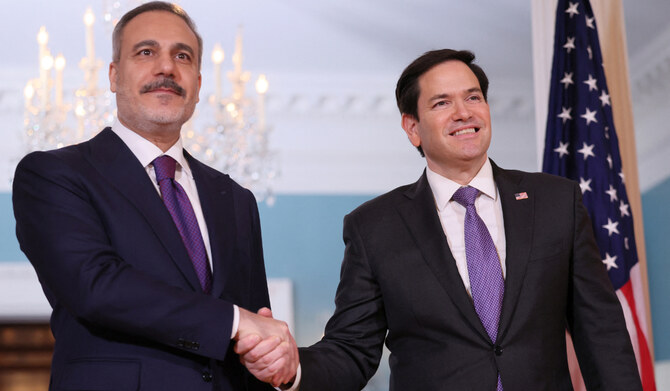

ANKARA/WASHINGTON: Turkiye and the United States want to remove obstacles to defense industry cooperation, a Turkish Foreign Ministry source said on Wednesday, after talks between the NATO allies’ top diplomats in Washington.
On Tuesday, Turkish Foreign Minister Hakan Fidan kicked off a two-day visit to Washington, where he was expected to ask Secretary of State Marco Rubio and other US officials to remove US sanctions on Turkiye and allow it back into a crucial fighter jet program.
The visit comes as Ankara seeks warmer ties with Washington under the administration of President Donald Trump and just days after a phone call between Trump and Turkish President Tayyip Erdogan that a top Trump aide described as “transformational.”
The top Turkish diplomat’s visit also comes at a critical time for Erdogan, after his main political rival and Istanbul’s mayor, Ekrem Imamoglu, was jailed pending trial on Sunday, prompting the largest anti-government protests in over a decade.
HIGHLIGHTS
• Turkish foreign minister meets Rubio in Washington
• Turkey wants back into F-35 program, lifting of CAATSA sanctions
• Trump and Turkey's Erdogan had 'transformational' phone call
Ties between the US and Turkiye have drifted away from a strategic partnership in recent years as disagreements between the two long-standing treaty allies have widened.
The administration of former President Joe Biden kept Turkiye at arm’s length over what it saw as the fellow NATO member’s close ties with Russia. Under Trump, who views Moscow much more favorably, Ankara is hoping for a warmer relationship with Washington. It also plans to capitalize on the personal ties between the two leaders.
During the meeting between Fidan and Rubio on Tuesday, both sides “clearly put forth their political will to lift obstacles to cooperation in the defense industry field,” the source said, adding they also followed up on matters discussed between Trump and Erdogan.
“Technical talks will be held for the resolution of existing problems,” the person added, without elaborating.
During his first term, Trump initially ignored advice from his aides to impose sanctions on Turkiye under its Countering America’s Adversaries Through Sanctions Act (CAATSA) over Ankara’s acquisition of Russian S-400 air defense missile systems in 2019. He then took the step in 2020.
That acquisition also led to Turkiye’s removal from the F-35 jet program, where it was a manufacturer and buyer. Ankara says its removal is unjust and illegal, and has demanded to rejoin or be reimbursed for its investment in the program.
Conversations between the allies on how to resolve the S-400 deadlock were ongoing under Biden. Turkiye had pledged to keep the systems non-operational, a source familiar with the discussions said, but a breakthrough never came.
A Turkish official, requesting anonymity, told Reuters ahead of Fidan’s visit that Ankara was aiming to agree with Washington that keeping the S-400s non-operational can be enough to resolve the matter.
RUSSIA IMPACT
During the Biden era, the allies had settled into a new phase of relations, with a more transactional focus rather than based on shared values, as differences over policies on Syria, the war in Gaza, and judicial matters persisted.
Since coming back into office on January 20, Trump upended Biden’s policy to isolate Moscow and provide unwavering support to Kyiv and instead focused on ending Russia’s war in Ukraine. His shift spooked European leaders who feared Washington could be turning its back to Europe and bolstered Ankara’s role as a potential partner in reshaping European security.
The Turkish official said discussions between Washington and Ankara had “taken a new dimension” after Trump’s shift in approach to Moscow.
“If US sanctions on Russia are to be lifted, it becomes illogical for CAATSA to be implemented on third countries. As much as this issue is about Turkiye-USA ties, it is also about Turkiye-Russia ties,” the official added.
Sources familiar with the matter said the phone call between Erdogan and Trump may bring positive momentum to conversations in coming days, though no promises were made.
“The president had a great conversation with Erdogan a couple of days ago. Really transformational, I would describe it,” Trump’s special envoy for the Middle East Steve Witkoff said in an interview with right-wing podcaster Tucker Carlson.
Exclusion from the F-35 program pushed Turkiye to purchase 40 Lockheed Martin Block-70 F-16 fighter jets. However, despite agreeing on the procurement, there has been little progress on the acquisition for months.
The Turkish source said Fidan and Rubio also discussed head of state-level visits to be held in the coming period, without elaborating.
The two also emphasized the importance of stability in Syria and in the Balkans, while discussing efforts to end the Russia-Ukraine war, and the need for a ceasefire in Gaza, the source added.