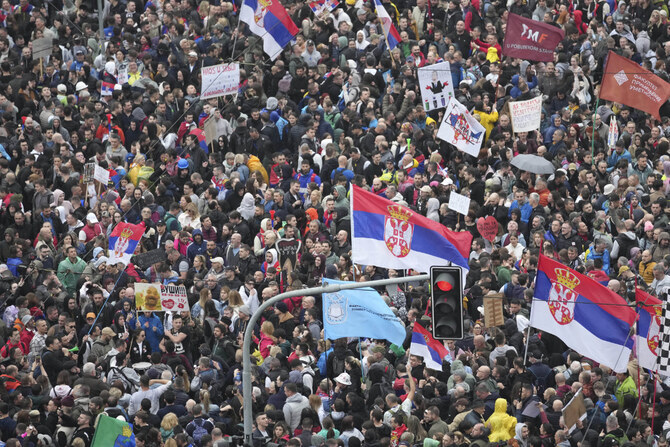
BELGRADE: Massive student-led anti-graft protests have spread from Serbia to neighboring Balkan countries, with thousands rallying under the slogan “Corruption kills” following a series of deadly tragedies that have claimed dozens of lives.
Young people have used the rallies to vent their anger in a region of Europe that rights groups say suffers from endemic corruption, prompting hundreds of thousands of mostly young people to go onto the streets in Serbia alone to demand change.
The wave of demonstrations on a scale unseen in Serbia since the 1990s kicked off after a recently renovated train station canopy collapsed on November 1 in the northern city of Novi Sad, killing 16 people.
With many blaming the deaths on corruption and inadequate oversight, the tragedy fueled outrage across Serbia and prompted the prime minister to resign in the protests’ wake.
After the Serbian example, young people have organized similar anti-graft rallies in North Macedonia and Montenegro, while protesters in European Union member state Bulgaria have offered solidarity with their Balkan neighbors.
Now the symbol of those protests — a bloodied red hand print — has turned up at rallies in neighboring North Macedonia after a fire at a nightclub operating under a questionable license killed 59 mostly young concert-goers on March 16.
“Girls from my generation died,” Ema Peseva, a 20-year-old student from Skopje, told AFP during Monday’s protest in the capital which drew thousands.
As in Serbia, demonstrators at the Skopje rally chanted “Corruption kills” while accusing officials of being “murderers.”
“Everyone is bribed so they can line their pockets for travels, yachts, private schools. Meanwhile, children are dying from fire and pyrotechnics at concerts,” Peseva said, referring to the stage effects blamed for the blaze.
Milena Janevska, one of the organizers, said that students wished to “demand accountability for the tragedy in Kocani,” where the fire took place.
“We demand transparency from all institutions, simply to be accountable to the citizens who have a duty to show this revolt,” the 26-year-old told AFP.
In a show of solidarity Bulgarian anti-graft protesters last week held a few minutes’ silence remembering the Kocani fire dead along with their own, with some drawing comparisons to the country’s 2001 Indigo Disco stampede that killed seven queueing teenagers.
“We said a long time ago that corruption kills — literally. We saw in Bulgaria how corruption killed children in front of the Indigo nightclub. We saw it when people died in bus crashes, on unsafe roads, in incidents caused by poor construction,” said lawyer Velislav Velichkov, one of the organizers.
Montenegro meanwhile was likewise shaken in early 2025 by protests after a man shot dead 13 people in the street on the evening of January 1 — the second mass killing in the small town of Cetinje in less than two and a half years.
Directly inspired by the Serbian protest movement, demonstrators demanded the dismissal of senior security officials, police reform, the confiscation of illegal weapons and better mental health care.
“Students in Serbia are truly an inspiration to all those frustrated by the high levels of corruption — which, as we have seen from concrete examples, can be deadly,” Aleksandar Popov, president of the Center for Regionalism, a Novi Sad-based think tank, told AFP.
And compared with the rest of Europe many Balkan countries struggle with graft, according to watchdog Transparency International.
Serbia ranks 105th out of 180 countries on the latest global corruption perceptions index — its worst position in more than a decade.
North Macedonia fares only slightly better at 88th place, while Bulgaria ranks 76th and Montenegro 65th.
Sofija Todorovic, director of the Serbian branch of the regional Youth Initiative for Human Rights NGO, said she found it encouraging that young people are leading the anti-graft protests and driving change in the Balkans.
She said that they have defied the stereotypes of their generation as being “passive and too absorbed by the Internet and their phones.”
“I believe young people have shown far more sharpness, capability, and wisdom than previous generations,” Todorovic told AFP, adding that the key difference lies in how they access and process information.
“They genuinely feel they have a role to play in society, that their voices matter, and I believe this is crucial for the future of the region.”


![]()

Student anti-corruption rallies spread across Balkans
Short Url
https://arab.news/jungh
Student anti-corruption rallies spread across Balkans
- Young people have used the rallies to vent their anger in a region of Europe that rights groups say suffers from endemic corruption
- After the Serbian example, young people have organized similar anti-graft rallies in North Macedonia and Montenegro


Latest updates





© 2026 SAUDI RESEARCH & PUBLISHING COMPANY, All Rights Reserved And subject to Terms of Use Agreement.