

Doctors warn US aid cuts leave rural Afghanistan without healthcare

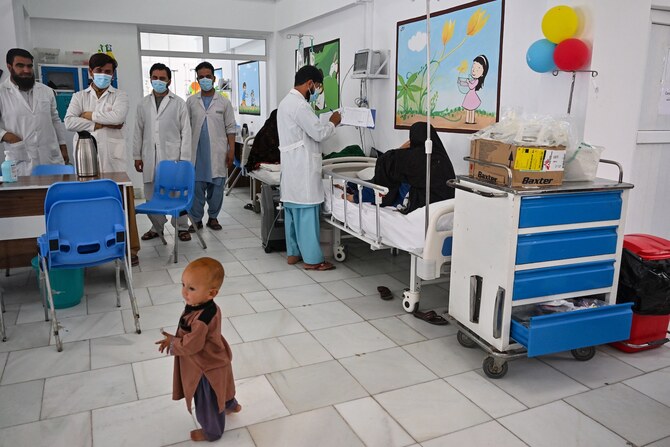
This photo taken on July 21, 2022 shows doctors treating patients in the critical care section of the malnutrition ward at the Boost Hospital, run by Medicines Sans Frontiers, in Lashkar Gah, Helmand. (AFP)
Short Url
Updated 25 March 2025
Follow

Doctors warn US aid cuts leave rural Afghanistan without healthcare

  • WHO says hundreds of health centers, clinics across country are set to close by June
  • Afghan health sector relies on donors as govt covers only 3% of total expenditure

Kabul: Afghan doctors warn that new foreign funding cuts are depriving the country’s most vulnerable of healthcare, especially in rural areas, where aid-dependent NGOs are the sole providers.

The WHO announced last week that 206 health facilities across 28 provinces of Afghanistan were either suspended or closed due to a lack of financial support.

About 200 more clinics, health centers and mobile health and nutrition teams operating in remote areas of the country are set to close by June.

The UN health agency said that the funding shortfall, which comes amid massive US aid cuts since January, is leaving an additional 1.8 million Afghans without access to primary health care.

“The big hospitals in provincial capitals are primarily run by the government while most of the health centers in rural areas are operated by NGOs with funding from different donors,” Dr. Zobair Saljuqi, a doctor at Herat Regional Hospital, told Arab News.

Most of the rural population cannot afford to travel to provincial capitals or major cities for treatment. Health facilities in remote areas are also crucial for women, especially since their movement has been curtailed by the Taliban administration.

“If these health facilities don’t receive the needed financial aid, they cannot continue functioning even for a month because from staff salaries, through running costs, to medicines — all are provided by the donors,” Saljuqi said.

“Women will face severe challenges during pregnancies and children could die due to malnutrition or infectious diseases.”

The halt in US aid is another blow to Afghanistan’s humanitarian situation since the Taliban took over in 2021. Following the collapse of the country’s Western-backed regime, the US withdrew its troops and froze all projects overnight, after spending billions on two decades of military and development operations.

Afghanistan’s health sector relies on donor funds. UN estimates show that out-of-pocket expenses and external funding make up 97 percent of total health expenditure, while government contributions account for just 3 percent.

Dr. Ahmad Tariq, who works at a health center in Qarghayi district, Laghman province, said that almost everyone in his neighborhood depended on the facility.

“People here are very poor. They are all either farmers or daily laborers. They can’t afford to travel to the center of the province or buy medicine,” he told Arab News.

“Our small facility is helping tens of patients every day, men and women, children and elderly persons. They come for OPD consultations as well as vaccination and receive some medicine for free. If it wasn’t for this center most of the people would have been deprived of basic health services.”

According to Afghanistan’s Ministry of Health data, 72 percent of the rural population lacks access to primary and secondary healthcare services.

Of the country’s 400 districts, only 93 have operational hospitals, and almost 10 million people in more than 20,000 villages have limited or no access to basic health services.

Dr. Mohammad Nazar, a public health practitioner in Kabul, forecast that the sudden shortage of US-led funding would further devastate Afghanistan’s already fragile health system, which had endured decades of war and Soviet and American invasions.

“Almost all health centers across rural areas are supported by donors and humanitarian organizations,” he said.

“Tens of health facilities are already closing, which means more and more women, children, elderly persons, displaced persons ... will have no access to essential health services and mortality from preventable diseases would rise.”


Kosovo voters cast ballots in a second attempt this year to elect a government and avoid more crisis

Updated 28 December 2025
Follow

Kosovo voters cast ballots in a second attempt this year to elect a government and avoid more crisis

  • The prime minister’s party is again the favorite in the race, but it is unclear whether it will manage to muster a majority this time in the 120-member parliament

PRISTINA: Voters in Kosovo cast ballots on Sunday in an early parliamentary election in hopes of breaking a political deadlock that has gripped the small Balkan nation for much of this year.
The snap vote was scheduled after Prime Minister Albin Kurti’s governing Vetevendosje, or Self-Determination, party failed to form a government despite winning the most votes in a Feb. 9 election.
The deadlock marked the first time Kosovo could not form a government since it declared independence from Serbia in 2008 following a 1998-99 war that ended in a NATO intervention.
The prime minister’s party is again the favorite in the race, but it is unclear whether it will manage to muster a majority this time in the 120-member parliament, after other mainstream parties refused an alliance.
According to Kosovo’s election laws, 20 parliamentary seats are automatically assigned to ethnic Serb representatives and other minority parties.
Another inconclusive vote would further deepen the crisis. Kosovo has already not approved a budget for next year, sparking fears of possible negative effects on the already poor economy in the country of 2 million people.
Lawmakers are set to elect a new president in March as current President Vjosa Osmani’s mandate expires in early April. If this fails too, another snap election must be held.
The main opposition parties are the Democratic League of Kosovo and the Democratic Party of Kosovo. They have accused Kurti of authoritarianism and of alienating Kosovo’s US and European Union allies since he came to power in 2021.
A former political prisoner during Serbia’s rule in Kosovo, the 50-year-old Kurti has taken a tough stand in talks mediated by the European Union on normalizing relations with Belgrade. In response, the EU and the United States imposed punitive measures.
Kurti has promised to buy military equipment to boost security.
No reliable pre-election polls have been published. Kurti’s party at the previous election won around 42 percent of the votes while the two main rival parties had together around 40 percent.
Analysts say that even the slightest changes in numbers on Sunday could prove decisive for the future distribution of power but that nothing is certain.
Tensions with restive ethnic Serbs in the north exploded in clashes in 2023 when scores of NATO-led peacekeepers were injured. In a positive step, ethnic Serb mayors this month took power peacefully there after a municipal vote.
Kurti has also agreed to accept third-country migrants deported from the United States as part of tough anti-immigration measures by the administration of President Donald Trump. One migrant has arrived so far, authorities have told The Associated Press.
Kosovo is one of the six Western Balkan countries striving to eventually join the EU, but both Kosovo and Serbia have been told they must first normalize relations.