

Sotheby’s to auction rare Islamic arms and armor collection 

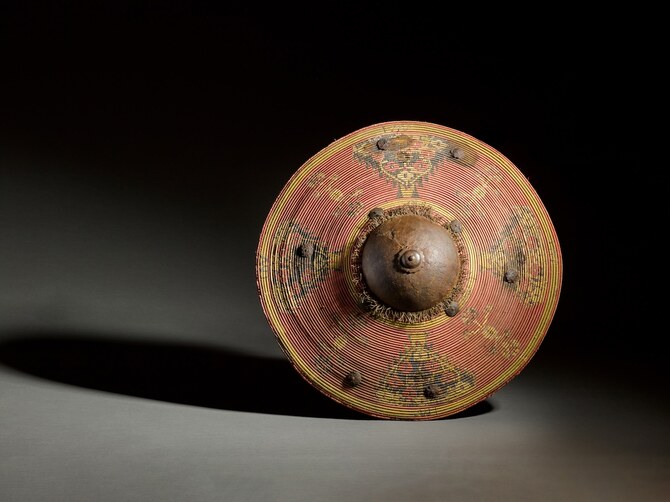
A Rare Ottoman Wicker Shield (Kalkan), Turkey, 17th Century (estimate £60,000-80,000). (Supplied)
Short Url
Updated 25 March 2025
Follow

Sotheby’s to auction rare Islamic arms and armor collection 

DUBAI: Sotheby’s is set to showcase a collection of Islamic arms and armor, representing more than 500 years of history and spanning more than 100 lots in April in London, Dubai and at the biannual Arts of the Islamic World & India. 

The collection presents the artistic traditions of numerous Islamic dynasties, from Spain to Indonesia, and is the result of over 50 years of study and acquisition by scholar-collector Philippe Gilles René Missillier (1949-2022).

The auction will take place on April 29 at Sotheby’s London, followed by the biannual Arts of the Islamic World & India sale on April 30. 


The collection presents the artistic traditions of numerous Islamic dynasties, from Spain to Indonesia. (Supplied)

Prior to the auctions, highlights from the collection will be exhibited at Sotheby’s Dubai gallery in Dubai International Financial Center from April 7-11. 

The collection highlights the technological evolution of weaponry, tracing developments from the equestrian age of chivalry through the gunpowder revolution and into the modern era. 

The items showcase skilled craftsmanship, featuring vegetal and geometric patterns combined with calligraphy. Similar motifs appear across different weapons, highlighting the connections between Islamic art across time and place.


An exceptional Sabre presented to Claude Martin by Nawab Asaf Al-Dawla of Awadh, India, late 18th century (estimate £300,000-500,000). (Supplied)

Notable items include rare Mamluk and Aqqoyunlu pieces, as well as examples from the Safavid, Ottoman and Mughal empires. Highlights include artifacts from the Siege of Vienna’s Turkenbeute and the personal swords of Mughal emperor Shah Jahan and French army officer Claude Martin.

Missillier, who assembled the collection over half a century, immersed himself in his field, visiting museums, attending auctions and studying reference works. 

His collection was exhibited in Paris in 1988 as part of Splendour des Armes Orientales, the largest exhibition of its kind in the 20th and 21st centuries. 

This upcoming sale marks the first public viewing of the collection since that exhibition.


World of Coffee trade show capitalizes on Gulf’s strong coffee culture

Updated 06 January 2026
Follow

World of Coffee trade show capitalizes on Gulf’s strong coffee culture

DUBAI: Long regarded as the birthplace of coffee brewing, the Middle East is entering a new phase of cafe culture — and the fifth edition of World of Coffee, which takes place in Dubai from Jan. 18-20, will help drive that momentum.

Saudi Arabia alone is home to more than 5,100 branded cafes, with daily coffee consumption exceeding 36 million cups. Coffee is part of the social and cultural fabric, from traditional majlis gatherings to contemporary specialty cafes.

“Saudi Arabia’s coffee sector is evolving rapidly. There is increasing investment in quality, education, and presentation, alongside renewed interest in origin storytelling and cultural context,” said Shouq Bin Redha, exhibition manager for World of Coffee Dubai 2026, where Saudi Arabia will host a national pavilion.

“Saudi coffee has a very distinct identity rooted in heritage, ritual, and hospitality. Its profile is closely tied to traditional preparation methods and regional flavor preferences, which sets it apart on the global stage,” she told Arab News. “The national pavilion reflects this balance between tradition and modernization.”

Organized by DXB LIVE in partnership with the Specialty Coffee Association, World of Coffee Dubai has expanded dramatically, growing from 5,000 sq. meters in 2022 to more than 20,000 sq. meters in 2026. The event brings together producers, traders, roasters, cafe owners and innovators from around the world.

“At its core, the event is about bringing together the full coffee value chain in one place,” Redha said. “We want participants to leave not only having discovered new products or origins, but with stronger partnerships, clearer market insight, and a deeper understanding of how the industry is evolving.”

She added: “The Gulf has become an increasingly attractive market for producers because it combines strong consumer demand with a growing appreciation for quality, origin, and traceability.”

The UAE’s coffee market alone exceeds $3.2 billion, while Dubai continues to strengthen its position as one of the world’s most cafe-dense and diverse cities.

“Dubai, in particular, offers a unique gateway to multiple markets at once. For producers, World of Coffee Dubai provides direct access not only to local buyers, but to an international audience that uses the city as a regional and global trading hub,” Redha said.

When it comes to trends in the Gulf’s coffee scene, Redha said she expected to see “continued diversification in sourcing, with buyers exploring a broader range of origins and flavor profiles. There is also growing interest in coffees that offer greater transparency, whether through direct trade relationships, clearer traceability, or stronger sustainability credentials.”