

Humanitarian aid cuts could cause more children to die: UN

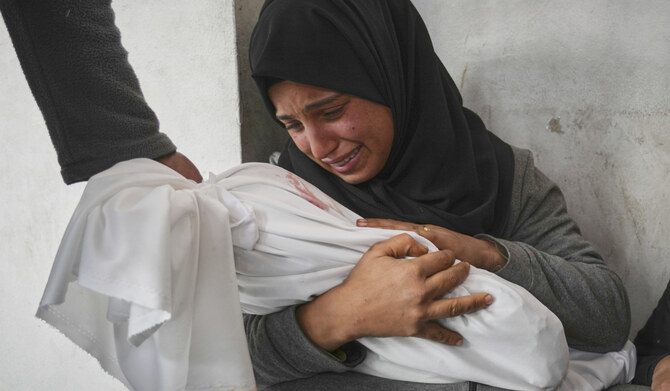
Amani Abu Aker holds the body of her two-year-old niece Salma, killed during an Israeli army strike, before their burial at the Baptist hospital in Gaza City, Monday March 24, 2025. (AP)
Short Url
Updated 25 March 2025
Follow

Humanitarian aid cuts could cause more children to die: UN

  • A separate report by the same organizations found a stubbornly high number of stillbirths — babies who die after 28 weeks of pregnancy, before or during childbirth — with a total of around 1.9 million such deaths in 2023

UNITED NATIONS, United States: Cuts in international aid could bring an end to decades of progress in fighting child mortality, and even reverse the trend, the United Nations warned Monday.
Although the annual report from UNICEF, the World Health Organization and the World Bank does not single out the United States, it comes as President Donald Trump’s administration has axed the vast majority of the programs carried out by USAID, America’s main overseas aid agency with a former annual budget of $42.8 billion.
“The global health community cannot be worried enough at the situation that we are seeing,” Fouzia Shafique, UNICEF’s Associate Director of Health, told AFP.
The report warns the consequences of aid money cuts will be the worst in countries where infant mortality rates are already the highest, such as in sub-Saharan Africa and southern Asia.
“Simply put, if support for life-saving services is not sustained, many countries can expect a resurgence of newborn and child deaths,” the report said.
In 2023, mortality of children under age five continued to drop, with 4.8 million deaths recorded, including 2.3 million newborn babies under a month old, according to the report.
The number of such deaths fell below five million for the first time in 2022, and the new record low marks a 52 percent decline since 2000.
But Shafique insisted that “4.8 million is 4.8 million too many.”
Since 2015, progress in fighting child mortality has slowed as aid money was redirected toward fighting Covid — and this could be just the start of a dangerous pattern.
“Bringing preventable child deaths to a record low is a remarkable achievement. But without the right policy choices and adequate investment, we risk reversing these hard-earned gains,” UNICEF executive director Catherine Russell said in a statement.
“We cannot allow that to happen,” she added.

Some negative impacts of the funding cuts are being felt already, such as health care worker shortages, clinic closures, vaccination program disruptions, and a lack of essential supplies, such as malaria treatments.
Ethiopia, for instance, is enduring a big increase in malaria cases, said Shafique.
But the country is facing an acute shortage of diagnostic tests, insecticide-treated nets for beds and funding for spraying campaigns against disease-carrying mosquitos.
A separate report by the same organizations found a stubbornly high number of stillbirths — babies who die after 28 weeks of pregnancy, before or during childbirth — with a total of around 1.9 million such deaths in 2023.
“Every day, more than 5,000 women around the world endure the heartbreaking experience of stillbirth,” the second report states.
With proper care during pregnancy and childbirth, many of these deaths could be averted, as could the premature births of fragile babies.
And deaths of small children could also be largely avoided by fighting preventable diseases such as pneumonia and diarrhea.
“From tackling malaria to preventing stillbirths and ensuring evidence-based care for the tiniest babies, we can make a difference for millions of families,” said Dr. Tedros Adhanom Ghebreyesus, Director-General of the World Health Organization.


Uganda’s presidential election experiences hours of delays at some polling stations

Updated 7 sec ago
Follow

Uganda’s presidential election experiences hours of delays at some polling stations

  • Some polling stations remained closed for up to four hours after the scheduled 7 a.m. start time due to “technical challenges“
  • The East African country of roughly 45 million people has 21.6 million registered voters

KAMPALA, Uganda: Uganda’s presidential election was plagued by widespread delays Thursday in addition to a days-long Internet shutdown that has been criticized as an anti-democratic tactic in a country where the president has held office since 1986.
Some polling stations remained closed for up to four hours after the scheduled 7 a.m. start time due to “technical challenges,” according to the nation’s electoral commission, which asked polling officers to use paper registration records to ensure the difficulties did not “disenfranchise any voter.”
President Yoweri Museveni, 81, faces seven other candidates, including Robert Kyagulanyi, a musician-turned-politician best known as Bobi Wine, who is calling for political change.
The East African country of roughly 45 million people has 21.6 million registered voters. Polls are expected to close at 4 p.m. Thursday, according to the electoral commission. Results are constitutionally required to be announced in 48 hours.
Impatient crowds gathered outside polling stations expressing concerns over the delays Thursday morning. Umaru Mutyaba, a polling agent for a parliamentary candidate, said it was “frustrating” to be waiting outside a station in the capital Kampala.
“We can’t be standing here waiting to vote as if we have nothing else to do,” he said.
Wine alleged there was electoral fraud occurring, noting that biometric voter identification machines were not working at polling places and claiming there was “ballot stuffing.”
“Our leaders, including Deputy President for Western Region, arrested. Many of our polling agents and supervisors abducted, and others chased off polling stations,” Wine wrote in a post on social media platform X.
Museveni told journalists he was notfied biometric machines were inoperable at some stations and he supported the electoral body’s decision to revert to paper registration records. He did not comment on the allegation of fraud.
Ssemujju Nganda, a prominent opposition figure and lawmaker seeking reelection in Kira municipality, told The Associated Press he had been waiting in line to vote for three hours.
Nganda also noted biometric machines were malfunctioning, in addition to the late arrival of balloting materials, and predicted the delays likely would lead to apathy and low turnout in urban areas where the opposition has substantial support.
“It’s going to be chaos,” he said Thursday morning.
Nicholas Sengoba, an independent analyst and newspaper columnist, said delays to the start of voting in urban, opposition areas favored the ruling party.
Museveni serving Africa’s third-longest presidential term
Uganda has not witnessed a peaceful transfer of presidential power since independence from British colonial rule six decades ago.
Museveni has served the third-longest term of any African leader and is seeking to extend his rule into a fifth decade. Some critics say removing him through elections remains difficult, but the aging president’s authority has become increasingly dependent on the military led by his son, Muhoozi Kainerugaba.
Museveni and Wine are reprising their rivalry from the previous election in 2021, when Wine appealed to mostly young people in urban areas. With voter turnout of 59 percent, Wine secured 35 percent of the ballots against Museveni’s 58 percent, the president’s smallest vote share since his first electoral campaign three decades ago.
The lead-up to Thursday’s election produced concerns about transparency, the possibility of hereditary rule, military interference and opposition strategies to prevent vote tampering at polling stations.
Uganda’s Internet was shut down Tuesday by the government communications agency, which cited misinformation, electoral fraud and incitement of violence. The shutdown has affected the public and disrupted critical sectors such as banking.
Heavy security deployed
There has been heavy security leading up to voting, including military units deployed on the streets this week.
Amnesty International said security forces are engaging in a “brutal campaign of repression,” citing a Nov. 28 opposition rally in eastern Uganda where the military blocked exits and opened fire on supporters, killing one person.
Museveni urged voters to come out in large numbers during his final rally Tuesday.
“You go and vote, anybody who tries to interfere with your freedom will be crushed. I am telling you this. We are ready to put an end to this indiscipline,” he said.
The national electoral commission chairperson, Simon Byabakama, urged tolerance among Ugandans as they vote.
“Let us keep the peace that we have,” Byabakama said late Wednesday. “Let us be civil. Let us be courteous. Let’s be tolerant. Even if you know that this person does not support (your) candidate, please give him or her room or opportunity to go and exercise his or her constitutional right.”
Authorities also suspended the activities of several civic groups during the campaign season. That Group, a prominent media watchdog, closed its office Wednesday after the interior ministry alleged in a letter that the group was involved in activities “prejudicial to the security and laws of Uganda.”
Veteran opposition figure Kizza Besigye, a four-time presidential candidate, remains in prison after he was charged with treason in February 2025.