
WASHINGTON: The US government has alleged that Columbia University student and pro-Palestinian demonstrator Mahmoud Khalil withheld that he worked for a United Nations Palestinian relief agency in his visa application, saying that should be grounds for deportation.
The UN agency known as UNRWA provides food and health care to Palestinian refugees and has become a flashpoint in the Israeli war in Gaza. Israel contends that 12 UNRWA employees were involved in Hamas’ attack on Israel on October 7, 2023, leading the US to halt funding of the group.
UNRWA said Khalil was briefly an unpaid intern.
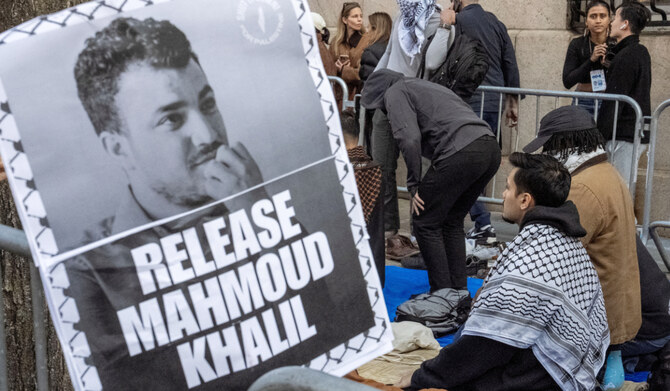
The administration of US President Donald Trump on March 8 detained Khalil, a prominent figure in the pro-Palestinian protests that rocked Columbia’s New York City campus last year, and sent him to Louisiana in an attempt to remove him from the country.
HIGHLIGHTS
• Khalil accused of withholding UNRWA affiliation on visa application
• UNRWA says he was an unpaid intern for a brief time
• U.S. claims Khalil's presence poses foreign policy risks
The case has drawn attention as a test of free speech rights, with supporters of Khalil saying he was targeted for publicly disagreeing with US policy on Israel and its occupation of Gaza. Khalil has called himself a political prisoner.
The US alleges Khalil’s presence or activities in the country would have serious foreign policy consequences.
A judge has ordered Khalil not be deported while his lawsuit challenging his detention, known as a habeas petition, is heard in another federal court.
Khalil, a native of Syria and citizen of Algeria, entered the US on a student visa in 2022 and later filed to become a permanent resident in 2024.
In a court brief dated Sunday, the US government outlined its arguments for keeping Khalil in custody while his removal proceedings continue, arguing first that the US District Court in New Jersey, where the habeas case is being heard, lacks jurisdiction.
The brief also says Khalil “withheld membership in certain organizations” which should be grounds for his deportation.
It references a March 17 document in his deportation case that informed Khalil he could be removed because he failed to disclose that he was a political officer of UNRWA in 2023.
A UNRWA spokesperson said Khalil was never on the payroll of the agency during his short internship and that the group does not have in its job descriptions the post of political affairs officer.
The UN said in August an investigation found nine of the agency’s 32,000 staff members may have been involved in the October 7 attacks.
The US court notice also accuses Khalil of leaving off his visa application that he worked for the Syria office in the British embassy in Beirut and that he was a member of the group Columbia University Apartheid Divest.
Attorneys for Khalil did not respond to a request for comment.
One attorney, Ramie Kassem, a co-director of the legal clinic CLEAR, was quoted in the New York Times as saying the new deportation grounds were “patently weak and pretextual.”
“That the government scrambled to add them at the 11th hour only highlights how its motivation from the start was to retaliate against Mr. Khalil for his protected speech in support of Palestinian rights and lives,” Kassem said, according to the Times.