

Authorities ban public gatherings in Karachi ahead of protest by Baloch rights group

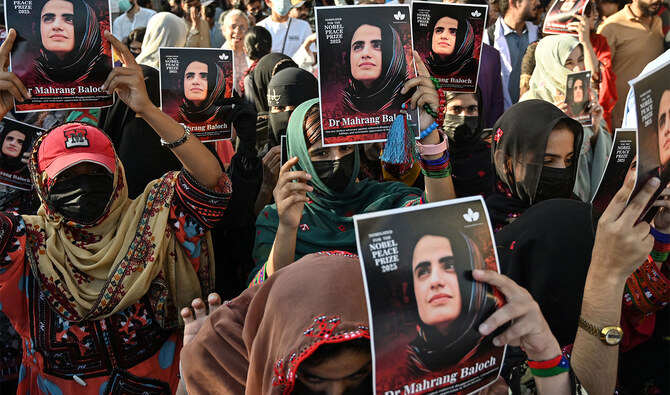
Activists from Baloch Yakjehti Committee (BYC) and civil society hold portraits of Mahrang Baloch as participate in a protest demanding the release of Mahrang Baloch, one of Pakistan's most prominent human rights advocates, along with missing Baloch persons, in Karachi on March 24, 2025. (AFP)
Short Url
Updated 24 March 2025
Follow

Authorities ban public gatherings in Karachi ahead of protest by Baloch rights group

  • The Baloch Yakjehti Committee announced a demonstration outside the Karachi Press Club against the detention of Dr. Mahrang Baloch
  • A number of BYC supporters tried to reach the venue for the protest at 4pm, but they were intercepted by police, local media says

ISLAMABAD: Authorities have banned all public gatherings in Pakistan’s southern port city of Karachi, the commissioner’s office announced on Monday, ahead of a protest by the Baloch Yakjehti Committee (BYC) rights group.

The BYC announced a demonstration outside the Karachi Press Club (KPC) against the detention of its leader, Dr. Mahrang Baloch, and some other members who were arrested last week at a protest camp in Quetta, the capital of Pakistan’s southwestern Balochistan province.

Dr. Baloch, one of Pakistan’s most prominent human rights advocates, has long campaigned for the ethnic Baloch people, many of whom say they have been targeted by authorities with harassment, enforced disappearances and extrajudicial killings. Authorities deny these claims.

The Karachi commissioner’s office said senior police officials in Karachi had requested for the ban on public gatherings in the city in view of the “prevailing law and order situation” and to protect lives of general public.

“Syed Hassan Naqvi, Commissioner Karachi Division, hereby impose a complete ban on any type of protests, demonstrations, sit-ins, rallies and assembly of more than five persons with the Karachi Division,” Naqvi’s office said in a notification.

A number of BYC supporters tried to reach the KPC but they were intercepted by police, local media reported on Monday. The BYC protest was scheduled for 4pm in Karachi, while the group had also organized a protest in Quetta, where three protesters had died following a pre-dawn raid by police last week. Both sides blamed each other for the deaths.

Dr. Baloch and other protesters have been charged with terrorism, sedition and murder, according to the police charge sheet. On Sunday, Mary Lawlor, the United Nations special rapporteur on human rights defenders, said she was “very concerned” at Baloch’s arrest.

Pakistan has been battling a separatist insurgency in Balochistan for decades, where militants target state forces and foreign nationals in the mineral-rich southwestern province bordering Afghanistan and Iran.

Earlier this month, the Baloch Liberation Army (BLA) separatist group launched a dramatic train siege that officials said ended in around 60 deaths, half of whom were separatists behind the assault.


Pakistan says Indian minister initiated handshake in Dhaka, first contact since May conflict

Updated 58 min 5 sec ago
Follow

Pakistan says Indian minister initiated handshake in Dhaka, first contact since May conflict

  • Pakistan’s Ayaz Sadiq and India’s Subrahmanyam Jaishankar met on the sidelines of Khaleda Zia’s funeral
  • The National Assembly of Pakistan says Islamabad has consistently emphasized dialogue with New Delhi

ISLAMABAD: Pakistan said on Wednesday Indian External Affairs Minister Subrahmanyam Jaishankar initiated a brief handshake with Speaker of the National Assembly Sardar Ayaz Sadiq in Dhaka, marking the first high-level contact between the two nuclear-armed rivals since their military conflict in May.

The encounter took place on the sidelines of the funeral of former Bangladeshi prime minister Khaleda Zia, attended by senior officials and diplomats from multiple countries.

Ties between India and Pakistan have remained frozen since a four-day military confrontation in May, during which both sides exchanged missile, drone and air strikes before a ceasefire brokered by Washington.

“During Speaker NA Sardar Ayaz Sadiq’s visit to the Parliament of Bangladesh ... the Indian External Minister Dr. S. Jaishankar approached the Speaker National Assembly and [shook] hands,” Pakistan’s National Assembly said in a post on social media platform X.

It added that Jaishankar introduced himself to Sadiq during the brief interaction. India has not commented publicly on the exchange.

“It is noteworthy that Pakistan has consistently emphasized dialogue, restraint, and cooperative measures, including proposals for peace talks,” the post continued.

Tensions between the two neighbors escalated in April after a militant attack in Indian-administered Kashmir killed more than 20 tourists. New Delhi blamed Pakistan for supporting the attack, an allegation Islamabad denied, calling instead for an independent and transparent investigation.

Officials from both countries have largely avoided public interactions since the conflict, with senior figures refraining from handshakes or exchanges at international gatherings.

Sadiq was in Dhaka to attend Zia’s funeral and to convey condolences from Pakistan’s leadership and people. He also met Zia’s son Tarique Rahman, the acting chairman of the Bangladesh Nationalist Party, according to Pakistan’s high commission in Bangladesh.

Speaking to Pakistan’s Geo TV, Sadiq confirmed that Jaishankar approached him in full media glare and exchanged pleasantries.

Responding to a question about being photographed with the Indian minister, he said: “Cameras arrived with them. Our people took the photographs later.”