

US trade officials to visit India for trade talks from Tuesday

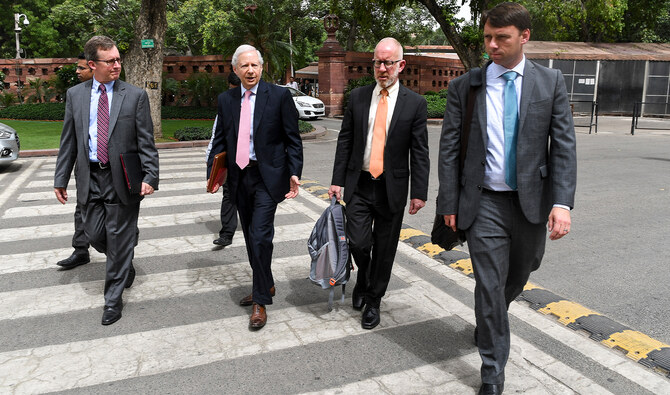
Assistant US Trade Representative for South and Central Asia Brendan Lynch (first right) arrives at the Parliament house for a meeting in New Delhi, India, on July 12, 2019. (AFP/File)
Short Url
Updated 24 March 2025
Follow

US trade officials to visit India for trade talks from Tuesday

  • Assistant US Trade Representative for South and Central Asia Brendan Lynch will lead the group
  • President Trump’s plans to impose reciprocal tariffs from April 2 are causing alarm among Indian exporters

NEW DELHI: A delegation of officials from the United States will visit India from March 25 to 29 for trade talks with Indian officials, a US embassy spokesperson said on Monday.

Assistant US Trade Representative for South and Central Asia Brendan Lynch will lead the group. “This visit reflects the United States’ continued commitment to advancing a productive and balanced trade relationship with India,” the spokesperson said.

Indian Trade Minister Piyush Goyal spent nearly a week in the United States earlier this month where he held trade discussions, and as US President Donald Trump’s plans to impose reciprocal tariffs from April 2 causing alarm among Indian exporters. During Prime Minister Narendra Modi’s visit to the US last month, both nations agreed to work on the first phase of a trade deal by autumn 2025, with a target of reaching $500 billion in bilateral trade by 2030. India and the US are engaged in discussions to resolve tariff-related issues, and finalize a framework for a bilateral trade pact, Randhir Jaiswal, spokesman for India’s external affairs ministry, said last week.

“We value our ongoing engagement with the Government of India on trade and investment matters and look forward to continuing these discussions in a constructive, equitable, and forward-looking manner,” the US embassy spokesperson said.


Japan reaffirms no-nukes pledge after senior official suggests acquiring weapons

Updated 3 sec ago
Follow

Japan reaffirms no-nukes pledge after senior official suggests acquiring weapons

  • The unnamed official said Japan needed nuclear weapons because of a worsening security environment
  • At a regular press briefing in Tokyo, Chief Cabinet Secretary Minoru Kihara said Japan’s nuclear policy had ‌not changed
TOKYO: Japan reaffirmed its decades-old pledge never to possess nuclear weapons on Friday after local media reported that a senior security official suggested the country should ​acquire them to deter potential aggressors. The unnamed official said Japan needed nuclear weapons because of a worsening security environment but acknowledged that such a move would be politically difficult, public broadcaster NHK and other outlets reported, describing the official as being from Prime Minister Sanae Takaichi’s office.
At a regular press briefing in Tokyo, Chief Cabinet Secretary Minoru Kihara said Japan’s nuclear policy had ‌not changed, but declined ‌to comment on the remarks or ‌to ⁠say whether ​the ‌person would remain in government. There is a growing political and public willingness in Japan to loosen its three non-nuclear principles not to possess, develop or allow nuclear weapons, a Reuters investigation published in August found.
This is driven in part by doubts over the reliability of US security guarantees under President Donald Trump and growing threats from nuclear-armed ⁠China, Russia and North Korea.
Japan hosts the largest overseas concentration of US military forces ‌and has maintained a security alliance with Washington ‍for decades.
Some lawmakers within Takaichi’s ‍ruling Liberal Democratic Party have said the United States should ‍be allowed to bring nuclear weapons into Japan on submarines or other platforms to reinforce deterrence. Takaichi last month stirred debate on her own stance by declining to say whether there would be any changes to the ​three principles when her administration formulates a new defense strategy next year.
“Putting these trial balloons out creates an opportunity ⁠to start to build consensus around the direction to move on changes in security policy,” said Stephen Nagy, professor at the department of politics and international studies at the International Christian University in Tokyo.
Beijing’s assertiveness and growing missile cooperation between Moscow and Pyongyang are “creating the momentum to really change Japan’s thinking about security,” he added.
Discussions about acquiring or hosting nuclear weapons are highly sensitive in the only country to have suffered atomic bombings, and risk unsettling neighboring countries, including China.
Ties between Tokyo and Beijing worsened last month after Takaichi said a ‌Chinese attack on Taiwan that also threatened Japan could constitute a “survival-threatening situation” and trigger a military response.