

China holds key position in Aramco’s investment strategy, CEO tells Beijing forum

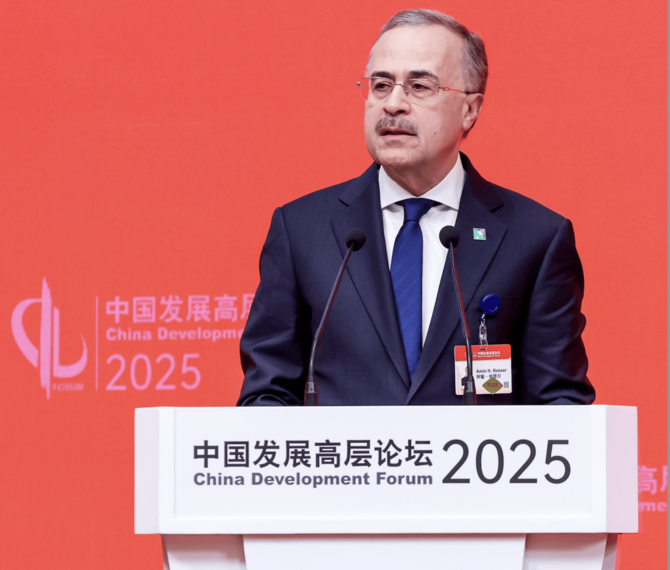
Amin Nasser speaking at the China Development Forum in Beijing. Supplied
Short Url
Updated 24 March 2025
Follow

China holds key position in Aramco’s investment strategy, CEO tells Beijing forum

RIYADH: Energy giant Saudi Aramco sees China as one of its key global investment destinations, with ongoing efforts to explore further opportunities across the power generation, chemicals, and technology sectors, according to its CEO. 

Speaking at the China Development Forum in Beijing, Amin Nasser emphasized his company’s three-decade-long partnership with the Asian country and its commitment to future growth and innovation. 

This comes as Aramco expands into new markets, including China, driven by the nation’s industrial growth, rising energy demand, and push for energy security. 

In his speech, Nasser said: “In China, Aramco is actively supporting energy and chemical feedstock security by investing in multiple downstream projects. In fact, China is among our key investment destinations.”

He highlighted current investments in Fujian, Liaoning, Zhejiang, and Tianjin, adding, “I emphasize ‘currently’ because we are continuing to identify additional opportunities, which include energy and chemicals, as well as technology.” 

Nasser also highlighted China’s role in the global economy, describing it as the world’s largest consumer and producer of petrochemicals, accounting for nearly half of global demand. 

“China is becoming a major hub for the entire chemicals industry value chain, which will be critical to industries of the future. China occupies a key position in Aramco’s global strategy,” he said. 

Aramco, as a long-term investor, is excited about the expanding opportunities in China, with Nasser expressing the company’s intent to elevate its relationship with the country. 

He underscored the importance of reliable oil and gas supply to China’s economic growth, predicting a shift in oil demand from light transport to petrochemicals due to rising demand for plastics, synthetic fibers, and advanced materials. 

“A reliable supply of these materials will be essential to China’s high-quality critical growth industries – including wind and solar energy, automotive, aerospace, and construction,” he added. 

In November, Aramco — in partnership with China Petrochemical & Chemical Corp. and Fujian Petrochemical Co. — began construction on a refinery and petrochemical complex in China’s Fujian province. 

At the time, the Saudi company said in a press statement that the facility would be fully operational by the end of 2030, featuring a 320,000-barrel-per-day oil refinery. 

The complex will also include a 1.5 million-tonnes-per-year ethylene unit, a 2 million-tonne paraxylene unit with downstream derivatives capacity, and a 300,000-tonne crude oil terminal. 


G7 countries to release oil reserves in global push to tackle Iran war energy price surge 

Updated 8 sec ago
Follow

G7 countries to release oil reserves in global push to tackle Iran war energy price surge 

  • IEA expected to recommend the largest oil reserve release in the agency’s history

RIYADH: Germany, the US, Japan and Austria will release part of their oil reserves after the International Energy Agency recommended the release of 400 million barrels of oil ‌from stockpiles, the largest ‌such move in IEA ​history.

Germany’s Economy ⁠Minister ​Katherina Reiche ⁠confirmed on Wednesday the government plans to limit petrol price increases at filling stations to once a day and to introduce more stringent antitrust regulation of the sector.

She did not ⁠give an exact timing for ‌those measures, but added that ‌the US and ​Japan would be the ‌largest contributors to the release of the ‌oil reserves.

The announcements did not stop oil prices rising, with Brent crude up 3.26 percent to $90.66 a barrel at 4:29 p.m Saudi time, and West Texas Intermediate up 3.12 percent to $86.05. Both were some way below the $119 a barrel seen earlier in the week.

“The situation regarding oil supplies is tense, as the Strait of Hormuz is currently virtually impassable,” Reiche said.

“We will comply with this request and ‌contribute our share, because Germany stands behind the IEA’s most important principle: mutual ⁠solidarity,” Reiche ⁠said about the IEA’s request.

According to a statement by Reiche’s ministry, Germany will contribute 2.64 million tonnes of oil. This corresponds to 19.51 million barrels.

Reiche stressed there was no supply shortage in the country, which has a legally mandated reserve of oil and oil products intended to cover 90 days’ demand.

The IEA’s move comes as countries are grappling with ​soaring crude prices amid ​the US-Israeli war with Iran. 

Austrian Economy Minister Wolfgang Hattmannsdorfer said his country was releasing part of the emergency oil reserve and extending the national strategic gas reserve, adding: “One thing is clear: in a crisis, there must be no crisis winners at the expense of commuters and businesses.”

Acting ahead of the IEA move, G7 ​member Japan announced plans to release 15 days' worth of ‌private-sector oil reserves and one month's worth of state oil reserves.

“Rather than wait for formal IEA approval ‌of a coordinated international reserve release, Japan will act first to ease global energy market supply and demand, releasing reserves as early as the 16th of this month,” Prime Minister Sanae Takaichi said in a broadcast statement.