

In glasses adorned with dried fruits, Peshawar shop serves ‘most unique’ shakes in town

1 / 2
Muhammad Ibrahim pours juice in a glass decorated with dry fruits at his shop in Peshawar, Pakistan on March 21, 2025. (AN Photo)
2 / 2
Muhammad Ibrahim prepares dessert, with bowls full of dry fruits on display at his shop in Peshawar, Pakistan on March 21, 2025. (AN Photo)
Short Url
Updated 26 March 2025
Follow

In glasses adorned with dried fruits, Peshawar shop serves ‘most unique’ shakes in town

  • Amir Sab’s Special Dry Fruits Juice shop serves fresh shakes in glasses entirely covered with gooey, sweet paste and whole dried fruits
  • Shakes retail for between $2-6, steep for Peshawar but which many people are still willing to pay due to drinks' unique look and taste

PESHAWAR: Muhammad Ibrahim stood at his shop, Ameer Sahib Juice Shop, earlier this month and stuck whole pistachios, cashew nuts, almonds, walnuts and raisins to a large milkshake glass covered in a gooey paste. 

He was preparing the glass for what many in the northwestern Pakistani city of Peshawar describe as the “most unique,” and “most beautifully presented” shakes in town. Ibrahim and his brother, Ismail, co-owners of the shop they set up in 2005, grind dates, honey and chocolate to prepare a soft and sticky paste that they carefully apply on the outside of each glass, on which the dried fruits are then glued. The end product is a glass that looks like it is entirely made of dried fruit.

Into the glass are poured thick shakes made from a variety of seasonal fruits, with more edible decorations added on top to finish the offering. The drinks have become as much of a social media hit as they are loved by customers who throng the shop in Ramadan and throughout the rest of the year. 

"At takes at least 15-20 minutes to prepare the glass," Ibrahim told Arab News at Peshawar’s famed Namak Mandi where his store is located. "We make it in the morning and serve it at iftar time.”
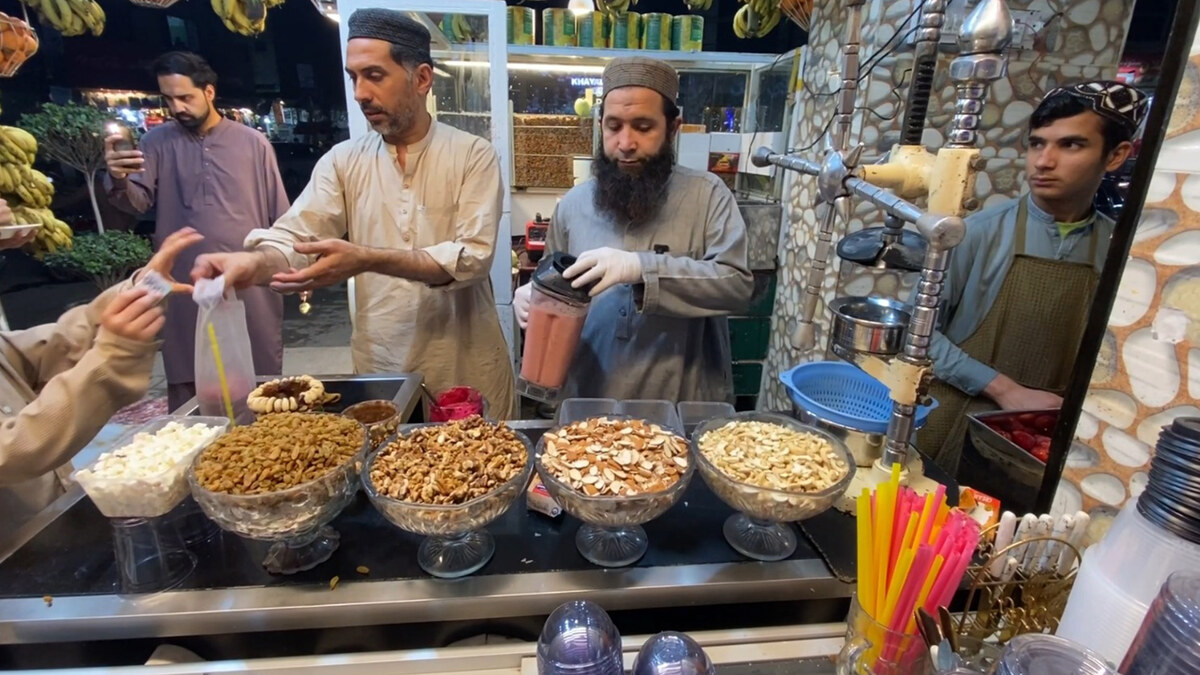


Muhammad Ibrahim (second from right) serves customers in his shop in Peshawar, Pakistan on March 21, 2025. (An Photo) 

Different sizes of the shakes retail for between $2-6, steep for a city like Peshawar, but which many people are still willing to pay due to the uniqueness of the drinks' presentation and taste. 

"People from different parts of the country come for this dried fruit juice,” Ibrahim said, saying he regularly served customers from cities across the KP province, of which Peshawar is the capital, as well as from the Punjab province and the federal capital, Islamabad. 

Ayub Sher, a resident of KP's Bajaur district who works in Peshawar, visited Ibrahim's shop last week and was all praise for the shakes.

“We came here to try this juice and to see if it has taste or not. When we tried it, we found it that it is fantastic,” he told Arab News as he scooped some thick shake out of the glass with a long spoon. 

“Forget about the taste, we haven’t seen any juice presented to us this beautifully.”


T20 World Cup: ICC deputy chief in Lahore for talks after Pakistan boycotts India match

Updated 8 sec ago
Follow

T20 World Cup: ICC deputy chief in Lahore for talks after Pakistan boycotts India match

  • Islamabad’s boycott over Bangladesh’s exclusion has threatened the tournament’s most lucrative game
  • Bangladesh Cricket Board chief has also arrived in Pakistan and is expected to participate in meetings

ISLAMABAD: International Cricket Council (ICC) Deputy Chairman Imran Khwaja arrived in Lahore on Sunday for talks with Pakistan Cricket Board (PCB) officials, the PCB said, as the sport’s governing body strives to save a high-stakes T20 World Cup clash between arch-rivals Pakistan and India.

The development follows Islamabad’s decision to boycott the Feb. 15 Pakistan-India match in Colombo, a move to protest the ICC’s exclusion of Bangladesh from the ongoing T20 World Cup.

The controversy over Pakistan’s participation erupted after the ICC replaced Bangladesh with Scotland, following Bangladesh’s decision to not play matches in India owing to security fears.

The ICC has since requested the Pakistan Cricket Board to reconsider the decision to boycott their match against India in Colombo or they will have to forfeit the marquee game of the tournament.

“ICC Deputy Chairman Imran Khwaja arrived in Lahore,” the PCB said on Sunday, adding that he was received at the airport by the PCB chairman’s adviser, Aamir Mir.

Prior to Khwaja’s arrival in Lahore, where the PCB is headquartered, Pakistan welcomed Bangladesh Cricket Board (BCB) President Aminul Islam, who was received by PCB CEO Salman Naseer.

The two visiting officials are scheduled to meet PCB Chairman Mohsin Naqvi.

“Bangladesh Cricket Board President Aminul Islam will also take part in other meetings,” the PCB said in a statement, hinting that he will be part of the meeting with ICC’s Khwaja.

The dispute stems from the ICC’s decision to replace Bangladesh with Scotland last month after Bangladesh refused to play tournament matches in India. Dhaka’s decision followed the removal of Mustafizur Rahman from the Indian Premier League (IPL). He was bought for $1 million by the IPL’s Kolkata Knight Riders, but on Jan. 3 the Board of Control for Cricket in India (BCCI) ordered Kolkata to release Mustafizur without a public explanation but amid regional tensions.

Pakistan have boycotted the 27th match of the tournament against India, due to take place at R. Premadasa Stadium in Colombo. An India-Pakistan fixture is the sport’s most lucrative asset, generating a massive share of global broadcasting and sponsorship revenue.

The PCB has remained defiant amid reports of potential sanctions. On Saturday, the board rejected claims by Indian media that it had initiated a dialogue with the ICC to find a way out of the standoff.

“I categorically reject the claim by Indian sports journalist Vikrant Gupta that PCB approached the ICC,” PCB’s Mir said in a statement. “As usual, sections of Indian media are busy circulating fiction. A little patience and time will clearly show who actually went knocking and who didn’t.”

The standoff highlights the growing friction within the sport’s governance.

Pakistan has accused India’s cricket board of influencing the ICC’s decisions.

Defense Minister Khawaja Asif this week called for the formation of a new cricket governing body, saying the ICC, currently chaired by Jay Shah, son of India’s Home Minister Amit Shah, was being held “hostage” to “Indian political interests.”

India generates the largest share of cricket’s commercial revenue and hence enjoys considerable influence over the sport. Critics argue that this financial contribution translates into decisive leverage within the ICC.

A large part of that revenue comes from the Indian Premier League (IPL), the sport’s most lucrative T20 cricket competition, which is run by the Board of Control for Cricket in India (BCCI). Between 2024 and 2027, the IPL is projected to earn $1.15 billion, nearly 39 percent of the ICC’s total annual revenue, according to international media reports.

While the Pakistani government cleared the team to participate in the rest of the tournament, Prime Minister Shehbaz Sharif maintained that the boycott of the India game was necessary to protest the “unjust” treatment of Bangladesh.