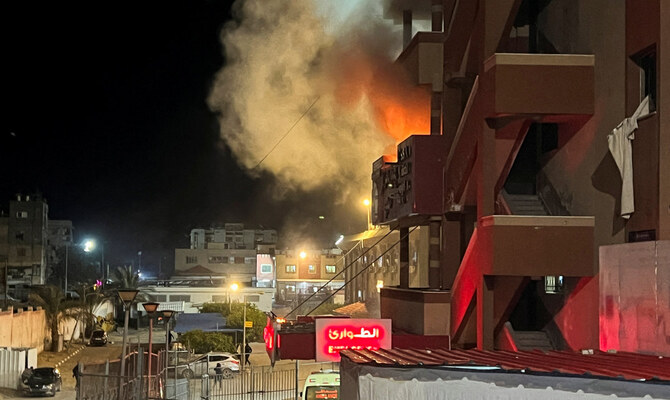
DEIR AL-BALAH, Gaza Strip: Israel’s military struck the largest hospital in southern Gaza on Sunday night, killing one person, wounding others and causing a large fire, the territory’s Health Ministry said.
The strike hit the surgical building of Nasser Hospital in the city of Khan Younis, the ministry said, days after the facility was overwhelmed with dead and wounded when Israel resumed the war in Gaza last week with a surprise wave of airstrikes.
Israel’s military confirmed the strike on the hospital, saying it hit a Hamas militant operating there. Israel blames civilian deaths on Hamas because it operates in densely populated areas.
Like other medical facilities around Gaza, Nasser Hospital has been damaged by Israeli raids and strikes throughout the war.
More than 50,000 Palestinians have now been killed in the war, the Health Ministry said earlier Sunday.
The military claimed to have “eliminated” dozens of militants since Israel ended a ceasefire Tuesday with strikes that killed hundreds of people on one of the deadliest days in the 17-month war.
Israel’s unrest over Gaza and political issues grew Sunday, with anger at Prime Minister Benjamin Netanyahu as his government voted to express no confidence in the attorney general, seen by many as a check on the power of his coalition.
“I’m worried for the future of this country. And I think it has to stop. We have to change direction,” said Avital Halperin, one of hundreds of protesters outside Netanyahu’s office. Police said three were arrested.
‘Displacement under fire’
Israel’s military ordered thousands of Palestinians to leave the heavily destroyed Tel Al-Sultan neighborhood in the southern city of Rafah. They walked to Muwasi, a sprawling area of squalid tent camps. The war has forced most of Gaza’s population of over 2 million to flee within the territory, often multiple times.
“It’s displacement under fire,” said Mustafa Gaber, a journalist who left with his family. He said tank and drone fire echoed nearby.
“The shells are falling among us and the bullets are (flying) above us,” said Amal Nassar, also displaced. “The elderly have been thrown into the streets. An old woman was telling her son, ‘Go and leave me to die.’ Where will we go?”
“Enough is enough. We are exhausted,” said a fleeing Ayda Abu Shaer, as smoke rose in the distance.
The Palestinian Red Crescent emergency service said it lost contact with a 10-member team responding to the strikes in Rafah. Spokesperson Nebal Farsakh said some were wounded.
Israel’s military said it had fired on advancing “suspicious vehicles” and later discovered some were ambulances and fire trucks.
In Gaza City, an explosion hit next to a tent camp where people had been told to evacuate. “My husband is blind and started running barefoot, and my children were running,” said witness Nidaa Hassuna.
Strikes kill Hamas leader
Hamas said Salah Bardawil, a well-known member of its political bureau, was killed in a strike in Muwasi that also killed his wife. Israel’s military confirmed it.
Hospitals in southern Gaza said they received a further 24 bodies from strikes overnight, including several women and children.
Gaza’s Health Ministry said 50,021 Palestinians have been killed in the war, including 673 people since Israel’s bombardment on Tuesday shattered the ceasefire.
Dr. Munir Al-Boursh, the ministry’s general director, said the dead include 15,613 children, with 872 of them under 1 year old.
The ministry does not distinguish between civilians and combatants in its count but says women and children make up over half the dead. Israel says it has killed around 20,000 fighters, without providing evidence.
Ceasefire in tatters
The ceasefire that took hold in January paused more than a year of fighting ignited by Hamas’ Oct. 7, 2023, attack into Israel, in which militants killed some 1,200 people, mostly civilians, and took 251 hostage. Most captives have been released in ceasefire agreements or other deals.
In the latest ceasefire’s first phase, 25 Israeli hostages and the bodies of eight others were released in exchange for nearly 2,000 Palestinian prisoners. Israeli forces allowed hundreds of thousands of people to return home. There was a surge in humanitarian aid until Israel cut off all supplies to Gaza earlier this month to pressure Hamas to change the ceasefire agreement.
The sides were supposed to begin negotiations in early February on the ceasefire’s next phase, in which Hamas was to release the remaining 59 hostages — 35 of them believed to be dead — in exchange for more Palestinian prisoners, a lasting ceasefire and an Israeli withdrawal. Those talks never began.
New settlements in the West Bank
Israel’s Cabinet passed a measure creating 13 new settlements in the occupied West Bank by rezoning existing ones, according to Bezalel Smotrich, Israel’s far-right finance minister, who is in charge of settlement construction.
This brings the number of settlements, considered illegal by the majority of the international community, to 140, said anti-settlement watchdog group Peace Now. They will receive independent budgets from Israel and can elect their own local governments, the group said.

Gaza’s Health Ministry says Israel has struck the largest hospital in the territory’s south
Short Url
https://arab.news/rzj3h
Gaza’s Health Ministry says Israel has struck the largest hospital in the territory’s south
- Like other medical facilities around Gaza, Nasser Hospital has been damaged by Israeli raids and strikes throughout the war
Trump says new Iran leader won’t last long without his approval
TERHAN: US President Donald Trump warned on Sunday that Iran’s next supreme leader would not last long without his approval, as Tehran prepared to reveal the successor to the slain Ayatollah Ali Khamenei.
Nine days after US-Israeli strikes on his compound killed Khamenei and plunged the Middle East into war, Iran’s Assembly of Experts met privately and chose their next leader, members of the body said.
The clerics did not say who had been selected, only that a name would be announced soon. Some suggested Khamenei’s 56-year old son Mojtaba Khamenei would succeed his father.
Trump had previously demanded a say in the appointment and dismissed the younger Khamenei as an unacceptable “lightweight.”
“He’s going to have to get approval from us,” Trump told ABC News on Sunday, referring to Iran’s next leader. “If he doesn’t get approval from us he’s not going to last long.”
But Tehran’s top diplomat said earlier in the day that the decision was Iran’s alone, adding it would “allow nobody to interfere in our domestic affairs.”
Speaking on NBC’s “Meet the Press,” Foreign Minister Abbas Araghchi went on to demand that Trump “apologize to people of the region” for the spiralling war.
The younger Khamenei is regarded as a conservative figure, notably because of his ties to the Revolutionary Guards, the ideological arm of the Islamic republic’s military.
Israel’s military has warned any successor that “we will not hesitate to target you.”
- Air ‘unbreathable’ -
Israel’s reach was underlined by two new operations overnight — strikes against fuel dumps in and around Tehran, and an attack on a hotel in the heart of Lebanon’s capital Beirut that targeted suspected Iranian commanders.
Warplanes hit five oil facilities around the Iranian capital, killing at least four people, according to a state oil executive, and blanketing the city in acrid smoke.
Tehran’s governor told the IRNA news agency that fuel distribution had been “temporarily interrupted” in the capital.
A dark haze hung over the city of 10 million people, blocking out the sun, while the smell of burning fuel lingered in the air.
Authorities warned the fumes could be toxic and urged citizens to stay indoors, but many windows were blown out by the force of the blasts.
“The blaze has been burning for more than 12 hours, the air has become unbreathable. I can’t even go out to do the daily shopping,” said a 35-year-old from Tehran.
“At first, I supported this war. After Khamenei’s death, I celebrated with my friends: we drank wine and we danced.
“But since yesterday... people say there’s not even any gasoline left at the gas stations,” she said in a text message to Europe.
As the war extended into its ninth day, Iran’s Revolutionary Guards said they had enough supplies to continue their drone and missile war over the Middle East for up to six months.
Several blasts were heard over Israel’s commercial hub of Tel Aviv after the Israeli military said it had detected a salvo of missiles from Iran. The Magen David Adom emergency services said six people were wounded in central Israel.
- Advanced missiles -
Trump again refused to rule out sending US ground troops into Iran, but continued to insist that the war was all but won despite the ongoing Iranian missile and drone strikes.
The US President spoke with British Prime Minister Keir Starmer on Sunday, Downing Street said, after Trump had lobbed insults at the premier and accused him of trying to join a war “we’ve already won.”
The pair discussed military cooperation, London said, with Britain having granted the US use of its military bases for “collective self-defense of partners in the region,” having refused to allow their use for the initial strikes on Iran.
Guards spokesman Ali Mohammad Naini said Iran had so far used only first- and second-generation missiles, but would use “advanced and less-used long-range missiles” in the coming days.
Saudi Arabia said two people were killed and 12 wounded by a “projectile” on Sunday in Al Kharj province, having earlier said it intercepted a wave of drones headed for targets including the diplomatic quarter of its capital Riyadh.
Kuwait, meanwhile, said an attack hit fuel tanks at its international airport and Bahrain reported a water desalination plant had been damaged.
Iran’s health ministry said Sunday that at least 1,200 civilians had been killed and around 10,000 wounded — figures AFP could not independently verify.
Lebanon’s health minister said at least 394 people had been killed in Israeli air strikes since Lebanon was dragged into the war a week ago, including 83 children and 42 women.
Two Israeli soldiers were killed during the fighting in southern Lebanon, the Israeli military said.
Trump on Saturday attended the return of the bodies of six American service members who were killed in a drone strike on a US base in Kuwait last Sunday.
- No clear way out -
Analysts warn there is still no clear path to ending a conflict that US and Israeli officials say could last a month or longer.
Trump has suggested Iran’s economy could be rebuilt if a leader “acceptable” to Washington replaces the late supreme leader.
China and Russia have largely stayed on the sidelines despite close ties with Tehran.
China’s top diplomat Wang Yi said the war in the Middle East should “never have happened,” telling a press conference in Beijing: “The world cannot return to the law of the jungle.”
On Sunday, Pope Leo XIV prayed “that the roar of the bombs may cease, the weapons may fall silent, and a space for dialogue may open.”
Nine days after US-Israeli strikes on his compound killed Khamenei and plunged the Middle East into war, Iran’s Assembly of Experts met privately and chose their next leader, members of the body said.
The clerics did not say who had been selected, only that a name would be announced soon. Some suggested Khamenei’s 56-year old son Mojtaba Khamenei would succeed his father.
Trump had previously demanded a say in the appointment and dismissed the younger Khamenei as an unacceptable “lightweight.”
“He’s going to have to get approval from us,” Trump told ABC News on Sunday, referring to Iran’s next leader. “If he doesn’t get approval from us he’s not going to last long.”
But Tehran’s top diplomat said earlier in the day that the decision was Iran’s alone, adding it would “allow nobody to interfere in our domestic affairs.”
Speaking on NBC’s “Meet the Press,” Foreign Minister Abbas Araghchi went on to demand that Trump “apologize to people of the region” for the spiralling war.
The younger Khamenei is regarded as a conservative figure, notably because of his ties to the Revolutionary Guards, the ideological arm of the Islamic republic’s military.
Israel’s military has warned any successor that “we will not hesitate to target you.”
- Air ‘unbreathable’ -
Israel’s reach was underlined by two new operations overnight — strikes against fuel dumps in and around Tehran, and an attack on a hotel in the heart of Lebanon’s capital Beirut that targeted suspected Iranian commanders.
Warplanes hit five oil facilities around the Iranian capital, killing at least four people, according to a state oil executive, and blanketing the city in acrid smoke.
Tehran’s governor told the IRNA news agency that fuel distribution had been “temporarily interrupted” in the capital.
A dark haze hung over the city of 10 million people, blocking out the sun, while the smell of burning fuel lingered in the air.
Authorities warned the fumes could be toxic and urged citizens to stay indoors, but many windows were blown out by the force of the blasts.
“The blaze has been burning for more than 12 hours, the air has become unbreathable. I can’t even go out to do the daily shopping,” said a 35-year-old from Tehran.
“At first, I supported this war. After Khamenei’s death, I celebrated with my friends: we drank wine and we danced.
“But since yesterday... people say there’s not even any gasoline left at the gas stations,” she said in a text message to Europe.
As the war extended into its ninth day, Iran’s Revolutionary Guards said they had enough supplies to continue their drone and missile war over the Middle East for up to six months.
Several blasts were heard over Israel’s commercial hub of Tel Aviv after the Israeli military said it had detected a salvo of missiles from Iran. The Magen David Adom emergency services said six people were wounded in central Israel.
- Advanced missiles -
Trump again refused to rule out sending US ground troops into Iran, but continued to insist that the war was all but won despite the ongoing Iranian missile and drone strikes.
The US President spoke with British Prime Minister Keir Starmer on Sunday, Downing Street said, after Trump had lobbed insults at the premier and accused him of trying to join a war “we’ve already won.”
The pair discussed military cooperation, London said, with Britain having granted the US use of its military bases for “collective self-defense of partners in the region,” having refused to allow their use for the initial strikes on Iran.
Guards spokesman Ali Mohammad Naini said Iran had so far used only first- and second-generation missiles, but would use “advanced and less-used long-range missiles” in the coming days.
Saudi Arabia said two people were killed and 12 wounded by a “projectile” on Sunday in Al Kharj province, having earlier said it intercepted a wave of drones headed for targets including the diplomatic quarter of its capital Riyadh.
Kuwait, meanwhile, said an attack hit fuel tanks at its international airport and Bahrain reported a water desalination plant had been damaged.
Iran’s health ministry said Sunday that at least 1,200 civilians had been killed and around 10,000 wounded — figures AFP could not independently verify.
Lebanon’s health minister said at least 394 people had been killed in Israeli air strikes since Lebanon was dragged into the war a week ago, including 83 children and 42 women.
Two Israeli soldiers were killed during the fighting in southern Lebanon, the Israeli military said.
Trump on Saturday attended the return of the bodies of six American service members who were killed in a drone strike on a US base in Kuwait last Sunday.
- No clear way out -
Analysts warn there is still no clear path to ending a conflict that US and Israeli officials say could last a month or longer.
Trump has suggested Iran’s economy could be rebuilt if a leader “acceptable” to Washington replaces the late supreme leader.
China and Russia have largely stayed on the sidelines despite close ties with Tehran.
China’s top diplomat Wang Yi said the war in the Middle East should “never have happened,” telling a press conference in Beijing: “The world cannot return to the law of the jungle.”
On Sunday, Pope Leo XIV prayed “that the roar of the bombs may cease, the weapons may fall silent, and a space for dialogue may open.”
© 2026 SAUDI RESEARCH & PUBLISHING COMPANY, All Rights Reserved And subject to Terms of Use Agreement.