

Palestinians, watchdog group denounce Israeli recognition of new West Bank settlements

1 / 2
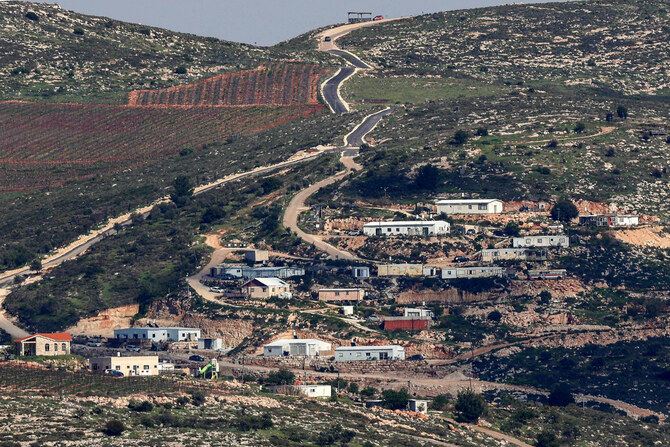
This picture taken from Nablus on March 23, 2025 shows east of the city the new expansion of the Israeli settlement of Elon Moreh in the occupied West Bank. (AFP)
2 / 2
This picture shows a view of the Israeli settlement of Givat Zeev, near the Palestinian city of Ramallah in the occupied West Bank on March 11, 2025. (AFP)
Short Url
Updated 24 March 2025
Follow

Palestinians, watchdog group denounce Israeli recognition of new West Bank settlements

  • Peace Now says that aside from creating new settlements, the Israeli Security Cabinet made a decision that would lead to the expulsion of Palestinians from Gaza
  • The decision brings the number of settlements, considered illegal by the majority of the international community, to 140, said the watchdog group

JERUSALEM/RAMALLAH: The Palestinian foreign ministry and an anti-settlement watchdog group on Sunday condemned an Israeli decision to recognize more than a dozen new settlements in the occupied West Bank, upgrading existing neighborhoods to independent settlement status.

Israel’s Finance Minister Bezalel Smotrich earlier announced that the security cabinet approved a plan to separate 13 Jewish settlements from their neighboring communities.


Israeli Prime Minister Benjamin Netanyahu (R) and Minister of Finance Bezalel Smotrich. (AFP file photo)

Smotrich, a far-right leader and settler who was behind the cabinet’s decision, hailed it as an “important step” for Israeli settlements in the West Bank. 

Smotrich is a leading voice calling for Israel to formally annex the West Bank — as it did in 1967 after capturing east Jerusalem in a move not recognized by most of the international community.

The settlements will ultimately be recognized as independent, he posted on X about the move, which follows the approval of tens of thousands of housing units across the West Bank.

“We continue to lead a revolution of normalization and regulation in the settlements. Instead of hiding and apologizing – we raise the flag, build and settle. This is another important step on the path to actual sovereignty in Judea and Samaria,” Smotrich said, using Israel’s term for the West Bank.

Israel’s opposition to ceding control of the West Bank has been deepened by its fears of a repeat of the October 7, 2023, attack by Hamas-led militants. Its military says it is conducting counter-terrorism operations in the West Bank and targeting suspected militants.

A statement from the Palestinian Authority’s foreign ministry condemned the decision by Israel’s security cabinet as a show of “disregard for international legitimacy and its resolutions.” 

The West Bank, occupied by Israel since 1967, is home to about three million Palestinians as well as nearly 500,000 Israelis living in settlements that are illegal under international law.


In its statement, the Palestinian foreign ministry also mentioned an ongoing major Israeli military operation in the northern West Bank, saying it was accompanied by “an unprecedented escalation in the confiscation of Palestinian lands.”

Peace Now, an anti-settlement watchdog group, said that aside from creating new settlements, the Security Cabinet made a decision that would lead to the expulsion of Palestinians from Gaza.


“The second decision, to recognize 13 settlements in the West Bank as independent settlements, exposes Israel’s long-standing lie that it does not establish new settlements, but only ’neighborhoods,’ of existing settlements,“ Peace Now wrote on the X platform.

This brings the number of settlements, considered illegal by the majority of the international community, to 140, said the watchdog group. They will now receive independent budgets from Israel and can elect their own local governments, it added.

The 13 settlement neighborhoods approved for development by the Israeli cabinet are located across the West Bank. Some of them are effectively part of the bigger settlements they belong to while others are practically separate.
Their recognition as separate communities under Israeli law is not yet final.
Hailing the “normalization” of settlement expansion, the Yesha Council, an umbrella organization for the municipal councils of West Bank settlements, thanked Smotrich for pushing for the cabinet decision.
According to EU figures, 2023 saw a 30-year record in settlement building permits issued by Israel.

(With AFP, AP & Reuters)


Refugees, migrants in Lebanon find rare sanctuary from Israeli strikes in Beirut church 

Updated 59 min 20 sec ago
Follow

Refugees, migrants in Lebanon find rare sanctuary from Israeli strikes in Beirut church 

  • Beirut church offers safe haven for displaced migrants, refugees
  • Many refugees lived through 2024 war, but are now more vulnerable

BEIRUT: When Israeli strikes began pummelling Beirut’s southern suburbs early on Monday, Sudanese refugee Ridina Muhammad and her family ​had no choice but to flee home on foot, eventually reaching the only shelter that would accept them: a church.
Eight months pregnant, Muhammad, 32, walked with her husband and three children for hours in the dark streets until they found a car to take them to the St. Joseph Tabaris Parish, which has opened its doors to refugees and migrants.
They are among 300,000 people displaced across Lebanon this week by heavy Israeli strikes, launched in response to a rocket and drone attackinto Israel by the Lebanese armed group Hezbollah.
Just 100,000 of the displaced are in government shelters. Others are staying ‌with relatives ‌or sleeping in the streets. But migrants and refugees say government ​shelters ‌were ⁠never an option ​for ⁠them, saying they were turned away during the last war between Hezbollah and Israel.
Muhammad’s oldest daughter, now seven, stopped speaking after the 2024 war.
This time, they are even more vulnerable: their home was destroyed in this week’s strikes and Muhammad is due to give birth at the end of the month.
“I don’t know if there’s a doctor or not, but I’m really scared about it because I haven’t prepared any clothes for the baby, nor arranged a hospital, and I don’t know where to go,” she told ⁠Reuters as her younger daughter leaned against her pregnant belly.
Muhammad ‌said she was registered with the United Nations’ refugee agency (UNHCR) ‌but had not received support.
“Us, as refugees, why did we ​register with the UN, if they are not ‌helping us in the most difficult times?” she said.
Dalal Harb, a spokesperson for UNHCR ‌Lebanon, said the agency had mobilized but reaching everyone immediately was extremely challenging given the scale and speed of displacement. The UNHCR operation in Lebanon is currently only around 14 percent funded, she said.
The Jesuit Refugee Service (JRS), which helped the church host displaced in 2024, is doing so again.
Michael Petro, JRS’ Emergency Shelter Director, said the church was ‌full within the first day of strikes, with 140 people from South Sudan, Ethiopia, Bangladesh, and other countries sheltering there.
“There are many, many more ⁠people coming than there ⁠were in 2024, and we have fewer and fewer places to put them,” he said.
Petro said he was told weeks ago that government shelters would be open to migrants if war erupted.
But when the strikes began and even Lebanese struggled to find shelter, the policy seemed to change, he said.
“We’re hearing from hotlines up to government officials and ministries that migrants are not welcome,” Petro said.
Lebanon’s Minister for Social Affairs Haneen Sayyed did not respond to a request for comment. On Thursday, Sayyed said Beirut shelters were full.
When Israeli strikes began, Othman Yahyeh Dawood, a 41-year-old Sudanese man, put his two young sons on his motorcycle.
They drove 75 kilometers (46 miles) from the southern Lebanese town of Nabatieh to St. Joseph’s, where they had sheltered in 2024.
“I know the area ​is safe and there are people who ​will welcome us,” he said.
“We don’t know where to go; there’s war there (in the south), war here (in Beirut), war in Sudan, and nowhere else to go,” he said.