

Saudi Arabia pushes for global water cooperation

1 / 5
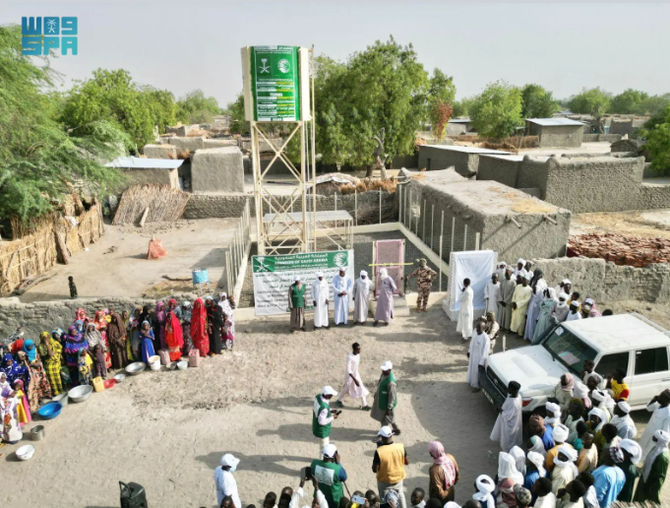
KSrelief has implemented a total of 105 water related projects valued at over $301 million in a total of 16 countries. (SPA)
2 / 5
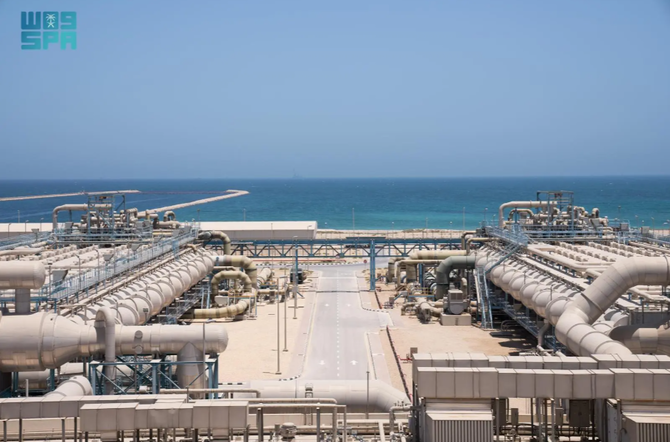
The Saudi Water Authority overlooks the production of approximately 15 million cubic meters of public and private sector water around the Kingdom daily. (SPA)
3 / 5
World Water Day was established at the 1992 UN Conference on Environment and Development in Rio de Janeiro. (SPA)
4 / 5
World Water Day was established at the 1992 UN Conference on Environment and Development in Rio de Janeiro. (SPA)
5 / 5
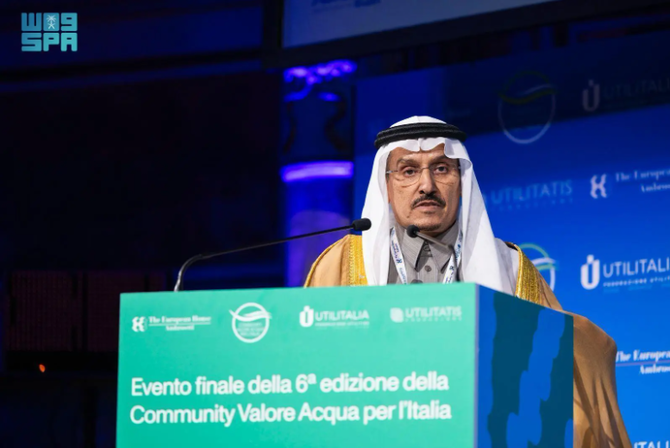
Abdulaziz Al-Shaibani, deputy minister for water at the Ministry of Environment, Water and Agriculture, speaks at 'Value of Water Community' forum in Rome. (SPA)
Short Url
Updated 23 March 2025
Follow

Saudi Arabia pushes for global water cooperation

  • Minister outlines Kingdom’s strategies to combat water scarcity; KSrelief’s global efforts reach millions with clean water projects

RIYADH: Saudi Arabia highlighted the importance of strengthening international cooperation in the water sector to address global challenges, emphasizing the need for integrated water resources management to ensure sustainability, overcome water scarcity, and develop resources.

Abdulaziz Al-Shaibani, deputy minister for water at the Ministry of Environment, Water and Agriculture, said that Vision 2030 prioritizes water sustainability as a key pillar of national development, the Saudi Press Agency reported.

At the “Value of Water Community” forum in Rome, Al-Shaibani noted that, due to the Kingdom’s natural water scarcity, strategies have been implemented to improve efficiency, balance supply and demand, and ensure long-term sustainability.

The forum addressed Italy’s water challenges, including climate change, declining groundwater levels, and the need for advanced technologies to sustain water resources.

Al-Shaibani outlined the National Water Strategy 2030, focusing on developing alternative water sources, reducing dependence on non-renewable groundwater, enhancing desalination, improving distribution networks, and minimizing water loss.

He also highlighted Saudi Arabia’s global efforts in water, including participation in initiatives like the G20 and collaboration with UN organizations.

Al-Shaibani emphasized investment opportunities in the Saudi water sector, especially in private sector partnerships, advanced technologies, and contributions to research and infrastructure development.

On World Water Day, observed on March 22, Saudi Arabia is recognized as the world’s largest water producer and a leader in water innovation, using artificial intelligence in desalination to improve efficiency and reduce environmental impact, according to SPA.

Technologies based on palm trees are also being developed to fight erosion and extend water infrastructure. These innovations strengthen the Kingdom’s position as a global water technology hub, showcasing its commitment to sustainability, climate change adaptation, and environmental protection.

The Saudi Water Authority, in collaboration with all water sector stakeholders, is redefining sustainable water management to maintain the Kingdom’s leadership in efficient water resource management despite scarcity.

The authority oversees the daily production of approximately 15 million cubic meters of water, which is distributed across 14,000 km of pipelines to 135,000 km of networks throughout the Kingdom.

KSrelief has supported water and sanitation sectors in affected countries, implementing 105 water-related projects worth over $301 million across 16 nations to create safe environments and enhance water security.

Yemen is the largest beneficiary, with 46 projects totaling more than $238 million, including drinking water distribution, well drilling, and improving access to water and sanitation in healthcare centers.

In Syria, KSrelief has completed four projects to improve water security, including emergency services for earthquake victims, establishing water purification stations, and rehabilitating water stations and waste management systems in Idlib.

KSrelief has also implemented five major projects in Sudan, benefiting nearly six million people, including the drilling of 33 medium-depth wells.

In Mali, KSrelief has drilled 250 shallow and 15 medium-depth wells, and 52 wells in Ghana, providing clean water, reducing waterborne diseases, and supporting agriculture and livestock.

KSrelief recently signed a joint agreement with the UN Development Programme to assist Gaza’s water and sanitation sector, benefiting one million people.

The agency’s projects extend to Iraq, Somalia, Pakistan, Afghanistan, Myanmar, and Niger, aiming to improve water security and sustainability, reflecting Saudi Arabia’s commitment to addressing global water challenges for future generations.


Saudi hospitality boom sparks innovation beyond the plate

Chefs at Julien prepare meals to pair with Diageo drinks. (AN photo by Basmah Albasrawi)
Updated 11 January 2026
Follow

Saudi hospitality boom sparks innovation beyond the plate

  • At the Four Seasons Riyadh, Diageo hosted a private tasting at Tonic Bar followed by a 10-course dinner at Julien
  • Dinner at Julien paired dishes with drinks made using Tanqueray 0.0, Captain Morgan 0.0, and Guinness 0.0

RIYADH: As restaurants and hotels in Saudi Arabia refine their culinary identities, beverages are increasingly being treated as crafted experiences in their own right, shaped by technique and intention.

At the Four Seasons Riyadh, Diageo hosted a private tasting at Tonic Bar followed by a 10-course dinner at Julien, offering a snapshot of how this evolution is beginning to take shape, as international players and local venues test new approaches to pairing and presentation. 

Speaking to Arab News, Nick Rees, marketing director of Diageo MENA, pointed to the rapid growth of the nonalcoholic segment globally and in the region: “There’s a far faster growing percentage of it (the industry) is non-alcohol … There (are) trends globally … A lot of it will be pointed to wellness, mindful drinking.”

Rees said that Saudi Arabia’s fast-developing culinary and hospitality scene calls for beverages that match the level of excellence seen in kitchens across the Kingdom.

“It’s kind of the lack of choices and that’s where we want to be able to provide people the option, and people here absolutely have the same kind of talent and desire as their counterparts behind the kitchen,” he said.

“That’s where our role is to give people the kind of core ingredients for them to be able to work with … we have many more brands that we would love to introduce to the Kingdom.”

The dinner at Julien paired dishes with drinks made using Tanqueray 0.0, Captain Morgan 0.0, and Guinness 0.0, offering a glimpse into the range of styles Diageo is bringing to the market.

Flavor profiles ranged from light and refreshing combinations with cucumber and capers brine to richer, malt-forward blends, each designed to complement the accompanying dishes, from ravioli to black cod. 

Rees emphasized that pairing food with thoughtfully crafted beverages is becoming an essential part of the hospitality experience. 

“In the Kingdom, we’re looking at giving people the experience that currently is not available to them because I know for sure that the kind of quality and expertise and craftsmanship that can go into creating some of these drinks is absolutely as exciting as the work that the chefs would do with their food,” he said.

Anthony Abou Haider, head of Gulf at Diageo, said the company sees long-term potential in Saudi Arabia’s hospitality sector. 

“It’s such an opportunity to be a part of this transformation journey,” he told Arab News. “We’re not looking for a short-term gain, we’re looking at a very long-term gain here because whatever we do now is building for the future.”