

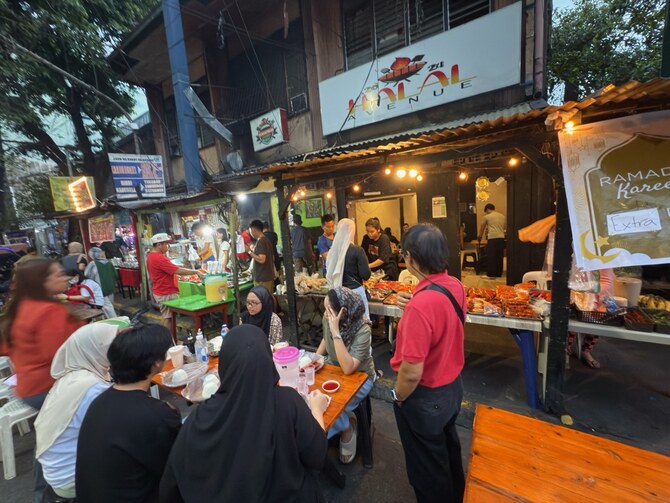
Filipino Muslims flock to Manila food hub for halal meals during Ramadan

Filipinos eat at the Halal Avenue food stall on Padre Campa Street in Manila on March 21, 2025. (AN Photo)
Short Url
Updated 24 March 2025
Follow

Filipino Muslims flock to Manila food hub for halal meals during Ramadan

  • Philippine capital region is home to more than 173,000 Filipino Muslims
  • Food sellers on Manila’s Padre Campa Street offer halal meals, including Mindanao dishes

MANILA: In the heart of Manila’s bustling University Belt, a food street known for its diverse culinary offerings has grown into a go-to spot for Filipino Muslims during Ramadan, as they search for halal food that reminds them of home.

The halal eateries along Padre Campa Street, a hub for grub located near the capital’s top colleges and universities, have in recent years become a haven for Muslim minorities, including Hanan, who is from Mindanao’s Sultan Kudarat province.

“I miss a lot of food from home, especially the ones prepared by my mom for iftar,” Hanan, who gave only her first name, told Arab News.

As she spent the holy month in Manila to prepare for a licensing exam, Hanan said finding halal food to break the fast was not as easy as it was back home.

“Fasting here is a bit difficult for us because not all the stores here are certified halal. So, we can only pick certain stores, and this is the only specific store we know is safe for us to eat.”

There are about 12 million Muslims in the predominantly Catholic Philippines, making up around 10 percent of its entire population.

While most live on the island of Mindanao and the Sulu archipelago in the country’s south, the Metro Manila capital region is also home to over 173,000 Filipino Muslims.

Along with the government’s recent efforts to promote halal cuisine from Mindanao, such food has become increasingly available in the Philippines’ largest metropolitan area.

But on Padre Campa Street, the presence of halal food stalls has a longer history that can be traced to the owners’ desire to cater to the minority Muslim community.

“We serve native delicacies because there are many Muslims in this area,” Ferdanah Talib, who is from Mindanao’s Zamboanga Sibugay province, told Arab News.

Her brother opened the Halal Avenue food stall in 2017, selling dishes like barbecue chicken and grilled fish, as well as traditional meals like binaki, steamed corn dessert and snacks originating from Mindanao and Cebu.

“It’s our way of supporting our fellow Muslims here, especially during Ramadan. Our store opens at 4:30 p.m. until midnight,” Talib said.

Mary Ann Serra, a Filipina Christian who had worked in Malaysia and spent time in Mindanao, has kept her food shop halal since she opened it over a decade ago.

“We opened this store in 2012, and from the start, it has always been halal,” Serra told Arab News.

“We noticed that there were many Muslims in the area, but there were no halal places to eat. So, we thought, what if we try opening a halal restaurant? Especially during Ramadan, it’s hard for them because there’s nothing for them to eat.”

While her shop specializes in the delicacies of Tausug, one of the largest Muslim ethnic groups in southwestern Philippines, it also sells simple mainstream dishes.

“What our customers keep coming back for are the chicken barbecue, grilled fish, and squid. We also have dishes like tiyula itum, or black soup,” Serra said.

Many Filipino Muslims, even those who are in the capital for a short stay, have grown fond of the food street.

“This is my third time spending Ramadan here in Metro Manila … It really means a lot to us to have a place like this because as Muslims, what we’re really looking for is halal food. We don’t have many places to go for food,” Arsie Muin, who is from Zamboanga City, told Arab News.

“It’s also good because they serve some native delicacies,” he said. “We are really grateful that this place exists.”


Pakistanis fleeing Iran describe strikes shaking ground under their feet

Updated 58 min 43 sec ago
Follow

Pakistanis fleeing Iran describe strikes shaking ground under their feet

  • Nearly 1,000 students, businessmen and pilgrims have fled Iran since the war started out of a total 35,000 Pakistanis in the country

QUETTA: Pakistanis fleeing Iran described explosions and missile strikes across Tehran shaking the ground under ​their feet and engulfing buildings in fire and smoke in a city emptied of many of its residents. The conflict has widened sharply, with a US submarine sinking an Iranian warship off Sri Lanka on Wednesday and NATO air defenses destroying an Iranian missile fired toward Turkiye.
Governments have been scrambling to evacuate stranded citizens, with most of the region’s airspace closed due to the risk of missiles hitting passenger planes.
“I was in the classroom when a powerful explosion rocked our university building,” Hareem ‌Zahra, 23, a ‌student at the Tehran University of Engineering, told ​Reuters ‌after ⁠crossing Pakistan’s land ​border with ⁠Iran.
“We saw thick smoke coming from many buildings on fire,” she said, adding Tehran was under attack until the moment she left.

TEHRAN LOOKED DESERTED
Nearly 1,000 students, businessmen and pilgrims have fled Iran since the war started out of a total 35,000 Pakistanis in the country, Mudassir Tipu, Pakistan’s ambassador to Tehran, said.
“There are now serious challenges. As you know there is no Internet in most parts of Iran,” he said. Iran ⁠has retaliated with a barrage of ballistic missiles targeting Israel and ‌Washington’s allies in the Gulf, including Qatar, Kuwait, ‌the UAE, and Saudi Arabia, following US and Israeli ​air strikes that killed Supreme Leader ‌Ayatollah Ali Khamenei on Saturday.
Tehran has looked deserted since the conflict began, said Nadir ‌Abbas, 25, a student of Persian literature at a university in the Iranian capital.
“I saw a drone hit a basketball court where six girl players lost their lives.”
Reuters could not verify his account.

DESTRUCTION EVERYWHERE

Islamabad is walking a diplomatic tightrope as it attempts to maintain warming ‌ties with Washington while expressing solidarity with Iran.
Pakistan is home to the second-largest Shiite population in the world after Iran and ⁠being drawn into ⁠the conflict could lead to instability at home as well as complications evacuating its citizens.
“The first attack happened right next to my hospital,” said Sakhi Aun Mohammad, a student at Tehran University of Medical Sciences. After he reached the border, an Iranian friend called to check if he was safe, saying: “’Thank God, you have gone to Pakistan, all of you are safe, but your hostel has been attacked’.” A Pakistani diplomat who is still in Tehran said attacks took place every four or five hours, adding one missile struck a building next to his office. “At times you will feel as if something exploded right at your feet,” he said. “The last time ​I got out was at night. ​Buildings had collapsed, some others were on fire. There is destruction everywhere.”
He added: “It is almost like a ghost town.”