Iraqis find Ramadan joy in centuries-old ring game

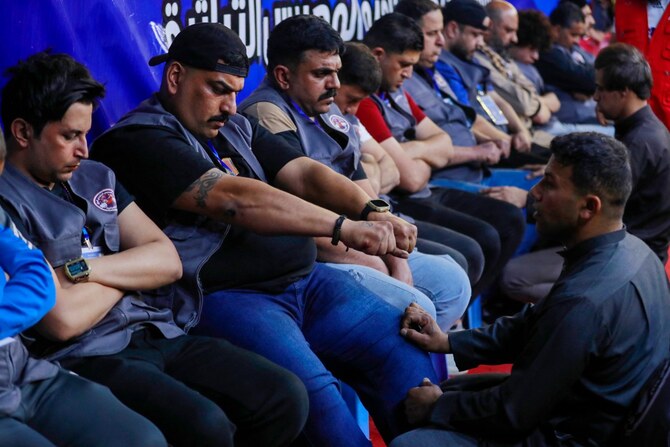
Participants play Mheibes, a decades-old fiery game in which rival teams must find a ring hidden by their oppearly onents, at Al-Shaab Stadium in Baghdad early on March 19, 2025, during the Islamic holy month of Ramadan (AFP)
Short Url
Updated 23 March 2025
Follow

Iraqis find Ramadan joy in centuries-old ring game

  • The game involves members of one team hiding a ring — “mehbis” in Arabic — and the captain of the opposing team trying to guess who has it in the palm of his hand

Baghdad: In a Baghdad arena, a crowd cheers to the rhythm of drums, not for a football match but for a fiery centuries-old game enjoyed by Iraqis during Ramadan called “mheibes.”
“It’s a heritage game, the game of our ancestors, which unites all Iraqis,” said Jassem Al-Aswad, a longtime mheibes champion in his early seventies and now president of the game’s national federation.
The game involves members of one team hiding a ring — “mehbis” in Arabic — and the captain of the opposing team trying to guess who has it in the palm of his hand.
And he has to do so within 10 minutes.
Played during the holy Muslim fasting month of Ramadan, the game first appeared as early as the 16th century in Ottoman-era Baghdad, according to Iraqi folklore expert Adel Al-Ardawi.
More than 500 fans and players gathered in the stands and on the field for two matches: the Baghdad neighborhood of Kadhimiya against the southern city of Nasiriyah, and the capital’s Al-Mashtal district versus a team from the port city of Basra.
Everyone watched as the 40 players on one team huddled together under a blanket to avoid prying eyes, and decided who would hide the “mehbis” or signet ring worn by many Iraqi men.
Sitting on the ground or on chairs, the members of the team hiding the ring then adopted serious expressions. Some closed their eyes, while others crossed their arms or even clenched their fists.
The rival team captain carefully read these facial expressions and body language to try and guess who had the ring — before pronouncing the verdict.
When the first team failed to guess correctly, the other team scored a point and the crowd went wild.
'It’s in our blood'
“Iraqis love football the most, but mheibes comes a close second. It’s in our blood,” Kadhimiya captain Baqer Al-Kazimi told AFP.
The clean-shaven 51-year-old, who wears a black robe called a jellaba, said he inherited his love of the game from his father.
Though mheibes was impacted during decades of conflict, including at the peak of the sectarian war between 2006 and 2008 marked by suicide attacks and kidnappings, Kazimi said he and others continued playing even during those dark years.
He said that only the coronavirus pandemic forced players to put their hobby on hold.
“Despite the sectarian violence, we played in cafes,” he said, recalling one game between players from the Sunni neighborhood of Adhamiya and those from Kadhimiya, a predominantly Shiite area.
The two districts were separated by a bridge that had been closed for years because of the violence.
“We played on the bridge. Sunnis and Shiites met,” he said.
Ahmed Maala from Basra recalled a game with a team from Baghdad that lasted all night.
“I learned the game by playing with friends and family,” he said.
“Mheibes will go down in history for its very large fan base throughout Iraq.”
Passion for the game runs so deep that sometimes arguments erupt among players, even escalating into physical violence.
In a country with nearly 400 teams, annual competitions see players from across the nation competing against each other, with 10 teams qualifying in Baghdad alone to represent the city’s different neighborhoods.
Mheibes champion Aswad said he hopes the game will one day expand beyond Iraq’s borders.
“Just as Brazil popularised football, we will transmit this game to the whole world,” he said.


Historic decree seeks to end decades of marginalization of Syria’s Kurds

Updated 51 min ago
Follow

Historic decree seeks to end decades of marginalization of Syria’s Kurds

DAMASCUS/RIYADH: A decree issued by President Ahmad Al-Sharaa on Friday marks a historic end to decades of marginalization of Syria’s Kurdish minority and seeks to open a new chapter based on equality and full citizenship in post-liberation Syria.

The presidential action, officially known as Decree No. 13, affirms that Syrian Kurds are an integral part of the national fabric and that their cultural and linguistic identity constitutes an inseparable element of Syria’s inclusive, diverse, and unified national identity.

Al-Sharaa’s move seeks to address the consequences of outdated policies that distorted social bonds and divided citizens.

The decree for ⁠the first time grants Kurdish Syrians rights, including recognition of Kurdish identity as part of Syria’s national fabric. It designates Kurdish as a national language alongside Arabic and allows schools to teach it.

Al-Sharaa’s decree came after fierce clashes that broke out last week in the northern city of Aleppo, leaving at least 23 people dead, according to Syria’s health ministry, and forced more than 150,000 to flee the two Kurdish-run pockets of the city. The clashes ended ⁠after Kurdish fighters withdrew.

The Syrian government and the Kurdish-led Syrian Democratic Forces (SDF), that controls the country’s northeast, have engaged in months of talks last year to integrate Kurdish-run military and civilian bodies into Syrian state institutions by the end of 2025, but there has been little progress.

The end of an era of exclusion

For more than half a century, Kurds in Syria were subjected to systematic discriminatory policies, most notably following the 1962 census in Hasakah Governorate, which stripped thousands of citizens of their nationality and deprived them of their most basic civil and political rights.

These policies intensified after the now-dissolved Baath Party seized power in 1963, particularly following the 1970 coup led by criminal Hafez al-Assad, entrenching a state of legal and cultural exclusion that persisted for 54 years.

With the outbreak of the Syrian revolution in March 2011, Syrian Kurds actively participated alongside other segments of society. However, the ousted regime exploited certain separatist parties, supplying them with weapons and support in an attempt to sow discord and fragment national unity.

Following victory and liberation, the state moved to correct this course by inviting the Kurdish community to fully integrate into state institutions. This approach was reflected in the signing of the “March 10 Agreement,” which marked an initial milestone on the path toward restoring rights and building a new Syria for all its citizens.

Addressing a sensitive issue through a national approach

Decree No. 13 offers a balanced legal and political response to one of the most sensitive issues in modern Syrian history. It not only restores rights long denied, but also redefines the relationship between the state and its Kurdish citizens, transforming it from one rooted in exclusion to one based on citizenship and partnership.

The decree shifts the Kurdish issue from a framework of conflict to a constitutional and legal context that guarantees meaningful participation without undermining the unity or territorial integrity of the state. It affirms that addressing the legitimate demands of certain segments strengthens, rather than weakens, the state by fostering equal citizenship, respecting cultural diversity, and embracing participatory governance within a single, centralized state.

Core provisions that restore dignity

The decree commits the state to protecting cultural and linguistic diversity, guaranteeing Kurdish citizens the right to preserve their heritage, develop their arts, and promote their mother tongue within the framework of national sovereignty. It recognizes the Kurdish language as a national language and permits its teaching in public and private schools in areas with significant Kurdish populations, either as an elective subject or as part of cultural and educational activities.

It also abolishes all laws and exceptional measures resulting from the 1962 Hasakah census, grants Syrian nationality to citizens of Kurdish origin residing in Syria, including those previously unregistered, and guarantees full equality in rights and duties. In recognition of its national symbolism as a celebration of renewal and fraternity, the decree designates Nowruz Day (21 March) as a paid official holiday throughout the Syrian Arab Republic.

A call for unity and participation

In a speech following the issuance of the decree, President Ahmad al-Sharaa addressed the Kurdish community, urging them not to be drawn into narratives of division and calling on them to return safely to full participation in building a single homeland that embraces all its people. He emphasized that Syria’s future will be built through cooperation and solidarity, not through division or isolation.

The decree presents a pioneering national model for engaging with diversity, grounded not in narrow identities but in inclusive citizenship, justice, and coexistence. The decree lays the foundations for a unified and strong Syria that respects all its components and safeguards its unity, sovereignty, and territorial integrity.