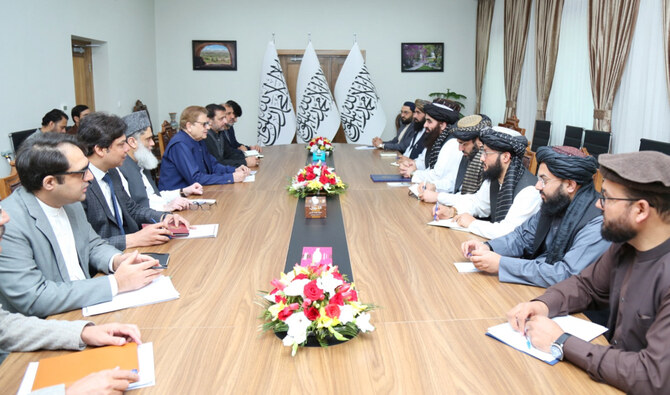
ISLAMABAD: A senior Pakistani diplomat designated to exclusively deal with Afghanistan-related matters is on a three-day visit to the neighboring country, the foreign office announced on Saturday, as bilateral ties between the two nations hit a low point amid a surge in militant attacks in Pakistan.
Pakistan-Afghanistan relations have remained tense in recent months due to a mix of security, political and border issues, with Islamabad accusing the Taliban-led interim government in Kabul of providing safe haven to anti-Pakistan militant groups facilitating cross-border attacks. Kabul has denied the allegations.
The friction escalated after a recent targeting of a passenger train in Pakistan’s southwestern Balochistan province, claimed by the separatist Baloch Liberation Army (BLA).
Pakistani officials said the BLA fighters remained in contact with “handlers” based in Afghanistan during the attack that lasted for two days and involved hundred of hostages.
“At the direction of Deputy Prime Minister / Foreign Minister Senator Mohammad Ishaq Dar @MIshaqDar50, Special Representative for Afghanistan, Amb. Muhammad Sadiq Khan, is undertaking an official visit to Afghanistan from 21-23 March 2025 to discuss Pakistan-Afghanistan bilateral relation,” the foreign office said in a social media post, without providing further details.
Pakistan launched a nationwide deportation campaign targeting undocumented foreigners, mostly Afghans, in November 2023, shortly after a series of deadly suicide bombings that officials blamed on Afghan nationals.
The move, which added to diplomatic tensions between the two countries, has so far led to the repatriation of more than 800,000 Afghans. Many of them had lived in Pakistan since fleeing the Soviet invasion of their country in 1979.
The Pakistani government earlier this month also directed Afghanistan Citizen Card holders to leave the country by March 31, warning they would face deportation if they failed to comply.

Pakistan’s special envoy visits Afghanistan amid deepening tensions over militancy
https://arab.news/yqff6
Pakistan’s special envoy visits Afghanistan amid deepening tensions over militancy
- The Pak-Afghan ties have remained tense in recent months due to a mix of security, political and border issues
- Pakistan has deported over 800,000 Afghans since Nov. 2023 and plans to repatriate more in the coming days
Pakistan to maintain hard line on Afghanistan after strikes as Taliban vows military response
- Islamabad blames Afghanistan’s ‘guerrilla mindset’ for escalating tensions between the two countries
- Afghan Taliban spokesperson denies militant presence in his country, accuses Pakistan of hitting civilians
ISLAMABAD: Pakistan vowed on Wednesday to continue its current policy toward Afghanistan unless the Taliban leadership abandons its “guerrilla mindset,” days after Islamabad carried out airstrikes inside Afghan territory, sharply escalating tensions between the two neighbors once again.
Pakistan conducted intelligence-based strikes overnight into Sunday in Afghanistan’s eastern Nangarhar and southeastern Paktika provinces, saying it had targeted camps of the banned Tehreek-e-Taliban Pakistan (TTP), its affiliates and Daesh-linked fighters.
Islamabad has long accused Kabul of allowing militant groups to use Afghan soil to launch attacks on Pakistani civilians and security forces, a charge the Taliban deny. The two sides also clashed in October last year, leading Pakistan to close key border crossings for bilateral and transit trade.
State Minister for Interior Talal Chaudhry told Geo News that Pakistan had attempted dialogue but would now persist with practical measures if the Taliban failed to change course.
“They call themselves a state, but they have not yet emerged from their guerrilla mindset,” he said.
“Now, with the practical steps we are taking, we want to change their behavior and see them in the form of a state,” he added.
Pakistan blamed a string of recent suicide bombings in Islamabad, Bajaur and Bannu on militants operating from Afghan territory before launching the latest strikes.
Chaudhry said Afghanistan had been acting like “an irresponsible neighbor,” warning that his country’s current approach would continue if attacks inside Pakistan persisted.
“This war will be won, and all this will end,” he said. “If it is not resolved the straight way, then it will be completely ended by a hard-line approach.”
Meanwhile, Kabul has condemned the airstrikes as violations of its sovereignty and said civilians were killed.
In an interview with Al Arabiya, Taliban government spokesman Zabihullah Mujahid also pledged to respond militarily.
“It would be a military response, but its details are confidential and I cannot explain further,” he said.
Mujahid rejected Pakistan’s allegations that TTP or Daesh militants operate from Afghan soil, saying security problems inside Pakistan were domestic in nature.
“Afghan soil is not allowed to be used against anyone,” he said, adding that Kabul had carried out extensive operations against Daesh and eliminated its presence in Afghanistan.
The 2,600-kilometer border between the two countries remains a vital trade and transit route, but crossings have faced repeated closures amid rising tensions, disrupting commerce and humanitarian movement.
Several regional countries, including Saudi Arabia, Türkiye and Qatar, have sought to mediate between the two countries, though their military exchanges risk further destabilizing their ties.


