KARACHI: A proposal to leverage surplus electricity for bitcoin mining was floated at the inaugural meeting of the Pakistan Crypto Council (PCC) on Friday, according to a statement by the Finance Division, as members of the newly established body vowed to open a new digital economy chapter in the country’s history.
The PCC was officially launched on March 15 to explore the integration of crypto and blockchain technologies into Pakistan’s financial ecosystem and draft a regulatory framework for the sector. Its formation marked a significant shift for the country that was once reluctant to embrace cryptocurrencies due to regulatory and security concerns.
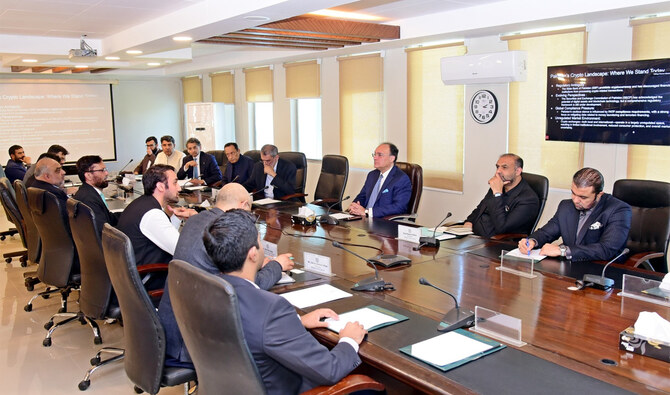
The council’s first meeting was presided over by Finance Minister Muhammad Aurangzeb and attended by senior officials, including the governor of the State Bank, the chairman of the Securities and Exchange Commission of Pakistan and the federal IT and law secretaries.
“The meeting focused on Pakistan’s untapped potential in the crypto space, with [PCC] CEO Bilal Bin Saqib presenting a comprehensive vision and mission for the Council,” the statement said.
“Saqib emphasized the importance of regulatory models and use cases, particularly in the region, that could be tailored to Pakistan’s unique context,” it added. “He also presented the concept of leveraging Pakistan’s surplus electricity for Bitcoin mining, potentially turning the country’s liabilities into assets.”
Bitcoin mining is the process by which new bitcoins are created and transactions verified through complex mathematical computations that require powerful, energy-intensive computers.
Pakistan’s surplus electricity, which often goes unused due to low demand or inadequate infrastructure, could be redirected to power these mining operations, according to the proposal, and generate revenue from otherwise wasted energy.
Finance Minister Aurangzeb praised the council’s vision and underlined its strategic importance for Pakistan’s digital transformation.
“This is the beginning of a new digital chapter for our economy,” he said. “We are committed to building a transparent, future-ready financial ecosystem that attracts investment, empowers our youth and puts Pakistan on the global map as a leader in emerging technologies.”
Aurangzeb noted that while Pakistan should learn from global best practices, it must develop business and revenue models grounded in local realities.
He called for building on previous work by various stakeholders to ensure the country doesn’t start from scratch.
Other council members highlighted the need for regulatory clarity, consumer protection, licensing regimes and a national blockchain policy. They also stressed the importance of sequencing the rollout, running pilot programs and ensuring compliance with international obligations.

Pakistan floats bitcoin mining proposal using surplus electricity at first crypto council meeting
https://arab.news/ccqyq
Pakistan floats bitcoin mining proposal using surplus electricity at first crypto council meeting
- The council was officially launched this month to integrate crypto technologies into Pakistan’s financial system
- The country’s finance chief emphasizes the need for a future-ready financial ecosystem that attracts investment
Pakistan, Japan discuss boosting trade, investment and cooperation in key sectors
- The Pakistani side highlighted various opportunities in sectors minerals and mining, agricultural and agri-food products, and IT sectors
- The development comes as Pakistan steps up economic diplomacy to expand trade, investment ties after emerging from a financial crisis
ISLAMABAD: Pakistan and Japan have held talks on improving bilateral trade and investment and expanding cooperation in key sectors, Pakistan’s Press Information Department said on Saturday.
Both countries held the 8th Pakistan–Japan Government–Business Joint Dialogue and the Pakistan Business Forum in Tokyo on Friday, marking the first convening of the dialogue in the Japanese capital since Dec. 2018.
The dialogue was co-chaired by Prime Minister Shehbaz Sharif’s aide on commerce Rana Ihsaan Afzal Khan and Takuo Komori, Japan’s parliamentary vice-minister of economy, trade and industry, according to the PID.
The two sides exchanged views on strengthening bilateral economic relations, with a focus on improving the trade and investment environment and advancing practical cooperation.
“The Pakistani side outlined Pakistan’s economic priorities and highlighted opportunities for collaboration in sectors such as minerals and mining, agricultural and agri-food products, and information technology,” the PID said in a statement.
“The Japanese side shared perspectives on the operating environment for Japanese companies in Pakistan and discussed areas where continued engagement and follow-up could further facilitate business activity.”
Pakistan steps up economic diplomacy to expand trade ties and attract foreign capital after emerging from a prolonged financial crisis that nearly pushed it into default in mid-2023. Islamabad has since set up the Special Investment Facilitation Council (SIFC), a civil-military body designed to cut red tape and provide a one-window operation for businesses, as it navigates a long path to economic recovery under a $7 billion International Monetary Fund (IMF) program.
Pakistan and Japan established diplomatic and economic relations in 1952. Since then, Japan has been a major development partner, financing infrastructure such as roads, power plants and water systems, while extending technical assistance and yen loans.
The Pakistan–Japan Government–Business Joint Dialogue brought together senior officials and private-sector representatives from both countries, including members of the Pakistan–Japan Business Forum (PJBF) and the Japan–Pakistan Business Co-operation Committee (JPBCC).
Participants reaffirmed the importance of sustained government-to-government engagement, supported by close coordination with the private sector, to advance mutually beneficial economic cooperation between Pakistan and Japan, according to the statement.
Following the Joint Dialogue, the Pakistan Business Forum, co-organized by the Embassy of Pakistan in Tokyo and the Japan External Trade Organization (JETRO), was held in Tokyo that was attended by Japanese and Pakistani business leaders.
The Forum featured selected sectoral presentations highlighting practical cooperation between Japanese and Pakistani partners. It included a presentation by the Trade and Investment Counsellor of the Embassy of Pakistan in Tokyo on “From Trade to Investment: Building Japan–Pakistan Joint Value Chains.”
“The Forum concluded with closing remarks by Mr. Abdul Hameed, Ambassador of Pakistan to Japan, who highlighted the importance of sustained engagement, trust-building, and long-term partnership in advancing Pakistan–Japan economic cooperation,” the PID added.


