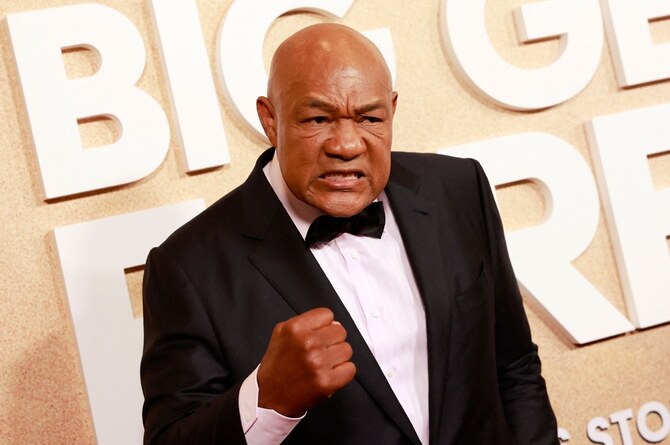
George Foreman, the glowering heavyweight who became a lovable champion, dies at 76

George Foreman. (AFP/File)
Short Url
Updated 22 March 2025
Follow

George Foreman, the glowering heavyweight who became a lovable champion, dies at 76

George Foreman, the fearsome heavyweight who lost the “Rumble in the Jungle” to Muhammad Ali before his inspiring second act as a 45-year-old champion and a successful businessman, died Friday night. He was 76.
Foreman’s family announced his death on social media.
“A devout preacher, a devoted husband, a loving father, and a proud grand- and great-grandfather, he lived a life marked by unwavering faith, humility and purpose,” his family wrote.
A native Texan, Foreman began his boxing career as an Olympic gold medalist who inspired fear as he climbed to the peak of the heavyweight division by stopping Joe Frazier in 1973. His formidable aura evaporated only a year later when Ali pulled off one of the most audacious victories in boxing history in Zaire, baiting and taunting Foreman into losing his belt in one of the greatest fights ever staged.
Foreman left the sport a few years later, but returned after a 10-year absence and a self-described religious awakening.
He then pulled off one of the most spectacular knockouts in boxing history in 1994, flooring Michael Moorer — 19 years his junior — with one perfect combination to claim Moorer’s two heavyweight belts.
Foreman’s transformation into an inspirational figure was complete, and he fought only four more times before moving onto his next career as a genial businessman, pitchman and occasional actor.
He was best known as the face of the George Foreman Grill, a rudimentary cooking machine which sold more than 100 million units and made him much wealthier than his sport ever did.


MESIF 2026 wraps up in Riyadh with spotlight on legacy, fans and sustainable sports growth

Updated 29 min 51 sec ago
Follow

MESIF 2026 wraps up in Riyadh with spotlight on legacy, fans and sustainable sports growth

  • A recurring theme in panel discussions was the importance of moving beyond siloed planning toward connected strategies
  • Abdullah Aldrees: I believe Saudi is a sleeping giant within the football ecosystem because of the high demand that exists

RIYADH: The sixth edition of the Middle East Sports Investment Forum concluded on Jan. 28 in Riyadh, reinforcing the need for long-term legacy planning, integrated infrastructure development and fan-centric strategies as the region’s sports ecosystem continues to mature.

Held over two days — Jan. 27-28 — at the ministry of investment headquarters and the Kingdom Arena, the forum brought together senior government officials, global sports executives, investors and technology leaders to assess how the Middle East — and Saudi Arabia in particular — can translate major event hosting and increased investment into sustainable impact.

A recurring theme in panel discussions was the importance of moving beyond siloed planning toward connected strategies that link infrastructure, finance, fan engagement and legacy from the earliest stages of project development.

Dr. Sakis Batsilas, deputy CEO of FIFA World Cup Qatar 2022, stressed that while international expertise has played a key role in the region’s rapid progress, long-term success depends on knowledge transfer and talent development.

“Yes, we do need experts and consultants and expatriates to help,” he said. “But the main, I would say, focus, is how we ensure that we transfer this knowledge and we build talent … to make sure we have the right talent.”

Drawing on his experience delivering major global events, Batsilas highlighted the need to embed legacy considerations during the bidding phase.

“Talking now from an operational point of view … I think everything starts with a bidding phase,” he said, adding that stronger legacy metrics would encourage greater long-term planning from host nations and rights holders alike.

Fan experience and commercialization also featured prominently, particularly as Saudi Arabia continues to expand its domestic leagues and host major international competitions. David Davies, chief experience officer of Catapult, said the Kingdom’s challenge lies in converting strong digital fandom into sustained in-stadium engagement.

“Saudi Arabia is … ranked consistently in the highest in the world” in terms of football fandom, Davies said. “However, attendance in-stadium is still developing.” He noted that younger, digitally native audiences require tailored engagement strategies. “The days of being able to ask them to come to you have gone,” he said.

From a government and delivery perspective, Abdullah Aldrees, chief of staff at the vice minister’s executive office at the ministry of sport, said MESIF highlighted the scale of opportunity ahead — and the importance of a joined-up approach.

“I believe Saudi is a sleeping giant within the football ecosystem because of the high demand that exists, the government support and the anchor IPs (intellectual properties — anchor sports properties and events that Saudi Arabia is hosting or investing in),” Aldrees said. “So all of this can create a lot of opportunities for football to grow in Saudi.”

He said the Kingdom has entered a critical preparation phase as it gears up for a packed calendar of major events. “We are now living in the preparation phase. We’re preparing for all these IPs, we’re preparing for all these big events coming up,” Aldrees said. “So how do you make sure that you really reap the right benefit from them and have the right legacy?”

Pointing to upcoming milestones such as the AFC Asian Cup Saudi Arabia 2027 and the FIFA World Cup 2034, Aldrees emphasized the need to think beyond hosting.

“Yes, we’re hosting World Cup. We’re hosting Asia 2027, but how do you make sure that they have a long, lasting impact on the ecosystem?” he said.

Echoing a key message from the forum, Aldrees concluded: “The effective strategy is to be looking at these things together. We no longer can be looking at them as silos and test cycles.”

The transformation of Saudi football was also highlighted as a reflection of broader cultural and structural change. Juan Esteban Gomez, a football expert specializing in digitalization and artificial intelligence, said the shift has been tangible in recent years. “The people here are breathing football,” he said, describing the Saudi league as “one of the most enjoyable competitions in the world.”

As MESIF 2026 drew to a close, participants agreed that the next phase of sports investment in the Middle East will be defined by execution — ensuring that capital, policy and innovation align to deliver measurable legacy, deeper fan engagement and resilient ecosystems capable of sustaining growth well beyond headline events.