

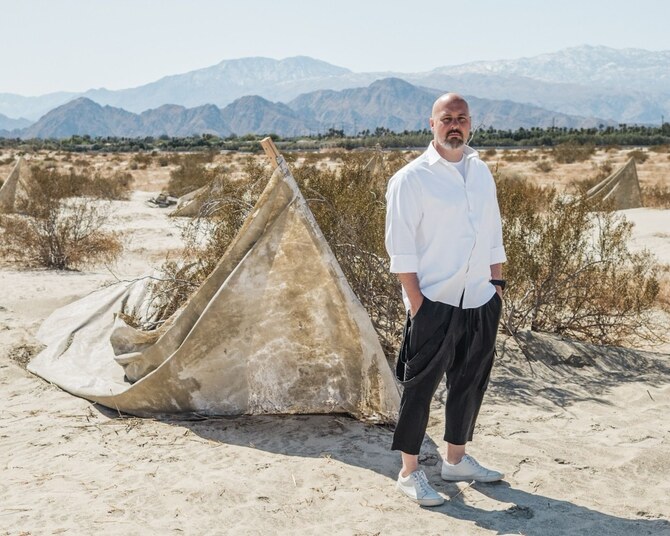

RIYADH: Saudi contemporary artist Muhannad Shono is the sole representative of the Middle East at this year’s Desert X — the site-specific international art exhibition in California’s Coachella Valley — which runs until May 11.
Shono’s piece, entitled “What Remains,” consists of 60 long strips of locally-sourced synthetic fabric infused with native sand.
“The fabric strips, orientated to align with the prevailing winds, follow the contours of the ground, fibrillating just above its surface,” a description of the work on the Desert X website reads. “As the wind direction shifts, the natural process of aeolian transportation that forms dunes is interrupted, causing the fabric to tangle and form chaotic bundles. In this way, the ground itself becomes mutable — a restlessly changing relic or memory.”

Desert X 2025 installation view of Muhannad Shono, What Remains. (Photo by Lance Gerber, courtesy Desert X)
This isn’t the first time Shono has created a large-scale installation in the desert. At Desert X AlUla in 2020, he presented “The Lost Path,” composed of 65,000 black plastic tubes snaking through the Saudi desert — a work exploring themes of transformation, memory and impermanence. And while “What Remains” is an entirely separate piece of art, it also delves into those topics, as has much of Shono’s work over the past decade.
“I’m first-generation Saudi,” Shono tells Arab News. “A year after I was born, I was given the nationality. For half of my life, I didn’t feel Saudi. I’d say Saudi was an authentic space that had specific motifs and cultural narratives that we were very disconnected from as a family. Why? Because we’re immigrants; my father is not Saudi, and my mom is not Saudi.
“But now I think the narrative of what is ‘Saudi’ is changing,” he continues. “And it feels like it’s part of this correction.”

Desert X 2025 installation view of Muhannad Shono, What Remains. (Photo by Lance Gerber, courtesy Desert X)
A feeling of not belonging was apparent in Shono’s early artistic endeavors. He loved comic books and wanted to create his own because he couldn’t find a true representation of himself in them.
“Saudis expect you to produce a figure they can relate to — with Saudi features or skin color — but I didn’t think they could relate to me,” he says. “I was more referencing myself, and what I thought ‘home’ looked like, or the ‘hero’ looked like, so there was a disconnect there.”
That disconnect continues to manifest in his work. “You can see it in Desert X and in a lot of my other projects tapping into materiality. I realized I couldn’t really fully connect with the materiality of the narrative of being Saudi.
“An interesting psychological thing that I haven’t really come to grips with is that I’m more comfortable doing work in Saudi because I’m responding to this natural source material,” he continues. “I’m disrupting — I’m offering divergence, narratives that can spill out from that experience of the work. I’m invested in the narrative of what’s happening (in Saudi). I think it’s the closest I’ve felt to being ‘at home.’ Something that I was missing in the beginning was being connected to the narrative of the place, because if you engage with that narrative, you can call it home.

Desert X 2025 installation view of Muhannad Shono, What Remains. (Photo by Lance Gerber, courtesy Desert X)
“When I go to California, I miss the landscape (of Saudi) that I’m contrasting. In California, it’s not juxtaposed against the experience of growing up. I’m still figuring out how to take these feelings and be able to show work overseas, because my backdrop is missing — the backdrop of Saudi.”
His early interest in comic books, he says, was partly down to “being able to create the world, the space, the setting for the story.” That was also a reason he decided to study architecture at university.
“I felt like it was creative problem solving,” he says. “A lot of my projects that I did in college were in ‘world making.’ My graduation project ended up being the creation of a whole city, and how it would grow on a random landscape. I got kind of caught up in the urban planning of it — the streets, and the rivers flowing through it. I never really got to the architectural part of designing a building.”
But that willingness to explore ideas in ways others might not has made Shono one of the Kingdom’s most compelling contemporary artists. “I’ve created my own kind of material palette, or language, or library, that I use,” he says.
In his current work, “The land is holding the narrative on this adventure within the seemingly barren landscape,” he explains. “These land fabrics become this idea of being able to roll up, carry and unroll ideas of belonging: What is home? How do we carry home?”

Desert X AlUla 2020 installation view of Muhannad Shono, The Lost Path. (Photo by Lance Gerber, courtesy the artist, RCU, and Desert X)
Shono and the team who helped him install “What Remains” had to “constantly adapt expectations” based on understanding the land and the environmental conditions, he says. It took them around a month, working seven or eight hours a day, to put it in place — flattening, aligning, and flipping fabric under Shono’s direction. His vision was clear, but he also allowed instinct to guide him.
“This work is fragile,” he says. “It’s an expression that is not here forever… that will change. And my ideas will change, the way I think about stories and concepts through my work. It’s important to change.”
With “What Remains,” he is offering that same opportunity to viewers. He wonders: “What portals will you pass through, through this unrolling of the earth in front of you?”
And change is a vital part of the work itself. “They’re always different,” Shono says of the fabric strips. “At some points, they’re opaque and earth-like — almost like a rock. But when the wind picks up, they become lightweight — like sails — and they animate and come to life. And when the light hits as they move through the sky, they reveal their translucency and there’s this projection of the trees and bushes and nature that they’re almost wrapped around or sailing past.”
Although the “What Remains” seen by Desert X visitors on any particular day will not be the same “What Remains” seen by visitors on any other day, or even any other hour, one part of it, at least, is constant.
“The work is a self-portrait,” Shono says. “Always.”


