

REVIEW: ‘The Electric State’ — visually dazzling, disastrously dull

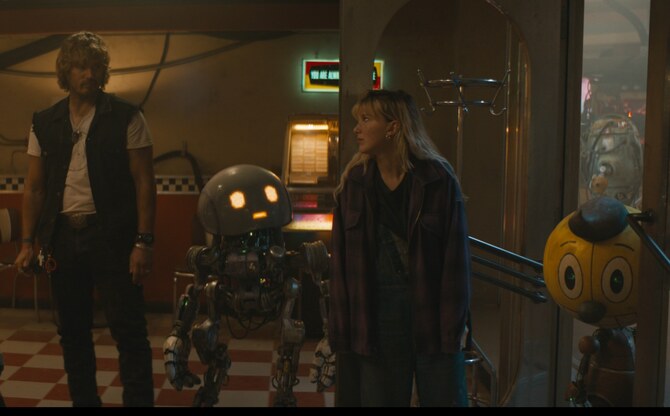
(L to R) Keats (Chris Pratt), Herman (voiced by Anthony Mackie), Michelle (Millie Bobby Brown) and Cosmo (voiced by Alan Tudyk) in 'The Electric State.' (Supplied)
Short Url
Updated 21 March 2025
Follow

REVIEW: ‘The Electric State’ — visually dazzling, disastrously dull

DUBAI: There’s irony that “The Electric State” — a film that champions people making genuine connections and facing reality rather than getting lost in virtual worlds — was created for the world’s largest streaming platform.

There’s irony, too — though less deliberate — that this $320-million(!) content package is the perfect example of a movie made for our short-attention-span, two-screens-at-a-time world: It looks great. It’s got a star-studded cast. It’s helmed by the Russo Brothers. It’s got retro vibes. It’s got a ton of sci-fi tropes. And it’s instantly forgettable.

It's set in an alternative 1990s in which robots — having become self-aware enough to demand rights —have been defeated in a costly and bloody war and are now banished to the Exclusion Zone. Their defeat was down to Neurocaster Technology, developed by tech mogul Ethan Skate (Stanley Tucci), which allowed humans to upload their minds into drone robots and so go to war without the considerable drawback of being flesh and bone.

That same technology means many humans now spend most of their time hooked up to drone helmets living idyllic virtual lives; humans such as the abusive adoptive father of teen orphan Michelle Green (Millie Bobby Brown), whose parents and much-loved younger brother Chris were killed in a car crash a few years earlier. Except…

Turns out Chris (a bona fide genius, we’re told) wasn’t dead, but in a coma. And his exceptional mind was vital to the creation of Neurocaster. But 13 months later, Chris woke up. And that didn’t fit Skate’s plans, so he just kept him prisoner. But Chris was able to sneak his mind into a robot that finds Michelle and lets her know Chris is alive. She sets out to find him in the dangerous Exclusion Zone, reluctantly aided by a smuggler (Chris Pratt) and his robot friend Herman.

It's a decent set-up for a family-friendly sci-fi romp. But good grief “The Electric State” is —except visually (but, y’know, $320 million…) — dull. Brown does her best with the clunky dialogue, and comes through mostly unscathed. Pratt’s performance is like an AI-rendered Chris Pratt performance (“Do the wisecracking-tough-guy thing. Do the tough-guy-with-a-heart-thing. Do the wisecracking-tough-guy thing again…”). Tucci goes pantomime villain. The robots are kind of cute. But there’s no substance underneath this multi-million-dollar gloss. Then again, if your target audience is People Who Will Be Watching Something Else Too, who needs substance?


At Jazan festival, Suad Al-Asiri paints memory, land and leadership

Updated 13 January 2026
Follow

At Jazan festival, Suad Al-Asiri paints memory, land and leadership

  • Local artist channels personal hardship into works that reflect Jazan’s identity, heritage
  • Jazan: A Nation and a Prince, places region at the heart of a composition featuring Prince Mohammed bin Abdulaziz and Prince Nasser bin Mohammed bin Abdullah bin Jalawi

RIYADH: At the Ahad Al-Masarihah pavilion at Jazan Festival 2026, Suad Al-Asiri’s paintings blend memory, place and personal history, offering visual narratives shaped by beauty and hardship. 

A novelist and visual artist, Al-Asiri has long used art as a storytelling tool. After a near-fatal car accident in March 2024, her work took on a new urgency. Bedridden for 11 months, cut off from the public world for more than a year, she describes that period as one of the most painful in her life — yet also transformative. 

“First of all, praise be to God for granting me life, as the accident was extremely severe,” she said. “By God’s grace, I was given a new life. All my thinking after the accident was about becoming an inspiration to others — about enduring pain and obstacles, and still leaving an impact.” 

Her return to public life came in 2025, when she participated in National Day celebrations with the ministry of interior. By the time she arrived at Jazan Festival, she was ready to channel that experience into her art. 

The centerpiece of her display, “Jazan: A Nation and a Prince,” places the region at the heart of a composition featuring Prince Mohammed bin Abdulaziz and Prince Nasser bin Mohammed bin Abdullah bin Jalawi, governor and deputy governor of Jazan respectively. 

Visitors linger over the details: the painting incorporates coffee beans, sesame and khudair — materials drawn from local products.

“I wanted people to recognize these products immediately,” she said. “They are part of Jazan’s daily life, and using them makes the work more tangible, more connected to everyday experience.” 

The painting sparks conversation. Visitors discuss leadership, identity, and the intimate relationship between people and their environment. 

Beyond the central piece, Al-Asiri presents individual portraits of the two princes, expanding the dialogue into a broader exploration of heritage and memory.  

Her journey into art is tied to her life as a storyteller. Early experiments with charcoal and pencil evolved into abstract art, drawn by its expressive freedom. 

From there, she explored realism, surrealism, and eventually modern art, particularly pop art, which has earned her wide recognition in artistic circles. Her novels and media work complement her visual practice, earning her the title “the comprehensive artist” from the governor.

Yet what stands out most in this exhibition is how Al-Asiri’s personal resilience flows through each piece. Her experience of surviving a devastating accident, enduring months of immobility, and returning to the public eye informs every brushstroke. 

Visitors sense not just her artistic skill, but her determination to turn life’s hardships into inspiration for others. 

Walking through the pavilion, one can see it in the way she blends heritage symbols, southern landscapes, and scenes of daily life. 

Each painting becomes both a document and a dialogue — a celebration of Jazan’s culture, a reflection on identity, and a testament to the power of human perseverance. 

At Jazan Festival 2026, Suad Al-Asiri’s art is a quiet, persistent inspiration for anyone who pauses long enough to listen.